Crimson Sunbird

Crimson Sunbird

Aethopyga siparaja

Silhouette: Rachael Joakim · PhyloPic

LCLeast ConcernNTVUENCR
Daily sighting probability ~10% · With luck
at Kinabalu Park

In 3 days ~20% in a week ~40%

236 Verified sightings at Kinabalu Park From 2019 to 2026
5,371 In all 23 parks
May Best month
🌅 Crepuscular When it's spotted

About the Crimson Sunbird

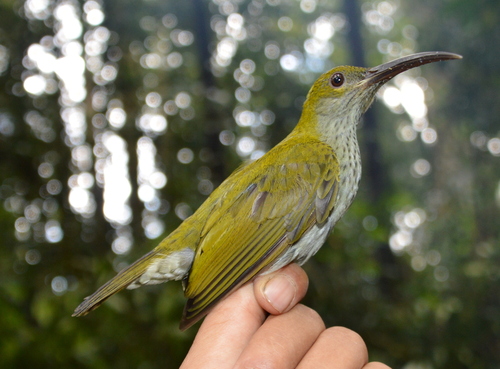
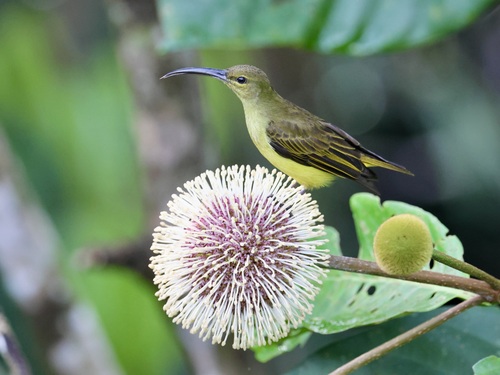
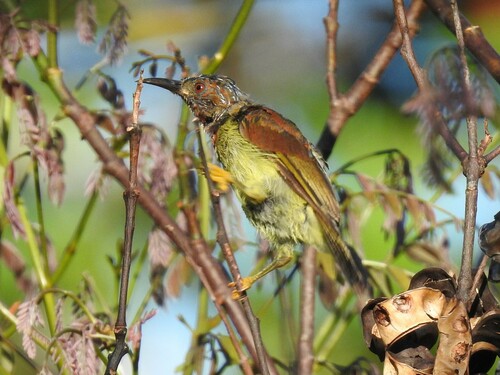
The crimson sunbird (Aethopyga siparaja) is a species of bird in the sunbird family which feed largely on nectar. They may also take insects, especially when feeding their young. Flight is fast and direct on their short wings. Most species can take nectar by hovering like a hummingbird, but usually perch to feed. It is the unofficial national bird of Singapore, as declared by the Nature Society Singapore.

Crimson sunbirds are tiny, only 11 cm long. They have medium-length thin down-curved bills and brush-tipped tubular tongues, both adaptations to their nectar feeding. The adult male has a crimson breast and maroon back, with black malar stripes. The rump is yellow and the belly is olive. The female has an olive-green back, yellowish breast and white tips to the outer tail feathers. In most of the range, males have a long green-blue tail, but A.s. nicobarica of the Nicobar Islands and the former subspecies A. vigorsii (Western crimson sunbird) of the Western Ghats of India lack the long central tail feathers. Their call is chee-cheewee.

The crimson sunbird is a resident breeder in tropical southern Asia from India, through Nepal, Pakistan... Wikipedia →

Sounds

Call0:45

India · 2025

© Peter Boesman · XC1030454 · CC BY-NC-ND 4.0

Song1:01

Indonesia · 2024

© Ding Li Yong · XC894701 · CC BY-NC-ND 4.0

Alarm call0:30

India · 2017

© Suniti Bhushan Datta · XC395217 · CC BY-NC-SA 4.0

Global Distribution

Parks Where Found

# Park Country Daily sighting probability
1 Sepilok 🇲🇾 Malaysia
~50%
2 Cuc Phuong National Park 🇻🇳 Vietnam
~40%
3 Royal Manas National Park 🇧🇹 Bhutan
~30%
4 Khao Luang National Park 🇹🇭 Thailand
~30%
5 Bako National Park 🇲🇾 Malaysia
~30%
6 Khao Sok National Park 🇹🇭 Thailand
~30%
7 Manas National Park 🇮🇳 India
~20%
8 Gunung Leuser National Park 🇮🇩 Indonesia
~20%
9 Kinabatangan Wildlife Sanctuary 🇲🇾 Malaysia
~20%
10 Jim Corbett National Park 🇮🇳 India
~20%
11 Kaeng Krachan National Park 🇹🇭 Thailand
~20%
12 Danum Valley Conservation Area 🇲🇾 Malaysia
~10%
13 Royal Bardia National Park 🇳🇵 Nepal
~10%
14 Kaziranga National Park 🇮🇳 India
~10%
15 Cat Tien National Park 🇻🇳 Vietnam
~10%
16 Khao Yai National Park 🇹🇭 Thailand
~10%
17 Kinabalu Park 🇲🇾 Malaysia
~10%
18 Tangkoko Nature Reserve 🇮🇩 Indonesia
~10%
19 Way Kambas National Park 🇮🇩 Indonesia
~10%
20 Chitwan National Park 🇳🇵 Nepal
<5%
21 Namdapha National Park 🇮🇳 India
<5%
22 Doi Inthanon National Park 🇹🇭 Thailand
<5%
23 Kanha National Park 🇮🇳 India
<5%

Cities Where Found

# City Country Daily sighting probability
1 Guwahati 🇮🇳 India
~30%
2 Dehradun 🇮🇳 India
~20%
3 Singapore 🇸🇬 Singapore
~20%
4 Kuching 🇲🇾 Malaysia
~20%
5 Johor Bahru 🇲🇾 Malaysia
~10%
6 Jammu 🇮🇳 India
~10%
7 Kathmandu 🇳🇵 Nepal
~10%
8 Hanoi 🇻🇳 Vietnam
~10%
9 Chandigarh 🇮🇳 India
<5%
10 Kuala Lumpur 🇲🇾 Malaysia
<5%

Zoos & Centres Where Found

# Zoo / Centre Country
1 Bird Paradise 🇸🇬 Singapore In captivity
2 Rainforest Wild Asia 🇸🇬 Singapore In captivity

Before you go

What are the chances of seeing a Crimson Sunbird in Kinabalu Park?

With luck

About 10% of wildlife watchers report a Crimson Sunbird sighting in Kinabalu Park on a given day, based on 236 verified sightings from GBIF citizen-science data from 2019 to 2026. It is the 74th most-seen of the 247 birds we can rate there. Over three days the chance rises to about 20%, and over a week to about 40%, if each day is a fresh chance.

When is the best time to see a Crimson Sunbird in Kinabalu Park?

January and March–October

In those months about 10% of wildlife watchers report a Crimson Sunbird in Kinabalu Park on a given day, against under 5% in February and November–December, the lowest months.

What time of day is best to see a Crimson Sunbird?

Between 2 and 5 am

Across all the parks we cover, that three-hour window holds the most Crimson Sunbird sightings with a recorded time, and about 6 in 10 of them come between 6 pm and 6 am: it is most active around dawn and dusk.

Where does the Crimson Sunbird sighting chance come from?

GBIF citizen-science records

It is estimated from how often the Crimson Sunbird is recorded against all the birds logged in Kinabalu Park (236 verified sightings from 2019 to 2026), calibrated against known sighting rates. Figures are rounded to the nearest 10% because citizen-science data supports honest approximations, not decimals, and months with records from fewer than five people show "—". How it works.

← Back to Kinabalu Park