Banded Linsang

Banded Linsang

Prionodon linsang

Silhouette: Margot Michaud · PhyloPic

LCLeast ConcernNTVUENCR
Daily sighting probability ~10% · With luck
at Kinabatangan Wildlife Sanctuary

In 3 days ~30% in a week ~50%

5 Verified sightings at Kinabatangan Wildlife Sanctuary From 2019 to 2026
5 In 1 park
April Best month
🌙 Nocturnal When it's spotted

About the Banded Linsang

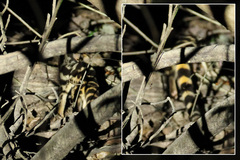
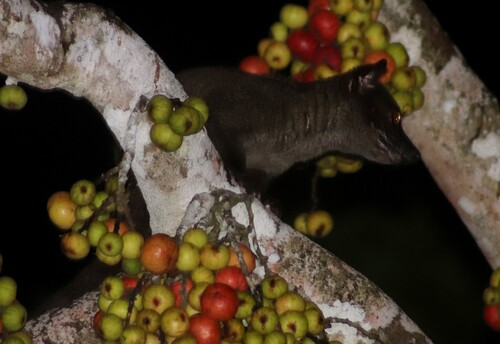
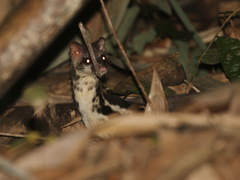
The banded linsang (Prionodon linsang) is a linsang, a tree-dwelling carnivorous mammal native to the Sundaic region of Southeast Asia. The banded linsang is pale yellow with broad stripes on its neck and five dark bands. Its tail has seven to eight dark bands and a dark tip. Its sharp claws are retractile. Its head to body length is 35–41.1 cm (13.8–16.2 in), and its tail is up to 36.2 cm (14.3 in) long. The average weight is around 700 g (25 oz).

The banded linsang occurs in Myanmar, Thailand, Peninsular Malaysia, Java, Bangka and Belitung Islands. Since 2006, it has been recorded by camera traps on the Sunda Islands of Borneo and Sumatra, and in southern Myanmar.

It inhabits evergreen forests, deciduous forests, secondary forest at elevations of 11–2,700 m (36–8,858 ft), and was also recorded close to oil palm plantations. The banded linsang is nocturnal and usually solitary. It is carnivorous, with its diet consisting of small vertebrates, such as birds, rats, and snakes. The two species of Asiatic linsangs were considered to be members of the family Viverridae and to be related to the morphologically... Wikipedia →

Global Distribution

Parks Where Found

# Park Country Daily sighting probability
1 Kinabatangan Wildlife Sanctuary 🇲🇾 Malaysia
~10%

More parks will be added in future updates.

Before you go

What are the chances of seeing a Banded Linsang in Kinabatangan Wildlife Sanctuary?

With luck

About 10% of wildlife watchers report a Banded Linsang sighting in Kinabatangan Wildlife Sanctuary on a given day, based on 5 verified sightings from GBIF citizen-science data from 2019 to 2026. It is the 24th most-seen of the 26 mammals we can rate there. Over three days the chance rises to about 30%, and over a week to about 50%, if each day is a fresh chance.

When is the best time to see a Banded Linsang in Kinabatangan Wildlife Sanctuary?

April

In that month about 20% of wildlife watchers report a Banded Linsang in Kinabatangan Wildlife Sanctuary on a given day, against under 5% in August to March, the lowest months.

What time of day is best to see a Banded Linsang?

Between 7 and 10 pm

Across all the parks we cover, that three-hour window holds the most Banded Linsang sightings with a recorded time, and about 7 in 10 of them come between 6 pm and 6 am: it is mostly seen at night.

Where else can you see a Banded Linsang?

Only Kinabatangan Wildlife Sanctuary, in our data

Kinabatangan Wildlife Sanctuary is the only park on Wallace's Line with enough records to rate Banded Linsang sightings: about 10% of wildlife watchers there report one on a given day.

Which relatives of the Banded Linsang live in Kinabatangan Wildlife Sanctuary?

Same family: Viverridae

The closest relatives of the Banded Linsang that you can see in Kinabatangan Wildlife Sanctuary (family Viverridae, Civets, Genets, and Oyans) are Common Palm Civet (about 40%), Malay Civet (about 40%) and Small-toothed Palm Civet (about 40%), with each one's daily chance of a sighting.

Where does the Banded Linsang sighting chance come from?

GBIF citizen-science records

It is estimated from how often the Banded Linsang is recorded against all the mammals logged in Kinabatangan Wildlife Sanctuary (5 verified sightings from 2019 to 2026), calibrated against known sighting rates. Figures are rounded to the nearest 10% because citizen-science data supports honest approximations, not decimals, and months with records from fewer than five people show "—". How it works.

← Back to Kinabatangan Wildlife Sanctuary