



Completed



Bornean Orangutan
Pongo pygmaeus
Silhouette: Gareth Monger · PhyloPic
- KingdomAnimalia (Animals)
- PhylumChordata (Chordates)
- ClassMammalia (Mammals)
- OrderPrimates
- FamilyHominidae (Great Apes)
- GenusPongo (Orangutans)
- SpeciesPongo pygmaeus (Bornean Orangutan)
In 3 days ~90% in a week >90%
307 Verified sightings at Kinabatangan Wildlife Sanctuary From 2019 to 2026
1,052 In all 4 parks
June Best month
🌅 Crepuscular When it's spotted






About the Bornean Orangutan
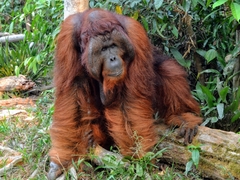
The Bornean orangutan (Pongo pygmaeus) is an orangutan species endemic to the island of Borneo. It belongs to the only genus of great apes native to Asia and is the largest of the three Pongo species. It has a coarse, reddish coat and up to 1.5 m (4 ft 11 in) long arms. It is sexually dimorphic — males are larger than females and develop large cheek pads (flanges).
The Bornean orangutan inhabits Borneo lowland rain forests and Borneo montane rain forests up to an elevation of 1,500 m (4,900 ft). Its diet includes fruits, seeds, flowers, bird eggs, sap and vines. It is highly intelligent, displaying tool use and distinct cultural patterns. It is listed as Critically Endangered, with deforestation, palm oil plantations, and hunting posing a serious threat to its survival. It is scheduled as a "totally protected animal" under Sarawak state law through the 1998 Wild Life Protection Ordinance.
The Bornean orangutan was originally named and scientifically described by Carl Linnaeus in 1799 under the scientific name Simia satyrus, meaning "satyr monkey", but was changed when scientists discovered that not all orangutans are one species. The holotype of this organism is located... Wikipedia →
Recent sightings of Bornean Orangutan in Kinabatangan Wildlife Sanctuary
LIVEiNaturalistGlobal Distribution
Parks Where Found
| # | Park | Country | Daily sighting probability |
|---|---|---|---|
| 1 | Tanjung Puting National Park | 🇮🇩 Indonesia | |
| 2 | Kinabatangan Wildlife Sanctuary | 🇲🇾 Malaysia | |
| 3 | Danum Valley Conservation Area | 🇲🇾 Malaysia | |
| 4 | Sepilok | 🇲🇾 Malaysia |
Zoos & Centres Where Found
| # | Zoo / Centre | Country | |
|---|---|---|---|
| 1 | Busch Gardens Tampa | 🇺🇸 United States | |
| 2 | Pairi Daiza | 🇧🇪 Belgium | |
| 3 | National Zoological Park | 🇺🇸 United States | |
| 4 | ZooParc de Beauval | 🇫🇷 France | |
| 5 | Dublin Zoo | 🇮🇪 Ireland | |
| 6 | Kaliningrad Zoo | 🇷🇺 Russia | |
| 7 | Espace zoologique de La Boissière-du-Doré | 🇫🇷 France | |
| 8 | Sepilok Orang Utan Rehabilitation Centre | 🇲🇾 Malaysia | |
| 9 | Bornean Sun Bear Conservation Centre | 🇲🇾 Malaysia | |
| 10 | Zoo Miami | 🇺🇸 United States | |
| 11 | Taman Safari Indonesia | 🇮🇩 Indonesia | |
| 12 | Toronto Zoo | 🇨🇦 Canada | |
| 13 | Taipei Zoo | 🇹🇼 Taiwan | |
| 14 | Shanghai Wild Animal Park | 🇨🇳 China | |
| 15 | Columbus Zoo and Aquarium | 🇺🇸 United States | |
| 16 | Kansas City Zoo | 🇺🇸 United States | |
| 17 | Brookfield Zoo | 🇺🇸 United States | |
| 18 | Ecological Center of Sonora | 🇲🇽 Mexico | |
| 19 | Shanghai Zoo | 🇨🇳 China | |
| 20 | Omaha’s Henry Doorly Zoo and Aquarium | 🇺🇸 United States | |
| 21 | Shenzhen Safari Park | 🇨🇳 China | |
| 22 | Milwaukee County Zoo | 🇺🇸 United States | |
| 23 | Safari World | 🇹🇭 Thailand | |
| 24 | Cheyenne Mountain Zoo | 🇺🇸 United States | |
| 25 | Los Angeles Zoo | 🇺🇸 United States | |
| 26 | Phoenix Zoo | 🇺🇸 United States | |
| 27 | Toledo Zoo | 🇺🇸 United States | |
| 28 | São Paulo Zoo | 🇧🇷 Brazil | |
| 29 | Leofoo Village Theme Park | 🇹🇼 Taiwan | |
| 30 | Louisville Zoo | 🇺🇸 United States | |
| 31 | Novosibirsk Zoo | 🇷🇺 Russia | |
| 32 | Fuzhou Zoo | 🇨🇳 China | |
| 33 | Mysore Zoo | 🇮🇳 India | |
| 34 | Woodland Park Zoo | 🇺🇸 United States | |
| 35 | Borås djurpark | 🇸🇪 Sweden | |
| 36 | Nyíregyháza Zoo | 🇭🇺 Hungary | |
| 37 | National Zoo of Malaysia | 🇲🇾 Malaysia | |
| 38 | ZooTampa | 🇺🇸 United States | |
| 39 | Fort Worth Zoo | 🇺🇸 United States | |
| 40 | Indianapolis Zoo | 🇺🇸 United States | |
| 41 | Oregon Zoo | 🇺🇸 United States | |
| 42 | Metro Richmond Zoo | 🇺🇸 United States | |
| 43 | Virginia Zoological Park | 🇺🇸 United States | |
| 44 | Houston Zoo | 🇺🇸 United States | |
| 45 | Dudley Zoo | 🇬🇧 United Kingdom | |
| 46 | Jackson Zoo | 🇺🇸 United States | |
| 47 | Monkey World | 🇬🇧 United Kingdom | |
| 48 | Zoo Osnabrück | 🇩🇪 Germany | |
| 49 | Gembira Loka Zoo | 🇮🇩 Indonesia | |
| 50 | Simba Safari | 🇧🇷 Brazil |
Closest Relatives at Kinabatangan Wildlife Sanctuary


Before you go
What are the chances of seeing a Bornean Orangutan in Kinabatangan Wildlife Sanctuary?
Likely
About 60% of wildlife watchers report a Bornean Orangutan sighting in Kinabatangan Wildlife Sanctuary on a given day, based on 307 verified sightings from GBIF citizen-science data from 2019 to 2026. It is the 5th most-seen of the 26 mammals we can rate there. Over three days the chance rises to about 90%, and over a week to over 90%, if each day is a fresh chance.
When is the best time to see a Bornean Orangutan in Kinabatangan Wildlife Sanctuary?
June and October
In those months about 70% of wildlife watchers report a Bornean Orangutan in Kinabatangan Wildlife Sanctuary on a given day, against about 40% in March and December, the lowest months.
What time of day is best to see a Bornean Orangutan?
Between 9 am and noon
Across all the parks we cover, that three-hour window holds the most Bornean Orangutan sightings with a recorded time, and about half of them come between 6 am and 6 pm: it is most active around dawn and dusk.
Is Kinabatangan Wildlife Sanctuary the best place to see a Bornean Orangutan?
2nd of 4
Of the 4 parks where we can rate Bornean Orangutan sightings, Kinabatangan Wildlife Sanctuary ranks 2nd at about 60%. The best odds are in Tanjung Puting National Park (Indonesia, about 80%). All parks ranked.
Which relatives of the Bornean Orangutan live in Kinabatangan Wildlife Sanctuary?
Same order: Primates
The closest relatives of the Bornean Orangutan that you can see in Kinabatangan Wildlife Sanctuary (order Primates) are Proboscis Monkey (about 80%), Crab-eating Macaque (about 70%) and Silvered Leaf Monkey (about 60%), with each one's daily chance of a sighting.
Where does the Bornean Orangutan sighting chance come from?
GBIF citizen-science records
It is estimated from how often the Bornean Orangutan is recorded against all the mammals logged in Kinabatangan Wildlife Sanctuary (307 verified sightings from 2019 to 2026), calibrated against known sighting rates. Figures are rounded to the nearest 10% because citizen-science data supports honest approximations, not decimals, and months with records from fewer than five people show "—". How it works.
