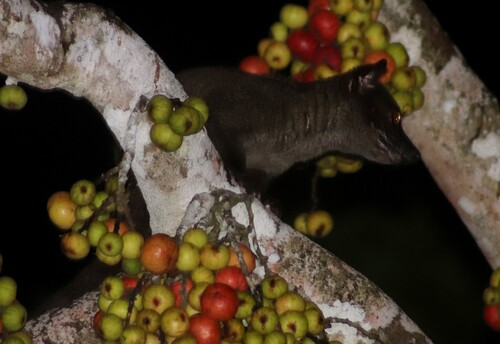
Sunda Stink-badger

Sunda Stink-badger

Mydaus javanensis

Silhouette: Margot Michaud · PhyloPic

LCLeast ConcernNTVUENCR
Daily sighting probability ~10% · With luck
at Kinabatangan Wildlife Sanctuary

In 3 days ~40% in a week ~70%

10 Verified sightings at Kinabatangan Wildlife Sanctuary From 2019 to 2026
15 In all 2 parks
March Best month
☀️ Diurnal When it's spotted

About the Sunda Stink-badger

The Sunda stink badger (Mydaus javanensis), also called the Javan stink badger, teledu, Malay stink badger, Malay badger, Indonesian stink badger and Sunda skunk, is a mammal native to Indonesia and Malaysia. Despite the common name, stink badgers are not closely related to true badgers, and are, instead, Old World relatives of the skunks. Coincidentally, its local name sigung in Sundanese is a false cognate to skunk which is of Algonquian origin.

Sunda stink badgers have a similar body shape to badgers, but are significantly smaller, being 37 to 52 cm (15 to 20 in) in total length, and weighing from 1.3 to 3.6 kg (2.9 to 7.9 lb). Their fur is coarse, and black or very dark brown over most of the body, with a white stripe running from the top of the head to the tail. The tail is short, measuring about 3.6 cm (1.4 in), and is covered in pure white fur. The width of the stripe varies considerably between individuals, but is usually narrow, and may be discontinuous. As the name indicates, stink badgers have an anal scent gland that secretes a foul-smelling substance, which the animal can spray up to 15 cm (5.9 in). Females have six teats. Wikipedia →

Global Distribution

Parks Where Found

# Park Country Daily sighting probability
1 Kinabatangan Wildlife Sanctuary 🇲🇾 Malaysia
~10%
2 Danum Valley Conservation Area 🇲🇾 Malaysia
~10%

Before you go

What are the chances of seeing a Sunda Stink-badger in Kinabatangan Wildlife Sanctuary?

With luck

About 10% of wildlife watchers report a Sunda Stink-badger sighting in Kinabatangan Wildlife Sanctuary on a given day, based on 10 verified sightings from GBIF citizen-science data from 2019 to 2026. It is the 21st most-seen of the 26 mammals we can rate there. Over three days the chance rises to about 40%, and over a week to about 70%, if each day is a fresh chance.

When is the best time to see a Sunda Stink-badger in Kinabatangan Wildlife Sanctuary?

March

In that month about 30% of wildlife watchers report a Sunda Stink-badger in Kinabatangan Wildlife Sanctuary on a given day, against under 5% in June–August and December–February, the lowest months.

What time of day is best to see a Sunda Stink-badger?

Between 1 and 4 pm

Across all the parks we cover, that three-hour window holds the most Sunda Stink-badger sightings with a recorded time, and about 8 in 10 of them come between 6 am and 6 pm: it is a daytime animal.

Is Kinabatangan Wildlife Sanctuary the best place to see a Sunda Stink-badger?

Yes

Of the 2 parks where we can rate Sunda Stink-badger sightings, Kinabatangan Wildlife Sanctuary has the highest daily chance: about 10%. Next come Danum Valley Conservation Area (Malaysia, about 10%).

Which relatives of the Sunda Stink-badger live in Kinabatangan Wildlife Sanctuary?

Same order: Carnivora

The closest relatives of the Sunda Stink-badger that you can see in Kinabatangan Wildlife Sanctuary (order Carnivora, Carnivorans) are Common Palm Civet (about 40%), Malay Civet (about 40%) and Small-toothed Palm Civet (about 40%), with each one's daily chance of a sighting.

Where does the Sunda Stink-badger sighting chance come from?

GBIF citizen-science records

It is estimated from how often the Sunda Stink-badger is recorded against all the mammals logged in Kinabatangan Wildlife Sanctuary (10 verified sightings from 2019 to 2026), calibrated against known sighting rates. Figures are rounded to the nearest 10% because citizen-science data supports honest approximations, not decimals, and months with records from fewer than five people show "—". How it works.

← Back to Kinabatangan Wildlife Sanctuary