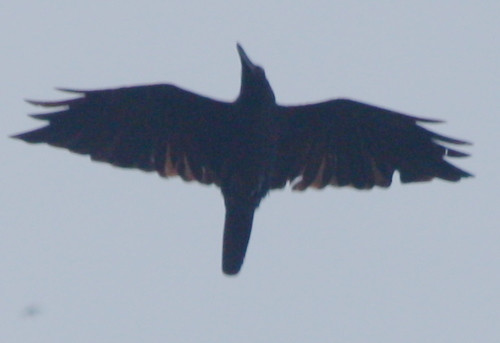
Blue-rumped Parrot

Blue-rumped Parrot

Psittinus cyanurus

Silhouette: Farelli (photo), John E. McCormack, Michael G. Harvey, Brant C. Faircloth, Nicholas G. Crawford, Travis C. Glenn, Robb T. Brumfield & T. Michael Keesey · PhyloPic

LCNTNear ThreatenedVUENCR
Daily sighting probability <5% · Rare
at Kinabatangan Wildlife Sanctuary

In 3 days <5%

7 Verified sightings at Kinabatangan Wildlife Sanctuary From 2019 to 2026
403 In all 6 parks
November Best month
☀️ Diurnal When it's spotted

About the Blue-rumped Parrot

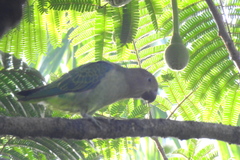
The blue-rumped parrot (Psittinus cyanurus) is a parrot found in the very southern tip of Myanmar, peninsular Thailand, Malaysia, Borneo, Sumatra and nearby islands. It is a small parrot (18 cm) and is primarily green with bright red underwing coverts, a reddish shoulder patch, and yellowish margins on the wing coverts. It is sexually dimorphic. The female has a grey-brown head. The male has a black mantle, red upper mandible, and blue head and rump.

It was formerly considered the only member of the genus Psittinus, but BirdLife International recognised the subspecies abbottii as a separate species, the Simeulue parrot, and the IOC later followed suit, supporting it as a distinct species.

There are two subspecies: Larger than the nominate subspecies. It is found in lowland forests, generally below 700 m, in forest, open woodland, orchards and plantations, mangroves, dense scrub, and coconut groves. It occurs in flocks up to 20 birds. They eat seeds, fruit and blossoms.

Juniper & Parr (1998) Parrots: A Guide to Parrots of the World; ISBN 0-300-07453-0. ��2... Wikipedia →

Sounds

Flight call0:20

Malaysia · 2025

© Ding Li Yong · XC1010156 · CC BY-NC-ND 4.0

Call0:38

Malaysia · 2018

© Mike Dooher · XC456691 · CC BY-NC-SA 4.0

Flight call0:10

Singapore · 2021

© Okamoto Keita Sin · XC665758 · CC BY-NC-SA 4.0

Global Distribution

Parks Where Found

# Park Country Daily sighting probability
1 Way Kambas National Park 🇮🇩 Indonesia
~30%
2 Taman Negara National Park 🇲🇾 Malaysia
~20%
3 Danum Valley Conservation Area 🇲🇾 Malaysia
~10%
4 Gunung Leuser National Park 🇮🇩 Indonesia
<5%
5 Sepilok 🇲🇾 Malaysia
<5%
6 Kinabatangan Wildlife Sanctuary 🇲🇾 Malaysia
<5%

Cities Where Found

# City Country Daily sighting probability
1 Singapore 🇸🇬 Singapore
<5%
2 Kuala Lumpur 🇲🇾 Malaysia
<5%

Before you go

What are the chances of seeing a Blue-rumped Parrot in Kinabatangan Wildlife Sanctuary?

Rare

Under 5% of wildlife watchers report a Blue-rumped Parrot sighting in Kinabatangan Wildlife Sanctuary on a given day, based on 7 verified sightings from GBIF citizen-science data from 2019 to 2026. It is the 211th most-seen of the 231 birds we can rate there. Over three days the chance rises to under 5%, if each day is a fresh chance.

When is the best time to see a Blue-rumped Parrot in Kinabatangan Wildlife Sanctuary?

Any time of year

In every month with enough records, under 5% of wildlife watchers report a Blue-rumped Parrot in Kinabatangan Wildlife Sanctuary on a given day, so our monthly data shows no clear season.

What time of day is best to see a Blue-rumped Parrot?

Between 8 and 11 am

Across all the parks we cover, that three-hour window holds the most Blue-rumped Parrot sightings with a recorded time, and about 8 in 10 of them come between 6 am and 6 pm: it is a daytime animal.

Which relatives of the Blue-rumped Parrot live in Kinabatangan Wildlife Sanctuary?

Same family: Psittacidae

The closest relatives of the Blue-rumped Parrot that you can see in Kinabatangan Wildlife Sanctuary (family Psittacidae, New World and African Parrots) are Long-tailed Parakeet (about 30%) and Blue-crowned Hanging-Parrot (about 20%), with each one's daily chance of a sighting.

Where does the Blue-rumped Parrot sighting chance come from?

GBIF citizen-science records

It is estimated from how often the Blue-rumped Parrot is recorded against all the birds logged in Kinabatangan Wildlife Sanctuary (7 verified sightings from 2019 to 2026), calibrated against known sighting rates. Figures are rounded to the nearest 10% because citizen-science data supports honest approximations, not decimals, and months with records from fewer than five people show "—". How it works.

← Back to Kinabatangan Wildlife Sanctuary