
Blyth's Hawk-Eagle

Blyth's Hawk-Eagle

Nisaetus alboniger

Silhouette: Sheatherius · PhyloPic

LCLeast ConcernNTVUENCR
Daily sighting probability <5% · Rare
at Kinabatangan Wildlife Sanctuary

In 3 days <5% in a week ~10%

21 Verified sightings at Kinabatangan Wildlife Sanctuary From 2019 to 2026
418 In all 7 parks
November Best month
🌅 Crepuscular When it's spotted

About the Blyth's Hawk-Eagle

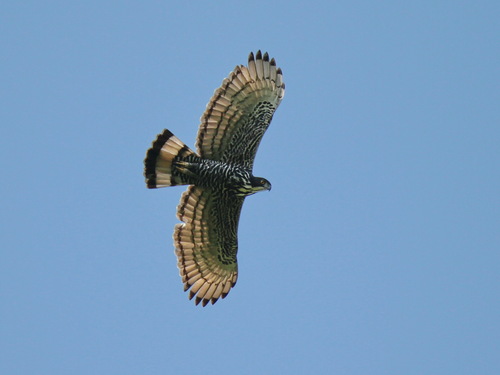
Blyth's hawk-eagle (Nisaetus alboniger) (earlier treated as Spizaetus) is a medium-sized bird of prey. Like all eagles, it is in the family Accipitridae. It can be found in the Malay Peninsula, Singapore, Sumatra and Borneo. It is a bird of open woodland, although island forms prefer a higher tree density. It builds a stick nest in a tree and lays a single egg.

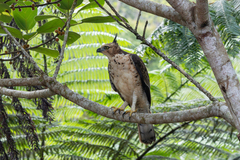
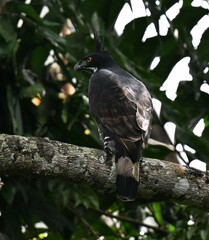
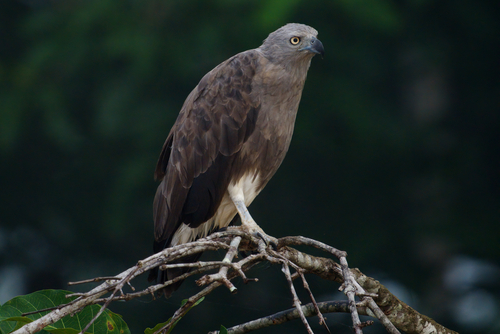
It is a fairly small eagle at about 50–60 cm (20–24 in) in length. The adult has a thick white band on uppertail and undertail, all black above, black spotted breast, barred below. It has a prominent crest like the bazas. Juvenile is dark brown above, and has a light brown head and underparts.

The common name commemorates Edward Blyth (1810–1873), English zoologist and Curator of the Museum of the Asiatic Society of Bengal. BirdLife Species Factsheet Wikipedia →

Sounds

Song0:30

Malaysia · 2019

© Marc Anderson · XC503351 · CC BY-NC-ND 4.0

Flight call0:13

Indonesia · 2016

© Frank Lambert · XC409604 · CC BY-NC-ND 4.0

Call0:08

Malaysia · 2017

© Greg Irving · XC398716 · CC BY-NC-SA 4.0

Global Distribution

Parks Where Found

# Park Country Daily sighting probability
1 Kerinci Seblat National Park 🇮🇩 Indonesia
~20%
2 Khao Luang National Park 🇹🇭 Thailand
~10%
3 Kinabalu Park 🇲🇾 Malaysia
~10%
4 Taman Negara National Park 🇲🇾 Malaysia
<5%
5 Danum Valley Conservation Area 🇲🇾 Malaysia
<5%
6 Khao Sok National Park 🇹🇭 Thailand
<5%
7 Kinabatangan Wildlife Sanctuary 🇲🇾 Malaysia
<5%

Cities Where Found

# City Country Daily sighting probability
1 Kuala Lumpur 🇲🇾 Malaysia
<5%

Before you go

What are the chances of seeing a Blyth's Hawk-Eagle in Kinabatangan Wildlife Sanctuary?

Rare

Under 5% of wildlife watchers report a Blyth's Hawk-Eagle sighting in Kinabatangan Wildlife Sanctuary on a given day, based on 21 verified sightings from GBIF citizen-science data from 2019 to 2026. It is the 182nd most-seen of the 231 birds we can rate there. Over three days the chance rises to under 5%, and over a week to about 10%, if each day is a fresh chance.

When is the best time to see a Blyth's Hawk-Eagle in Kinabatangan Wildlife Sanctuary?

Any time of year

In every month with enough records, under 5% of wildlife watchers report a Blyth's Hawk-Eagle in Kinabatangan Wildlife Sanctuary on a given day, so our monthly data shows no clear season.

What time of day is best to see a Blyth's Hawk-Eagle?

Between 4 and 7 am

Across all the parks we cover, that three-hour window holds the most Blyth's Hawk-Eagle sightings with a recorded time, and about 6 in 10 of them come between 6 am and 6 pm: it is most active around dawn and dusk.

Is Kinabatangan Wildlife Sanctuary the best place to see a Blyth's Hawk-Eagle?

7th of 7

Of the 7 parks where we can rate Blyth's Hawk-Eagle sightings, Kinabatangan Wildlife Sanctuary ranks 7th at under 5%. The best odds are in Kerinci Seblat National Park (Indonesia, about 20%), Khao Luang National Park (Thailand, about 10%) and Kinabalu Park (Malaysia, about 10%).

Which relatives of the Blyth's Hawk-Eagle live in Kinabatangan Wildlife Sanctuary?

Same genus: Nisaetus

The closest relatives of the Blyth's Hawk-Eagle that you can see in Kinabatangan Wildlife Sanctuary (genus Nisaetus, Asian Hawk-Eagles) are Wallace's Hawk-Eagle (about 50%) and Crested Hawk-Eagle (about 10%), with each one's daily chance of a sighting.

Where does the Blyth's Hawk-Eagle sighting chance come from?

GBIF citizen-science records

It is estimated from how often the Blyth's Hawk-Eagle is recorded against all the birds logged in Kinabatangan Wildlife Sanctuary (21 verified sightings from 2019 to 2026), calibrated against known sighting rates. Figures are rounded to the nearest 10% because citizen-science data supports honest approximations, not decimals, and months with records from fewer than five people show "—". How it works.

← Back to Kinabatangan Wildlife Sanctuary