Sunda Pangolin

Sunda Pangolin

Manis javanica

Silhouette: Steven Traver · PhyloPic

LCNTVUENCRCritically Endangered
Daily sighting probability ~10% · With luck
at Kinabatangan Wildlife Sanctuary

In 3 days ~20% in a week ~40%

6 Verified sightings at Kinabatangan Wildlife Sanctuary From 2019 to 2026
12 In all 2 parks
October Best month
🌅 Crepuscular When it's spotted

About the Sunda Pangolin

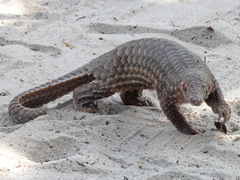
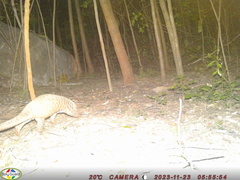
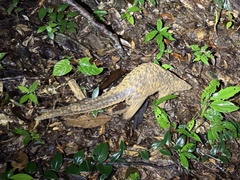
The Sunda pangolin (Manis javanica), also known as the Malayan or Javan pangolin, is a species of pangolin. It is a member of the Manidae family. Its English name comes from the Malay name pëngulin, which means "roller".

It is native to Southeast Asia, including Myanmar, Thailand, Cambodia, Laos, Malaysia, Singapore, Vietnam, and the islands of Borneo, Java, Sumatra and the Lesser Sunda Islands. It prefers forested primary, secondary and scrub forest habitats, but also lives in rubber and palm oil plantations. It is largely arboreal.

In the past, this species has included the closely related Palawan pangolin (M. culionensis), as both are in the subgenus Paramanis. It is closely related to the Chinese pangolin, although the Malayan species is larger, lighter in colour, and has shorter fore claws.

During the Pilo-Pleistocene, something that has shaped its phylogeographic patterns is the experience of the pangolin geographically and its climate history. The skin of the Sunda pangolin's feet is granular, although pads are found on its front feet. It has thick and powerful claws to dig into the soils in search of ant nests or to tear... Wikipedia →

Global Distribution

Parks Where Found

# Park Country Daily sighting probability
1 Cat Tien National Park 🇻🇳 Vietnam
~10%
2 Kinabatangan Wildlife Sanctuary 🇲🇾 Malaysia
~10%

Zoos & Centres Where Found

# Zoo / Centre Country
1 Gembira Loka Zoo 🇮🇩 Indonesia In captivity
2 Johor Zoo 🇲🇾 Malaysia In captivity
3 Acuario Inbursa 🇲🇽 Mexico In captivity

Closest Relatives at Kinabatangan Wildlife Sanctuary

No species of the same family or order lives in Kinabatangan Wildlife Sanctuary, so these are its closest relatives here: other mammals.

Before you go

What are the chances of seeing a Sunda Pangolin in Kinabatangan Wildlife Sanctuary?

With luck

About 10% of wildlife watchers report a Sunda Pangolin sighting in Kinabatangan Wildlife Sanctuary on a given day, based on 6 verified sightings from GBIF citizen-science data from 2019 to 2026. It is the 26th most-seen of the 26 mammals we can rate there. Over three days the chance rises to about 20%, and over a week to about 40%, if each day is a fresh chance.

When is the best time to see a Sunda Pangolin in Kinabatangan Wildlife Sanctuary?

March, May–June and October

In those months about 10% of wildlife watchers report a Sunda Pangolin in Kinabatangan Wildlife Sanctuary on a given day, against under 5% in April, July–September and November–February, the lowest months.

What time of day is best to see a Sunda Pangolin?

Between 3 and 6 pm

Across all the parks we cover, that three-hour window holds the most Sunda Pangolin sightings with a recorded time, and about 6 in 10 of them come between 6 am and 6 pm: it is most active around dawn and dusk.

Is Kinabatangan Wildlife Sanctuary the best place to see a Sunda Pangolin?

Among the best

Of the 2 parks where we can rate Sunda Pangolin sightings, Kinabatangan Wildlife Sanctuary ranks 2nd at about 10%, level with the leaders once rounded. The best odds are in Cat Tien National Park (Vietnam, about 10%).

Where does the Sunda Pangolin sighting chance come from?

GBIF citizen-science records

It is estimated from how often the Sunda Pangolin is recorded against all the mammals logged in Kinabatangan Wildlife Sanctuary (6 verified sightings from 2019 to 2026), calibrated against known sighting rates. Figures are rounded to the nearest 10% because citizen-science data supports honest approximations, not decimals, and months with records from fewer than five people show "—". How it works.

← Back to Kinabatangan Wildlife Sanctuary