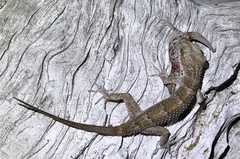
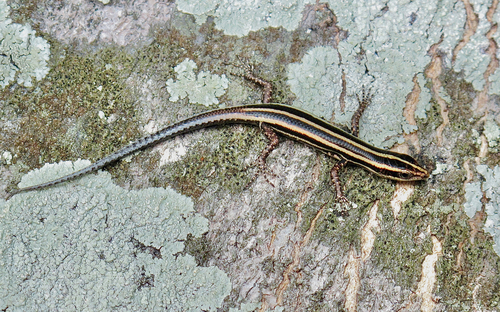
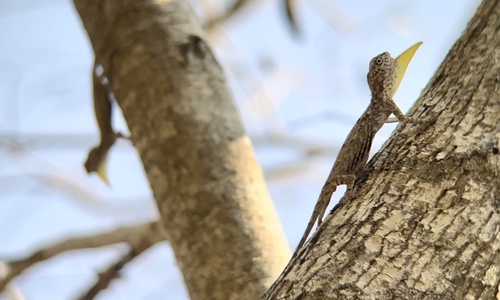
Darmandville Bow-fingered Gecko

Darmandville Bow-fingered Gecko

Cyrtodactylus darmandvillei

Silhouette: Jose Carlos Arenas-Monroy · PhyloPic

LCLeast ConcernNTVUENCR
Daily sighting probability ~30% · Possible
at Komodo National Park

In 3 days ~70% in a week ~90%

12 Verified sightings at Komodo National Park From 2019 to 2026
12 In 1 park
February Best month
🌙 Nocturnal When it's spotted

About the Darmandville Bow-fingered Gecko

The Darmandville bow-fingered gecko (Cyrtodactylus darmandvillei) is a species of lizard in the family Gekkonidae. The species is endemic to Indonesia. The specific name, darmandvillei, is in honor of Jesuit Missionary Father Cornelis J. F. le Coq d'Armandville (1846–1896).

C. darmandvillei is found on the Indonesian islands of Flores, Komodo, Lombok, Pulau Kalao, and Sumbawa. The preferred natural habitats of C. darmandvillei are forest and freshwater wetlands, at altitudes from sea level to 650 m (2,130 ft).

The holotype of C. darmandvillei has a snout-to-vent length (SVL) of 8.5 cm (3.3 in) and a tail length of 10 cm (3.9 in). C. darmandvillei is both terrestrial and arboreal. C. darmandvillei is oviparous. Mecke S, Kieckbusch M, Hartmann L, Kaiser H (2016). "Historical considerations and comments on the type series of Cyrtodactylus marmoratus Gray, 1831, with an updated comparative table for the bent-toed geckos of the Sunda Islands and Sulawesi". Zootaxa 4175 (4): 353–365.

Rösler H (2000). "Kommentierte Liste der rezent, subrezent und fossil... Wikipedia →

Global Distribution

Parks Where Found

# Park Country Daily sighting probability
1 Komodo National Park 🇮🇩 Indonesia
~30%

More parks will be added in future updates.

Before you go

What are the chances of seeing a Darmandville Bow-fingered Gecko in Komodo National Park?

Possible

About 30% of wildlife watchers report a Darmandville Bow-fingered Gecko sighting in Komodo National Park on a given day, based on 12 verified sightings from GBIF citizen-science data from 2019 to 2026. It is the 10th most-seen of the 19 reptiles we can rate there. Over three days the chance rises to about 70%, and over a week to about 90%, if each day is a fresh chance.

When is the best time to see a Darmandville Bow-fingered Gecko in Komodo National Park?

February

In that month about 50% of wildlife watchers report a Darmandville Bow-fingered Gecko in Komodo National Park on a given day, against under 5% in September and November–January, the lowest months. That is one of Komodo National Park's wettest months, with about 200 mm of rain against 10 mm in August.

What time of day is best to see a Darmandville Bow-fingered Gecko?

Between 7 and 10 pm

Across all the parks we cover, that three-hour window holds the most Darmandville Bow-fingered Gecko sightings with a recorded time, and about 8 in 10 of them come between 6 pm and 6 am: it is mostly seen at night.

Where else can you see a Darmandville Bow-fingered Gecko?

Only Komodo National Park, in our data

Komodo National Park is the only park on Wallace's Line with enough records to rate Darmandville Bow-fingered Gecko sightings: about 30% of wildlife watchers there report one on a given day.

Which relatives of the Darmandville Bow-fingered Gecko live in Komodo National Park?

Same family: Gekkonidae

The closest relatives of the Darmandville Bow-fingered Gecko that you can see in Komodo National Park (family Gekkonidae, Typical Geckos) are Tokay Gecko (about 40%), Flat-tailed House Gecko (about 30%) and Common House Gecko (about 20%), with each one's daily chance of a sighting.

Where does the Darmandville Bow-fingered Gecko sighting chance come from?

GBIF citizen-science records

It is estimated from how often the Darmandville Bow-fingered Gecko is recorded against all the reptiles logged in Komodo National Park (12 verified sightings from 2019 to 2026), calibrated against known sighting rates. Figures are rounded to the nearest 10% because citizen-science data supports honest approximations, not decimals, and months with records from fewer than five people show "—". How it works.

← Back to Komodo National Park