
Common Wolf Snake

Common Wolf Snake

Lycodon capucinus

Silhouette: Alex Slavenko · PhyloPic

LCLeast ConcernNTVUENCR
Daily sighting probability ~40% · Likely
at Komodo National Park

In 3 days ~70% in a week >90%

18 Verified sightings at Komodo National Park From 2019 to 2026
27 In all 2 parks
March Best month
🌙 Nocturnal When it's spotted

About the Common Wolf Snake

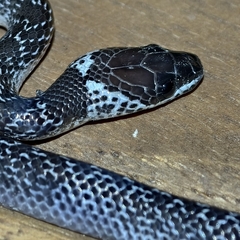
Lycodon capucinus, also known as the common wolf snake, is a species of colubrid snake commonly found in the Indo-Australian Archipelago. The species is named after the enlarged front teeth which give them a muzzled appearance similar to canines and makes the snout somewhat more squarish than other snakes.

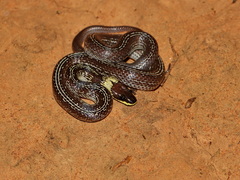
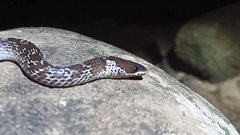
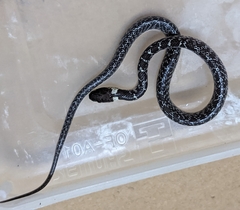
A slender-bodied small snake that ranges from barely three feet to less than one meter. Most wild-caught specimens usually reach less than these lengths. Coloration is adapted for life underground and on the forest floor. Shades of jet black, reddish-brown or dark gray with speckles, blotches and spots of white or pale yellow scattered over the body are its usual colors. There is also a distinct white coloration around its neck. Their color patterns vary from one geographic location to another. There are albino-colored ones which are very rare among this snake species. The snout is duck-bill-shaped for digging in soft or sandy ground, with enlarged front teeth. This species is relatively benign (not harmful) to humans.

The common wolf snake is found in Cambodia, Thailand, Vietnam, Singapore, Laos, SE China, Hong Kong, Indonesia (Sumatra, Java... Wikipedia →

Global Distribution

Parks Where Found

# Park Country Daily sighting probability
1 Komodo National Park 🇮🇩 Indonesia
~40%
2 Kaeng Krachan National Park 🇹🇭 Thailand
~10%

Cities Where Found

# City Country Daily sighting probability
1 Denpasar 🇮🇩 Indonesia
~30%
2 Jakarta 🇮🇩 Indonesia
~30%
3 Yogyakarta 🇮🇩 Indonesia
~20%
4 Hong Kong 🇨🇳 China
~20%
5 Manila 🇵🇭 Philippines
~10%
6 Kuala Lumpur 🇲🇾 Malaysia
~10%
7 Tuen Mun 🇨🇳 China
~10%
8 Singapore 🇸🇬 Singapore
~10%
9 Bangkok 🇹🇭 Thailand
<5%

Zoos & Centres Where Found

# Zoo / Centre Country
1 Kadoorie Farm and Botanic Garden 🇭🇰 Hong Kong SAR China In captivity

Before you go

What are the chances of seeing a Common Wolf Snake in Komodo National Park?

Likely

About 40% of wildlife watchers report a Common Wolf Snake sighting in Komodo National Park on a given day, based on 18 verified sightings from GBIF citizen-science data from 2019 to 2026. It is the 6th most-seen of the 19 reptiles we can rate there. Over three days the chance rises to about 70%, and over a week to over 90%, if each day is a fresh chance.

When is the best time to see a Common Wolf Snake in Komodo National Park?

March

In that month about 50% of wildlife watchers report a Common Wolf Snake in Komodo National Park on a given day, against under 5% in January, the lowest month. That is one of Komodo National Park's wettest months, with about 140 mm of rain against 10 mm in August.

What time of day is best to see a Common Wolf Snake?

Between 8 and 11 pm

Across all the parks we cover, that three-hour window holds the most Common Wolf Snake sightings with a recorded time, and about 8 in 10 of them come between 6 pm and 6 am: it is mostly seen at night.

Is Komodo National Park the best place to see a Common Wolf Snake?

Yes

Of the 2 parks where we can rate Common Wolf Snake sightings, Komodo National Park has the highest daily chance: about 40%. Next come Kaeng Krachan National Park (Thailand, about 10%).

Which relatives of the Common Wolf Snake live in Komodo National Park?

Same family: Colubridae

The closest relatives of the Common Wolf Snake that you can see in Komodo National Park (family Colubridae, Colubrid Snakes) are Lesser Sundas bronzeback (about 40%) and Lesser Sundas Cat Snake (about 20%), with each one's daily chance of a sighting.

Where does the Common Wolf Snake sighting chance come from?

GBIF citizen-science records

It is estimated from how often the Common Wolf Snake is recorded against all the reptiles logged in Komodo National Park (18 verified sightings from 2019 to 2026), calibrated against known sighting rates. Figures are rounded to the nearest 10% because citizen-science data supports honest approximations, not decimals, and months with records from fewer than five people show "—". How it works.

← Back to Komodo National Park