Olive Whip Snake

Olive Whip Snake

Psammophis mossambicus

Silhouette: SeismicShrimp · PhyloPic

LCLeast ConcernNTVUENCR
Daily sighting probability ~10% · With luck
at Kruger National Park

In 3 days ~30% in a week ~50%

47 Verified sightings at Kruger National Park From 2019 to 2026
61 In all 3 parks
December Best month
☀️ Diurnal When it's spotted

About the Olive Whip Snake

Psammophis mossambicus, the olive grass snake, is a snake species in the family Psammophiidae, the sand and whip snakes (not to be confused with the Australian olive whipsnake, Demansia olivacea). P. mossambicus is native to Southern Africa (Angola, Botswana, Eswatini, Malawi, Mozambique, Namibia, eastern South Africa, Zambia, Zimbabwe), but may also be found in Central African Republic, Democratic Republic of the Congo, Gabon, Kenya, South Sudan, Tanzania, and Uganda, and as far north as southern Chad.

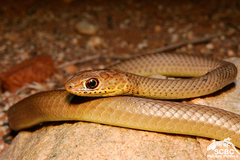
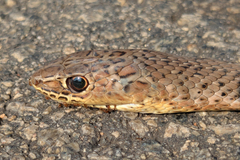
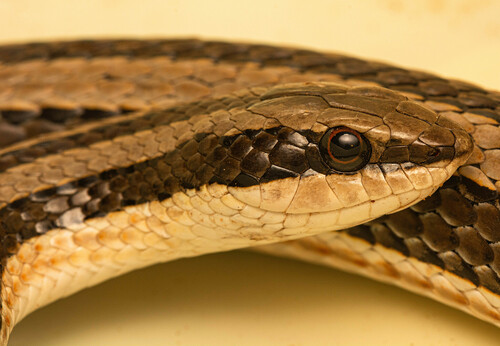
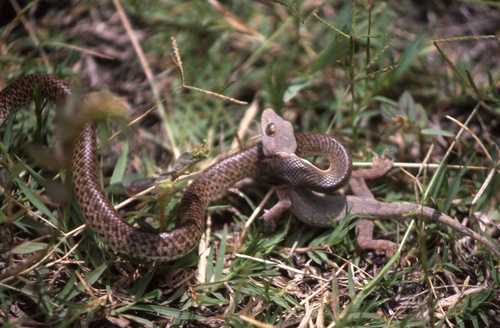
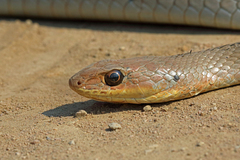
This snake grows to 100 to 180 cm (roughly 3–5 feet) in length, and lives in somewhat moist places near a source of water. It is olive-brown in color, with dark-edged scales and a lighter-hued underside. It is often confused with the black mamba, as it can raise its head in a similar fashion to the mambas, cobras and other elapid snakes; however, unlike the aforementioned species, the olive grass snake is opisthoglyphous (rear-fanged), with small teeth located at the back of the mouth that deliver mild venom (and/or toxic salival compounds), primarily used for subduing small, slippery or "squirmy" prey such as frogs, lizards and some rodents. It... Wikipedia →

Sounds

Recording0:07

Angola · 2025

© Zilpa Miranda · iNaturalist · CC BY-NC 4.0

Global Distribution

Parks Where Found

# Park Country Daily sighting probability
1 Kruger National Park 🇿🇦 South Africa
~10%
2 Etosha National Park 🇳🇦 Namibia
~10%
3 iSimangaliso Wetland Park 🇿🇦 South Africa
~10%

Zoos & Centres Where Found

# Zoo / Centre Country
1 Riverbend Crocodile Farm 🇿🇦 South Africa In captivity

Before you go

What are the chances of seeing an Olive Whip Snake in Kruger National Park?

With luck

About 10% of wildlife watchers report an Olive Whip Snake sighting in Kruger National Park on a given day, based on 47 verified sightings from GBIF citizen-science data from 2019 to 2026. It is the 26th most-seen of the 62 reptiles we can rate there. Over three days the chance rises to about 30%, and over a week to about 50%, if each day is a fresh chance.

When is the best time to see an Olive Whip Snake in Kruger National Park?

December

In that month about 20% of wildlife watchers report an Olive Whip Snake in Kruger National Park on a given day, against under 5% in June and July, the lowest months. That is one of Kruger National Park's wettest months, with about 95 mm of rain against almost none in August.

What time of day is best to see an Olive Whip Snake?

Between 10 am and 1 pm

Across all the parks we cover, that three-hour window holds the most Olive Whip Snake sightings with a recorded time, and about 9 in 10 of them come between 6 am and 6 pm: it is a daytime animal.

Is Kruger National Park the best place to see an Olive Whip Snake?

Yes

Of the 3 parks where we can rate Olive Whip Snake sightings, Kruger National Park has the highest daily chance: about 10%. Next come Etosha National Park (Namibia, about 10%) and iSimangaliso Wetland Park (South Africa, about 10%).

Where does the Olive Whip Snake sighting chance come from?

GBIF citizen-science records

It is estimated from how often the Olive Whip Snake is recorded against all the reptiles logged in Kruger National Park (47 verified sightings from 2019 to 2026), calibrated against known sighting rates. Figures are rounded to the nearest 10% because citizen-science data supports honest approximations, not decimals, and months with records from fewer than five people show "—". How it works.

← Back to Kruger National Park