Rainbow Skink

Rainbow Skink

Trachylepis margaritifera

Silhouette: David Orr · PhyloPic

Daily sighting probability ~40% · Likely
at Kruger National Park

In 3 days ~80% in a week >90%

876 Verified sightings at Kruger National Park From 2019 to 2026
971 In all 7 parks
November Best month
☀️ Diurnal When it's spotted

About the Rainbow Skink

Trachylepis margaritifera, the rainbow skink, is a species of Afro-Malagasy mabuya or skink in the subfamily Lygosominae. Mabuya quinquetaeniata margaritifera, formerly a subspecies of Trachylepis quinquetaeniata (the five-lined mabuya, also known as the rainbow skink), was elevated to full species in 1998 (as Trachylepis margaritifera).

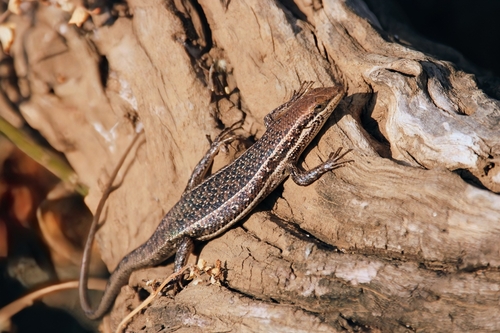
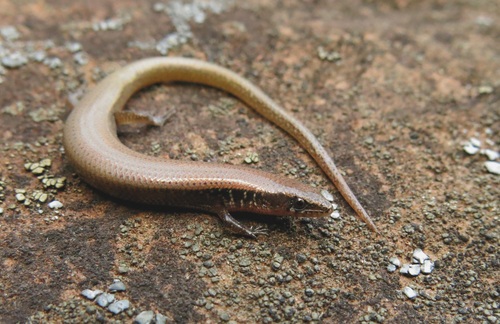
Trachylepis margaritifera is a medium-sized lizard reaching a length of about 20 centimetres (7.9 in). The coloration of this species is quite variable, depending on the gender and the age. The scales are glossy, with metallic reflections. The basic colour is usually olive-brown or dark brown, sometimes with pearly whitish spots and with three light yellow-orange longitudinal stripes running from the head to the electric blue tail. These stripes may fade and become indistinct in the adults.

The head shows a pointed snout and clearly visible ears holes. Just behind the ear opening, there are some black spots. Legs are dark brown, short and strong, with relatively long toes. The flanks are mainly yellowish and the underside of the body is whitish.

It is found in southern Africa, from KwaZulu-Natal in... Wikipedia →

Global Distribution

Parks Where Found

# Park Country Daily sighting probability
1 Gonarezhou National Park 🇿🇼 Zimbabwe
~50%
2 Kruger National Park 🇿🇦 South Africa
~40%
3 Tsavo East National Park 🇰🇪 Kenya
~40%
4 Hwange National Park 🇿🇼 Zimbabwe
~30%
5 Tsavo West National Park 🇰🇪 Kenya
~30%
6 uMkhuze Game Reserve 🇿🇦 South Africa
~30%
7 Hluhluwe-Imfolozi Park 🇿🇦 South Africa
~20%

Zoos & Centres Where Found

# Zoo / Centre Country
1 Prague Zoo 🇨🇿 Czechia In captivity
2 Leipzig Zoological Garden 🇩🇪 Germany In captivity
3 Zoologischer Garten Leipzig 🇩🇪 Germany In captivity
4 Rákosův pavilon 🇨🇿 Czechia In captivity
5 Velemlokárium 🇨🇿 Czechia In captivity
6 Wolfgang-Köhler-Primaten-Forschungszentrum 🇩🇪 Germany In captivity

Before you go

What are the chances of seeing a Rainbow Skink in Kruger National Park?

Likely

About 40% of wildlife watchers report a Rainbow Skink sighting in Kruger National Park on a given day, based on 876 verified sightings from GBIF citizen-science data from 2019 to 2026. It is the 2nd most-seen of the 62 reptiles we can rate there. Over three days the chance rises to about 80%, and over a week to over 90%, if each day is a fresh chance.

When is the best time to see a Rainbow Skink in Kruger National Park?

September to January

In those months about 50% of wildlife watchers report a Rainbow Skink in Kruger National Park on a given day, against about 30% in July, the lowest month. Those are among Kruger National Park's wettest months, with about 60 mm of rain a month against almost none in August.

What time of day is best to see a Rainbow Skink?

Between noon and 3 pm

Across all the parks we cover, that three-hour window holds the most Rainbow Skink sightings with a recorded time, and nearly all of them come between 6 am and 6 pm: it is a daytime animal.

Is Kruger National Park the best place to see a Rainbow Skink?

2nd of 7

Of the 7 parks where we can rate Rainbow Skink sightings, Kruger National Park ranks 2nd at about 40%. The best odds are in Gonarezhou National Park (Zimbabwe, about 50%). All parks ranked.

Which relatives of the Rainbow Skink live in Kruger National Park?

Same genus: Trachylepis

The closest relatives of the Rainbow Skink that you can see in Kruger National Park (genus Trachylepis, Afro-Malagasy Mabuyas) are African Striped Skink (about 30%), Damara Skink (about 10%) and Variable Skink (about 10%), with each one's daily chance of a sighting.

Where does the Rainbow Skink sighting chance come from?

GBIF citizen-science records

It is estimated from how often the Rainbow Skink is recorded against all the reptiles logged in Kruger National Park (876 verified sightings from 2019 to 2026), calibrated against known sighting rates. Figures are rounded to the nearest 10% because citizen-science data supports honest approximations, not decimals, and months with records from fewer than five people show "—". How it works.

← Back to Kruger National Park