Peter's Giant Blind Snake

Peter's Giant Blind Snake

Afrotyphlops schlegelii

Silhouette: Jessica Tingle · PhyloPic

LCLeast ConcernNTVUENCR
Daily sighting probability ~10% · With luck
at Kruger National Park

In 3 days ~30% in a week ~60%

57 Verified sightings at Kruger National Park From 2019 to 2026
63 In all 2 parks
April Best month
☀️ Diurnal When it's spotted

About the Peter's Giant Blind Snake

Afrotyphlops schlegelii, commonly known as Schlegel's beaked blind snake or Schlegel's giant blind snake, is a species of snake in the family Typhlopidae. The species is endemic to eastern and southern Africa, and bears the distinction of being the world's largest typhlopid. It is harmless to humans and lives exclusively on a diet of termites.

The specific name, schlegelii, is in honor of German herpetologist Hermann Schlegel. A. schlegelii is found in Angola, Botswana, the Democratic Republic of the Congo, Eswatini, Ethiopia, Kenya, Malawi, southern Mozambique, northern Namibia, Somalia, South Africa, southern Sudan, Tanzania, northern Uganda, Zambia, and Zimbabwe.

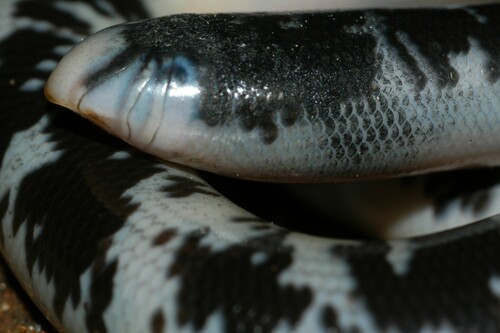
Three distinct color phases of A. schlegelii are found: uniform, blotched, or striped. Uniform phase specimens are black to brown dorsally, straw-colored ventrally. Blotched phase individuals have black to dark brown irregular blotches dorsally, and are yellow-green to yellow ventrally and on the sides.

The striped phase results from each scale being edged with black. These black lines merge with age. The maximum recorded snout-vent length (SVL) is 95 cm (37+3⁄8... Wikipedia →
Global Distribution

Parks Where Found

# Park Country Daily sighting probability
1 Kruger National Park 🇿🇦 South Africa
~10%
2 iSimangaliso Wetland Park 🇿🇦 South Africa
~10%

Closest Relatives at Kruger National Park

No species of the same family or order lives in Kruger National Park, so these are its closest relatives here: other reptiles.

Before you go

What are the chances of seeing a Peter's Giant Blind Snake in Kruger National Park?

With luck

About 10% of wildlife watchers report a Peter's Giant Blind Snake sighting in Kruger National Park on a given day, based on 57 verified sightings from GBIF citizen-science data from 2019 to 2026. It is the 22nd most-seen of the 62 reptiles we can rate there. Over three days the chance rises to about 30%, and over a week to about 60%, if each day is a fresh chance.

When is the best time to see a Peter's Giant Blind Snake in Kruger National Park?

April

In that month about 30% of wildlife watchers report a Peter's Giant Blind Snake in Kruger National Park on a given day, against under 5% in March and July–September, the lowest months. That is one of Kruger National Park's driest months, with about 20 mm of rain against 110 mm in February.

What time of day is best to see a Peter's Giant Blind Snake?

Between 6 and 9 am

Across all the parks we cover, that three-hour window holds the most Peter's Giant Blind Snake sightings with a recorded time, and about 8 in 10 of them come between 6 am and 6 pm: it is a daytime animal.

Is Kruger National Park the best place to see a Peter's Giant Blind Snake?

Yes

Of the 2 parks where we can rate Peter's Giant Blind Snake sightings, Kruger National Park has the highest daily chance: about 10%. Next come iSimangaliso Wetland Park (South Africa, about 10%).

Where does the Peter's Giant Blind Snake sighting chance come from?

GBIF citizen-science records

It is estimated from how often the Peter's Giant Blind Snake is recorded against all the reptiles logged in Kruger National Park (57 verified sightings from 2019 to 2026), calibrated against known sighting rates. Figures are rounded to the nearest 10% because citizen-science data supports honest approximations, not decimals, and months with records from fewer than five people show "—". How it works.

← Back to Kruger National Park