Black-headed Cat Snake

Black-headed Cat Snake

Boiga nigriceps

Silhouette: Alex Slavenko · PhyloPic

LCLeast ConcernNTVUENCR
Daily sighting probability ~20% · Possible
at Kubah National Park

In 3 days ~50% in a week ~80%

7 Verified sightings at Kubah National Park From 2019 to 2026
22 In all 3 parks
December Best month
🌙 Nocturnal When it's spotted

About the Black-headed Cat Snake

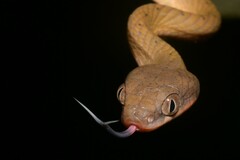
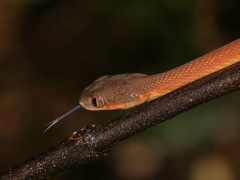
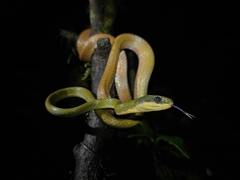
Boiga nigriceps (black-headed cat snake) is a species of colubrid snake from South-East Asia. They are large snakes; adults may attain a total length of 1.75 m (5+1⁄2 ft). It gets its name from the greenish to blackish coloration of its head. Neonates and juveniles do not exhibit this dark color on the head until adulthood. The body color ranges greatly from brown, orange, red, and even black. The ventral region of the snake is yellowish below the neck and white for the rest.

Two subspecies are recognized: Boiga nigriceps nigriceps (Günther, 1863) Boiga nigriceps brevicauda Smith, 1926 Indonesia, Borneo, Peninsular Malaysia, Thailand. The black-headed cat snake is arboreal, but frequently comes down to the ground in search of prey. They occupy lowland and mid-elevation tropical rainforests of Southeast Asia.

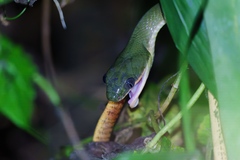
Little is known about the black-headed cat snake's venom toxicity on humans, but it is thought to be comparable to the severity of a copperhead. This rear fanged colubrid's bite rarely results in adverse effects due to its poor venom delivery system. Luckily their fangs' positioning doesn't result...

Wikipedia →

Global Distribution

Parks Where Found

# Park Country Daily sighting probability
1 Kubah National Park 🇲🇾 Malaysia
~20%
2 Gunung Leuser National Park 🇮🇩 Indonesia
~10%
3 Kinabalu Park 🇲🇾 Malaysia
~10%

Zoos & Centres Where Found

# Zoo / Centre Country
1 Siam Serpentarium 🇹🇭 Thailand In captivity
2 Snake Farm of Queen Saovabha Memorial Institute 🇹🇭 Thailand In captivity

Before you go

What are the chances of seeing a Black-headed Cat Snake in Kubah National Park?

Possible

About 20% of wildlife watchers report a Black-headed Cat Snake sighting in Kubah National Park on a given day, based on 7 verified sightings from GBIF citizen-science data from 2019 to 2026. It is the 19th most-seen of the 29 reptiles we can rate there. Over three days the chance rises to about 50%, and over a week to about 80%, if each day is a fresh chance.

When is the best time to see a Black-headed Cat Snake in Kubah National Park?

April and December

In those months about 40% of wildlife watchers report a Black-headed Cat Snake in Kubah National Park on a given day, against under 5% in February, May–July and September–October, the lowest months.

What time of day is best to see a Black-headed Cat Snake?

Between 9 pm and midnight

Across all the parks we cover, that three-hour window holds the most Black-headed Cat Snake sightings with a recorded time, and about 8 in 10 of them come between 6 pm and 6 am: it is mostly seen at night.

Is Kubah National Park the best place to see a Black-headed Cat Snake?

Yes

Of the 3 parks where we can rate Black-headed Cat Snake sightings, Kubah National Park has the highest daily chance: about 20%. Next come Gunung Leuser National Park (Indonesia, about 10%) and Kinabalu Park (Malaysia, about 10%).

Which relatives of the Black-headed Cat Snake live in Kubah National Park?

Same genus: Boiga

The closest relatives of the Black-headed Cat Snake that you can see in Kubah National Park (genus Boiga, Australasian Cat Snakes) are White-spotted Cat Snake (about 30%) and Gold-ringed Cat Snake (about 20%), with each one's daily chance of a sighting.

Where does the Black-headed Cat Snake sighting chance come from?

GBIF citizen-science records

It is estimated from how often the Black-headed Cat Snake is recorded against all the reptiles logged in Kubah National Park (7 verified sightings from 2019 to 2026), calibrated against known sighting rates. Figures are rounded to the nearest 10% because citizen-science data supports honest approximations, not decimals, and months with records from fewer than five people show "—". How it works.

← Back to Kubah National Park