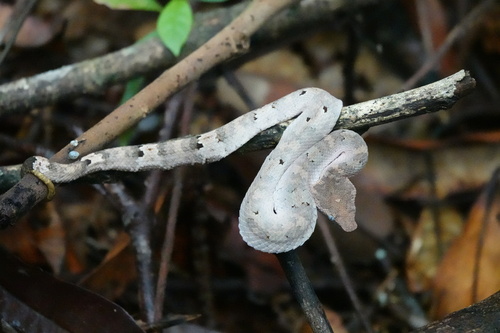
North Philippine Temple Pitviper

North Philippine Temple Pitviper

Tropidolaemus subannulatus

Silhouette: Steven Traver · PhyloPic

LCLeast ConcernNTVUENCR
Daily sighting probability ~50% · Likely
at Kubah National Park

In 3 days ~80% in a week >90%

37 Verified sightings at Kubah National Park From 2019 to 2026
809 In all 7 parks
August Best month
☀️🌙 Day & Night When it's spotted

About the North Philippine Temple Pitviper

The Bornean keeled green pit viper or North Philippine temple pit viper (Tropidolaemus subannulatus) is a pit viper species native to Brunei, Indonesia, Malaysia, and the Philippines. Until 2007, this species was considered part of the Tropidolaemus wagleri species complex.

The Borneo Keeled Green Pit Viper can have a range of colors but generally it is bright green with numerous thin crossbands. Some localities have a mixture of light green to blue background colors. The bands are variable and can be a combination of blue, red or white. Females may have blue or red dots on their underbelly, while juveniles and males only have red dots. Females are much larger than males and can grow to a maximum size of 96 cm, while males can reach a size of 46 cm. This species is one of the most common species encountered in the lowland rainforests of Borneo. It is known to eat birds, small mammals and frogs. It is ovoviparous and gives birth to live young.

This species is arboreal, with a prehensile tail. It can be found in low level vegetation up to a height of 20m. Like many other arboreal snakes, this species has a disrupted green color to allow it excellent camouflage in the...

Wikipedia →

Global Distribution

Parks Where Found

# Park Country Daily sighting probability
1 Bako National Park 🇲🇾 Malaysia
~90%
2 Sepilok 🇲🇾 Malaysia
~80%
3 Tanjung Puting National Park 🇮🇩 Indonesia
~60%
4 Danum Valley Conservation Area 🇲🇾 Malaysia
~60%
5 Kubah National Park 🇲🇾 Malaysia
~50%
6 Kinabalu Park 🇲🇾 Malaysia
~50%
7 Kinabatangan Wildlife Sanctuary 🇲🇾 Malaysia
~10%

Zoos & Centres Where Found

# Zoo / Centre Country
1 Moscow Zoo 🇷🇺 Russia In captivity
2 Aquarium of the Pacific 🇺🇸 United States In captivity
3 Bali Bird Park 🇮🇩 Indonesia In captivity

Before you go

What are the chances of seeing a North Philippine Temple Pitviper in Kubah National Park?

Likely

About 50% of wildlife watchers report a North Philippine Temple Pitviper sighting in Kubah National Park on a given day, based on 37 verified sightings from GBIF citizen-science data from 2019 to 2026. It is the 4th most-seen of the 29 reptiles we can rate there. Over three days the chance rises to about 80%, and over a week to over 90%, if each day is a fresh chance.

When is the best time to see a North Philippine Temple Pitviper in Kubah National Park?

August

In that month about 70% of wildlife watchers report a North Philippine Temple Pitviper in Kubah National Park on a given day, against about 10% in February, June and November, the lowest months.

What time of day is best to see a North Philippine Temple Pitviper?

Between 7 and 10 pm

Across all the parks we cover, that three-hour window holds the most North Philippine Temple Pitviper sightings with a recorded time, and about half of them come between 6 pm and 6 am: it is seen both by day and at night.

Is Kubah National Park the best place to see a North Philippine Temple Pitviper?

5th of 7

Of the 7 parks where we can rate North Philippine Temple Pitviper sightings, Kubah National Park ranks 5th at about 50%. The best odds are in Bako National Park (Malaysia, about 90%), Sepilok (Malaysia, about 80%) and Tanjung Puting National Park (Indonesia, about 60%). All parks ranked.

Which relatives of the North Philippine Temple Pitviper live in Kubah National Park?

Same family: Viperidae

The closest relatives of the North Philippine Temple Pitviper that you can see in Kubah National Park (family Viperidae, Vipers) are Sumatra Pit Viper (about 40%) and Borneo Pit Viper (about 20%), with each one's daily chance of a sighting.

Where does the North Philippine Temple Pitviper sighting chance come from?

GBIF citizen-science records

It is estimated from how often the North Philippine Temple Pitviper is recorded against all the reptiles logged in Kubah National Park (37 verified sightings from 2019 to 2026), calibrated against known sighting rates. Figures are rounded to the nearest 10% because citizen-science data supports honest approximations, not decimals, and months with records from fewer than five people show "—". How it works.

← Back to Kubah National Park