Sumatra Pit Viper

Sumatra Pit Viper

Trimeresurus sumatranus

Silhouette: Steven Traver · PhyloPic

LCLeast ConcernNTVUENCR
Daily sighting probability ~40% · Likely
at Kubah National Park

In 3 days ~80% in a week >90%

33 Verified sightings at Kubah National Park From 2019 to 2026
64 In all 3 parks
August Best month
🌙 Nocturnal When it's spotted

About the Sumatra Pit Viper

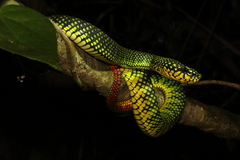
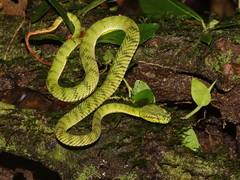
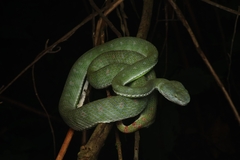
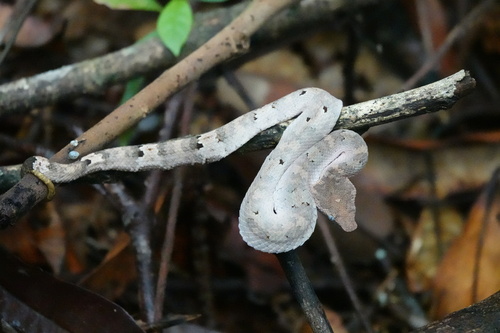
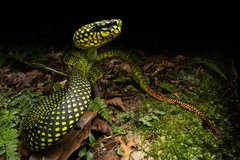
Trimeresurus sumatranus is a species of venomous pitviper (a subfamily of vipers within the larger Viperidae family) found in the tropical forests of Indonesia, Malaysia and Thailand. Arboreal by nature, its coloration is pale to neon-green, with some black vertical markings, and a red-tipped tail. As with other vipers, this species has prominent, "keeled" scales, which appear somewhat raised and give the snake a rough-textured appearance. Common names include Sumatran pitviper, Sumatran tree viper, and Sumatran pit viper.

Trimeresurus sumatranus is a large heavy-bodied pitviper, with a prehensile tail. Adults may attain 1.6 metres (5 feet 3 inches) SVL (snout–vent length), with fangs over 10 mm (3⁄8 in) long. It is an arboreal species that is pale green in color with a red tail. The dorsal scales are edged with black, which may form crossbands in more mature specimens. There is a white or yellow stripe on each side along the first row of dorsal scales. Ventrally it is greenish or yellowish, and the ventral scales may be thinly edged with black.

Scalation includes 21 (23) rows of dorsal scales at midbody, 183–190/182–191 ventral scales in males/females, 57–66/55–64...

Wikipedia →

Global Distribution

Parks Where Found

# Park Country Daily sighting probability
1 Kubah National Park 🇲🇾 Malaysia
~40%
2 Kinabalu Park 🇲🇾 Malaysia
~20%
3 Danum Valley Conservation Area 🇲🇾 Malaysia
~20%

Before you go

What are the chances of seeing a Sumatra Pit Viper in Kubah National Park?

Likely

About 40% of wildlife watchers report a Sumatra Pit Viper sighting in Kubah National Park on a given day, based on 33 verified sightings from GBIF citizen-science data from 2019 to 2026. It is the 7th most-seen of the 29 reptiles we can rate there. Over three days the chance rises to about 80%, and over a week to over 90%, if each day is a fresh chance.

When is the best time to see a Sumatra Pit Viper in Kubah National Park?

August

In that month about 70% of wildlife watchers report a Sumatra Pit Viper in Kubah National Park on a given day, against under 5% in October and November, the lowest months.

What time of day is best to see a Sumatra Pit Viper?

Between 7 and 10 pm

Across all the parks we cover, that three-hour window holds the most Sumatra Pit Viper sightings with a recorded time, and about 8 in 10 of them come between 6 pm and 6 am: it is mostly seen at night.

Is Kubah National Park the best place to see a Sumatra Pit Viper?

Yes

Of the 3 parks where we can rate Sumatra Pit Viper sightings, Kubah National Park has the highest daily chance: about 40%. Next come Kinabalu Park (Malaysia, about 20%) and Danum Valley Conservation Area (Malaysia, about 20%).

Which relatives of the Sumatra Pit Viper live in Kubah National Park?

Same family: Viperidae

The closest relatives of the Sumatra Pit Viper that you can see in Kubah National Park (family Viperidae, Vipers) are North Philippine Temple Pitviper (about 50%) and Borneo Pit Viper (about 20%), with each one's daily chance of a sighting.

Where does the Sumatra Pit Viper sighting chance come from?

GBIF citizen-science records

It is estimated from how often the Sumatra Pit Viper is recorded against all the reptiles logged in Kubah National Park (33 verified sightings from 2019 to 2026), calibrated against known sighting rates. Figures are rounded to the nearest 10% because citizen-science data supports honest approximations, not decimals, and months with records from fewer than five people show "—". How it works.

← Back to Kubah National Park