Borneo Pit Viper

Borneo Pit Viper

Craspedocephalus borneensis

Silhouette: Vijay Karthick · PhyloPic

LCLeast ConcernNTVUENCR
Daily sighting probability ~20% · Possible
at Kubah National Park

In 3 days ~50% in a week ~80%

6 Verified sightings at Kubah National Park From 2019 to 2026
34 In all 3 parks
March Best month
☀️🌙 Day & Night When it's spotted

About the Borneo Pit Viper

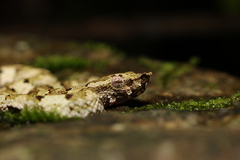
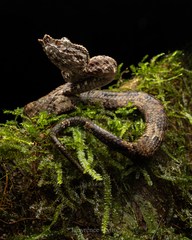
Craspedocephalus borneensis, commonly known as the Bornean pit viper, is a venomous pit viper species endemic to the island of Borneo. No subspecies are currently recognized. Scalation includes 19–21 rows of dorsal scales at midbody, 152–180 ventral scales, undivided anal scale, 45–58 divided subcaudal scales, and 8–11 supralabial scales.

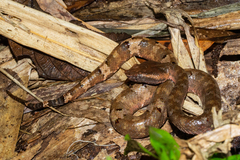
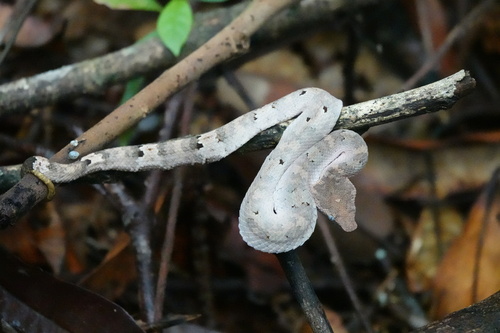
Its coloration varies. Individuals may be brown with darker brown saddles, or light brown with a few darker markings, or even bright yellow with darker markings. Adults may attain 83 cm (33 in) in snout-vent length (SVL).

Craspedocephalus borneensis is found on the island of Borneo (Brunei, Kalimantan, Sabah, Sarawak) as well as in the Natuna Islands. The type locality given is "Sarawack" (= Sarawak, Borneo). It is found in forests below an altitude of 1,130 m (3,710 ft). Even though the tail is prehensile, adults are usually on the forest floor. Juveniles may be in low vegetation.

Craspedocephalus borneensis preys upon small rodents and small birds. Whether this species of Craspedocephalus lays eggs or bears live young is as yet unknown.
Wikipedia →

Global Distribution

Parks Where Found

# Park Country Daily sighting probability
1 Kubah National Park 🇲🇾 Malaysia
~20%
2 Kinabalu Park 🇲🇾 Malaysia
~20%
3 Sepilok 🇲🇾 Malaysia
~20%

Before you go

What are the chances of seeing a Borneo Pit Viper in Kubah National Park?

Possible

About 20% of wildlife watchers report a Borneo Pit Viper sighting in Kubah National Park on a given day, based on 6 verified sightings from GBIF citizen-science data from 2019 to 2026. It is the 22nd most-seen of the 29 reptiles we can rate there. Over three days the chance rises to about 50%, and over a week to about 80%, if each day is a fresh chance.

When is the best time to see a Borneo Pit Viper in Kubah National Park?

March and May

In those months about 40% of wildlife watchers report a Borneo Pit Viper in Kubah National Park on a given day, against under 5% in April, June–July and October–February, the lowest months.

What time of day is best to see a Borneo Pit Viper?

Between 7 and 10 pm

Across all the parks we cover, that three-hour window holds the most Borneo Pit Viper sightings with a recorded time, and about 7 in 10 of them come between 6 pm and 6 am: it is seen both by day and at night.

Is Kubah National Park the best place to see a Borneo Pit Viper?

Yes

Of the 3 parks where we can rate Borneo Pit Viper sightings, Kubah National Park has the highest daily chance: about 20%. Next come Kinabalu Park (Malaysia, about 20%) and Sepilok (Malaysia, about 20%).

Which relatives of the Borneo Pit Viper live in Kubah National Park?

Same family: Viperidae

The closest relatives of the Borneo Pit Viper that you can see in Kubah National Park (family Viperidae, Vipers) are North Philippine Temple Pitviper (about 50%) and Sumatra Pit Viper (about 40%), with each one's daily chance of a sighting.

Where does the Borneo Pit Viper sighting chance come from?

GBIF citizen-science records

It is estimated from how often the Borneo Pit Viper is recorded against all the reptiles logged in Kubah National Park (6 verified sightings from 2019 to 2026), calibrated against known sighting rates. Figures are rounded to the nearest 10% because citizen-science data supports honest approximations, not decimals, and months with records from fewer than five people show "—". How it works.

← Back to Kubah National Park