Scaled Antpitta

Scaled Antpitta

Grallaria guatimalensis

Silhouette: Edwin Price · PhyloPic

LCLeast ConcernNTVUENCR
Daily sighting probability ~10% · With luck
at La Tigra National Park

In 3 days ~20% in a week ~50%

36 Verified sightings at La Tigra National Park From 2019 to 2026
368 In all 9 parks
October Best month
☀️ Diurnal When it's spotted

About the Scaled Antpitta

The scaled antpitta (Grallaria guatimalensis) is a species of bird in the family Grallariidae. It is found in Bolivia, Brazil, Colombia, Costa Rica, Ecuador, El Salvador, Guatemala, Guyana, Honduras, Mexico, Nicaragua, Panama, Peru, and Venezuela It has occurred as a vagrant on Trinidad. There is also a single record in Belize.

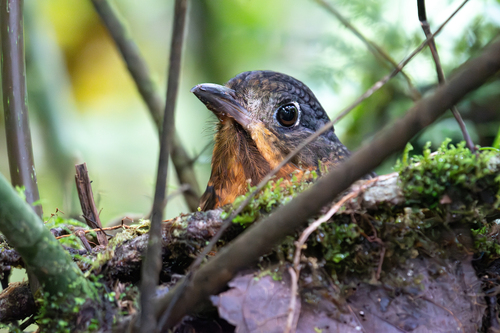
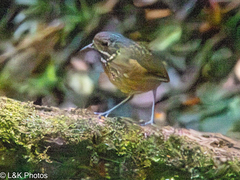
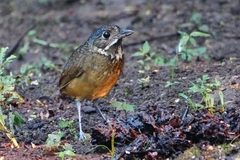
The scaled antpitta has these 10 subspecies: The scaled antpitta and the moustached antpitta (G. alleni) form a superspecies, and some authors have suggested that they are conspecific. Grallaria antpittas are a "wonderful group of plump and round antbirds whose feathers are often fluffed up...they have stout bills [and] very short tails". The scaled antpitta is 15 to 19 cm (5.9 to 7.5 in) long and weighs 70 to 98 g (2.5 to 3.5 oz). The sexes have the same plumage. Adults of the nominate subspecies G. g. guatimalensis have a pale olive brownish forecrown with fine black scaling and a gray crown and nape. They have whitish or buffy lores, olive brown ear coverts with thin streaks, and blue-gray skin around their eye. Their back and wing coverts are olive brown with black feather edges that give the eponymous scaled... Wikipedia →

Sounds

Call0:07

Panama · 2026

© Octavio · XC1150381 · CC BY-NC-SA 4.0

Song0:40

Colombia · 2026

© Julio Delgado · XC1094021 · CC BY-NC-SA 4.0

Uncertain0:05

Venezuela · 2021

© Daniel de Jesus Garcia · XC632065 · CC BY-NC-SA 4.0

Global Distribution

Parks Where Found

# Park Country Daily sighting probability
1 La Tigra National Park 🇭🇳 Honduras
~10%
2 Farallones de Cali National Natural Park 🇨🇴 Colombia
<5%
3 Cerro Azul Meámbar National Park 🇭🇳 Honduras
<5%
4 Monteverde Cloud Forest Reserve 🇨🇷 Costa Rica
<5%
5 Los Quetzales National Park 🇨🇷 Costa Rica
<5%
6 Braulio Carrillo National Park 🇨🇷 Costa Rica
<5%
7 Tapantí-Macizo de la Muerte National Park 🇨🇷 Costa Rica
<5%
8 Arenal Volcano National Park 🇨🇷 Costa Rica
<5%
9 La Amistad International Park (Panama) 🇵🇦 Panama
<5%

Before you go

What are the chances of seeing a Scaled Antpitta in La Tigra National Park?

With luck

About 10% of wildlife watchers report a Scaled Antpitta sighting in La Tigra National Park on a given day, based on 36 verified sightings from GBIF citizen-science data from 2019 to 2026. It is the 74th most-seen of the 176 birds we can rate there. Over three days the chance rises to about 20%, and over a week to about 50%, if each day is a fresh chance.

When is the best time to see a Scaled Antpitta in La Tigra National Park?

September and October

In those months about 20% of wildlife watchers report a Scaled Antpitta in La Tigra National Park on a given day, against under 5% in February, May, July–August and November–December, the lowest months. Those are among La Tigra National Park's wettest months, with about 250 mm of rain a month against 25 mm in February.

What time of day is best to see a Scaled Antpitta?

Between 4 and 7 pm

Across all the parks we cover, that three-hour window holds the most Scaled Antpitta sightings with a recorded time, and about 7 in 10 of them come between 6 am and 6 pm: it is a daytime animal.

Which relatives of the Scaled Antpitta live in La Tigra National Park?

Same order: Passeriformes

The closest relatives of the Scaled Antpitta that you can see in La Tigra National Park (order Passeriformes, Perching Birds) are Bushy-crested Jay (about 50%), Slate-colored Solitaire (about 50%) and Melodious Blackbird (about 50%), with each one's daily chance of a sighting.

Where does the Scaled Antpitta sighting chance come from?

GBIF citizen-science records

It is estimated from how often the Scaled Antpitta is recorded against all the birds logged in La Tigra National Park (36 verified sightings from 2019 to 2026), calibrated against known sighting rates. Figures are rounded to the nearest 10% because citizen-science data supports honest approximations, not decimals, and months with records from fewer than five people show "—". How it works.

← Back to La Tigra National Park