Blue-breasted Bee-eater

Blue-breasted Bee-eater

Merops variegatus

Silhouette: Sheatherius · PhyloPic

LCLeast ConcernNTVUENCR
Daily sighting probability <5% · Rare
at Lake Mburo National Park

In 3 days ~10%

19 Verified sightings at Lake Mburo National Park From 2019 to 2026
122 In all 6 parks
October Best month
☀️ Diurnal When it's spotted

About the Blue-breasted Bee-eater

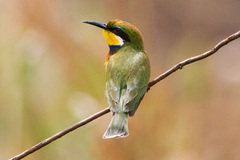
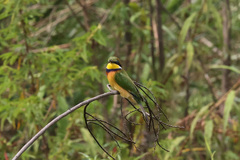
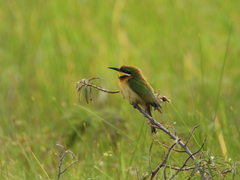
The blue-breasted bee-eater (Merops variegatus) is a central African species of bird. It is a member of the family Meropidae. Meropids are all visually similar and have a diet specialized in Hymenopterans. The blue-breasted bee-eater, Merops variegatus, exhibits several physically defining characteristics of the Meropidae. It has a relatively large head, short neck, bright plumage, long curved slim sharp beak and a broad black eyestripe. M. variegatus weights between 20 and 26 g and measures between 18 and 21 cm in length. It is primarily a green bird, with a green crown, green upper parts and light greenish-yellow underparts.

Primary wings are washed with rufous and secondaries are green with black tips. Overall the wings are rounded at the tip compared to the pointed tips of the migratory species in Meropidae. The tail has twelve rectrices, the outer rectrices are washed with rufous and the center feathers are green. The tail has a subterminal black bar and is tipped with white. Furthermore, the tail has a shallow v -shape and is lacking tail-streamers present in other members of the family.

The head of the blue-breasted bee-eater can be distinguished from other... Wikipedia →

Sounds

Call0:23

Uganda · 2022

© Peter Boesman · XC739816 · CC BY-NC-ND 4.0

Call0:14

Zambia · 2020

© Dries Van de Loock · XC585220 · CC BY-NC-SA 4.0

Call0:59

Gabon · 2019

© Étienne Leroy · XC497378 · CC BY-NC-SA 4.0

Global Distribution

Parks Where Found

# Park Country Daily sighting probability
1 Odzala-Kokoua National Park 🇨🇬 Republic of the Congo
~30%
2 Murchison Falls National Park 🇺🇬 Uganda
<5%
3 Virunga National Park 🇨🇩 Democratic Republic of the Congo
<5%
4 Lake Mburo National Park 🇺🇬 Uganda
<5%
5 Kafue National Park 🇿🇲 Zambia
<5%
6 Queen Elizabeth National Park 🇺🇬 Uganda
<5%

Cities Where Found

# City Country Daily sighting probability
1 Kampala 🇺🇬 Uganda
<5%

Before you go

What are the chances of seeing a Blue-breasted Bee-eater in Lake Mburo National Park?

Rare

Under 5% of wildlife watchers report a Blue-breasted Bee-eater sighting in Lake Mburo National Park on a given day, based on 19 verified sightings from GBIF citizen-science data from 2019 to 2026. It is the 272nd most-seen of the 362 birds we can rate there. Over three days the chance rises to about 10%, if each day is a fresh chance.

When is the best time to see a Blue-breasted Bee-eater in Lake Mburo National Park?

May and October

In those months about 10% of wildlife watchers report a Blue-breasted Bee-eater in Lake Mburo National Park on a given day, against under 5% in June–September and November–April, the lowest months.

What time of day is best to see a Blue-breasted Bee-eater?

Between 8 and 11 am

Across all the parks we cover, that three-hour window holds the most Blue-breasted Bee-eater sightings with a recorded time, and about 9 in 10 of them come between 6 am and 6 pm: it is a daytime animal.

Is Lake Mburo National Park the best place to see a Blue-breasted Bee-eater?

4th of 6

Of the 6 parks where we can rate Blue-breasted Bee-eater sightings, Lake Mburo National Park ranks 4th at under 5%. The best odds are in Odzala-Kokoua National Park (Republic of the Congo, about 30%), Murchison Falls National Park (Uganda, under 5%) and Virunga National Park (Democratic Republic of the Congo, under 5%).

Which relatives of the Blue-breasted Bee-eater live in Lake Mburo National Park?

Same genus: Merops

The closest relatives of the Blue-breasted Bee-eater that you can see in Lake Mburo National Park (genus Merops, Typical Bee-eaters) are Little Bee-eater (about 60%) and European Bee-eater (about 10%), with each one's daily chance of a sighting.

Where does the Blue-breasted Bee-eater sighting chance come from?

GBIF citizen-science records

It is estimated from how often the Blue-breasted Bee-eater is recorded against all the birds logged in Lake Mburo National Park (19 verified sightings from 2019 to 2026), calibrated against known sighting rates. Figures are rounded to the nearest 10% because citizen-science data supports honest approximations, not decimals, and months with records from fewer than five people show "—". How it works.

← Back to Lake Mburo National Park