Long-tailed Widow-bird

Long-tailed Widow-bird

Euplectes progne

Silhouette: Sheatherius · PhyloPic

LCLeast ConcernNTVUENCR
Daily sighting probability ~10% · With luck
at Lake Nakuru National Park

In 3 days ~20% in a week ~50%

90 Verified sightings at Lake Nakuru National Park From 2019 to 2026
217 In all 5 parks
May Best month
☀️ Diurnal When it's spotted

About the Long-tailed Widow-bird

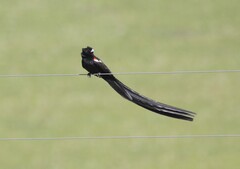
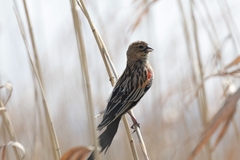
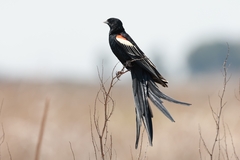
The long-tailed widowbird (Euplectes progne) is a species of bird in the weaver family Ploceidae. The species is found in Angola, Botswana, the Democratic Republic of the Congo, Kenya, Lesotho, South Africa, Eswatini, and Zambia. The long-tailed widowbird is a medium-sized bird and one of the most common in the territories it inhabits. Adult breeding males are almost entirely black with orange and white shoulders ("epaulets"), long, wide tails, and a bluish white bill. Females are rather inconspicuous, their feathers streaked tawny and black with pale patches on the chest, breast and back, narrow tail feathers, and horn-coloured bills.

When flying, male long-tailed widowbirds are readily visible due to their extremely long tails. Between six and eight of their twelve tail feathers are approximately half a metre (approximately 20 inches) long. The tail during flight display is expanded vertically into a deep, long keel below the male as he flies with slow wingbeats 0.5 to 2 metres (20 to 78 inches) above his territory.

Because of the seemingly large cost to such male ornaments, the long-tailed widowbird has been the subject of extensive research into the function and evolution of sexually selected traits. This research has demonstrated the existence of female choice in sexual selection and indicates the trade-offs between sexual appeal and physical constraints with regard to the evolution of sexual ornaments. Wikipedia →

Sounds

Call0:55

Zambia · 2026

© Magnus Wadstein · XC1184937 · CC BY-NC-SA 4.0

Song0:30

Zambia · 2024

© Dries Van de Loock · XC958781 · CC BY-NC-ND 4.0

Call0:47

Kenya · 2026

© Ding Li Yong · XC1179251 · CC BY-NC-ND 4.0

Global Distribution

Parks Where Found

# Park Country Daily sighting probability
1 Golden Gate Highlands National Park 🇿🇦 South Africa
~40%
2 Lake Nakuru National Park 🇰🇪 Kenya
~10%
3 Hluhluwe-Imfolozi Park 🇿🇦 South Africa
<5%
4 Addo Elephant National Park 🇿🇦 South Africa
<5%
5 Kruger National Park 🇿🇦 South Africa
<5%

Cities Where Found

# City Country Daily sighting probability
1 Johannesburg 🇿🇦 South Africa
<5%

Before you go

What are the chances of seeing a Long-tailed Widow-bird in Lake Nakuru National Park?

With luck

About 10% of wildlife watchers report a Long-tailed Widow-bird sighting in Lake Nakuru National Park on a given day, based on 90 verified sightings from GBIF citizen-science data from 2019 to 2026. It is the 166th most-seen of the 369 birds we can rate there. Over three days the chance rises to about 20%, and over a week to about 50%, if each day is a fresh chance.

When is the best time to see a Long-tailed Widow-bird in Lake Nakuru National Park?

May

In that month about 30% of wildlife watchers report a Long-tailed Widow-bird in Lake Nakuru National Park on a given day, against under 5% in February and August–November, the lowest months.

What time of day is best to see a Long-tailed Widow-bird?

Between 10 am and 1 pm

Across all the parks we cover, that three-hour window holds the most Long-tailed Widow-bird sightings with a recorded time, and about 9 in 10 of them come between 6 am and 6 pm: it is a daytime animal.

Is Lake Nakuru National Park the best place to see a Long-tailed Widow-bird?

2nd of 5

Of the 5 parks where we can rate Long-tailed Widow-bird sightings, Lake Nakuru National Park ranks 2nd at about 10%. The best odds are in Golden Gate Highlands National Park (South Africa, about 40%).

Where does the Long-tailed Widow-bird sighting chance come from?

GBIF citizen-science records

It is estimated from how often the Long-tailed Widow-bird is recorded against all the birds logged in Lake Nakuru National Park (90 verified sightings from 2019 to 2026), calibrated against known sighting rates. Figures are rounded to the nearest 10% because citizen-science data supports honest approximations, not decimals, and months with records from fewer than five people show "—". How it works.

← Back to Lake Nakuru National Park