Broad-palmed Frog

Broad-palmed Frog

Litoria latopalmata

Silhouette: Robbi Bishop-Taylor · PhyloPic

LCLeast ConcernNTVUENCR Endemic
Daily sighting probability ~10% · With luck
at Lamington National Park

In 3 days ~30% in a week ~50%

8 Verified sightings at Lamington National Park From 2019 to 2026
16 In all 2 parks
April Best month
☀️🌙 Day & Night When it's spotted

About the Broad-palmed Frog

The broad-palmed frog (Litoria latopalmata) is a species of ground-dwelling tree frog. It is native to much of eastern Australia. They can be found from mid-Queensland to south of Sydney. It is associated with the coast and inland, and is distributed as far west in New South Wales to the South Australia border.

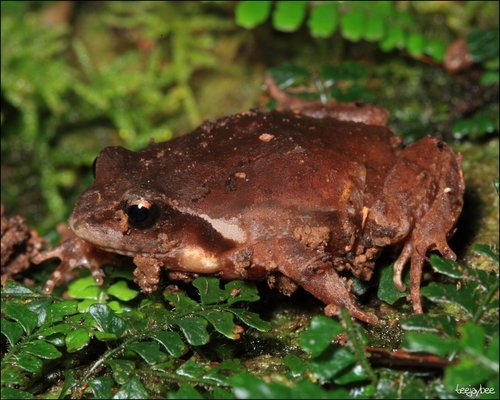
The broad-palmed frog is pale to dark brown on its dorsal surface; it can have darker blotches or variegations. Its skin is smooth, with the occasional wart on its back. A black band runs from the snout, through the eye and tympanum, and breaks into blotches down the side. A white line breaks the black band in front of the eye, and runs under the eye. The thighs are marbled yellow and black and the armpit is yellow. The lower lip is normally marbled black and white. The belly is white.

The broad-palmed frog will call in a large chorus during mating season, around a still water source, normally a dam, but may be a roadside ditch, temporary puddle or still area of a stream. The call is a short "quark" repeated continuously. This species of frog can be found great distances from the breeding area and tends to inhabit open country... Wikipedia →

Sounds

Advertisement call0:24

Australia · 2022

© Marc Anderson · XC883709 · CC BY-NC-ND 4.0

Recording0:10

Australia · 2022

© KDendle · iNaturalist · CC BY-NC 4.0

Recording0:20

Australia · 2021

© chrisnken · iNaturalist · CC BY-NC 4.0

Global Distribution

Parks Where Found

# Park Country Daily sighting probability
1 Lamington National Park 🇦🇺 Australia
~10%
2 Blue Mountains National Park 🇦🇺 Australia
~10%

Cities Where Found

# City Country Daily sighting probability
1 Brisbane 🇦🇺 Australia
<5%

Before you go

What are the chances of seeing a Broad-palmed Frog in Lamington National Park?

With luck

About 10% of wildlife watchers report a Broad-palmed Frog sighting in Lamington National Park on a given day, based on 8 verified sightings from GBIF citizen-science data from 2019 to 2026. It is the 12th most-seen of the 14 amphibians we can rate there. Over three days the chance rises to about 30%, and over a week to about 50%, if each day is a fresh chance.

When is the best time to see a Broad-palmed Frog in Lamington National Park?

April and October

In those months about 20% of wildlife watchers report a Broad-palmed Frog in Lamington National Park on a given day, against under 5% in May–September and December–February, the lowest months.

What time of day is best to see a Broad-palmed Frog?

Between 7 and 10 pm

Across all the parks we cover, that three-hour window holds the most Broad-palmed Frog sightings with a recorded time, and about 6 in 10 of them come between 6 pm and 6 am: it is seen both by day and at night.

Is Lamington National Park the best place to see a Broad-palmed Frog?

Yes

Of the 2 parks where we can rate Broad-palmed Frog sightings, Lamington National Park has the highest daily chance: about 10%. Next come Blue Mountains National Park (Australia, about 10%).

Which relatives of the Broad-palmed Frog live in Lamington National Park?

Same genus: Litoria

The closest relatives of the Broad-palmed Frog that you can see in Lamington National Park (genus Litoria) are Eastern Dwarf Treefrog (about 20%) and Peron's Tree Frog (about 20%), with each one's daily chance of a sighting.

Where does the Broad-palmed Frog sighting chance come from?

GBIF citizen-science records

It is estimated from how often the Broad-palmed Frog is recorded against all the amphibians logged in Lamington National Park (8 verified sightings from 2019 to 2026), calibrated against known sighting rates. Figures are rounded to the nearest 10% because citizen-science data supports honest approximations, not decimals, and months with records from fewer than five people show "—". How it works.

← Back to Lamington National Park