Tusked Frog

Tusked Frog

Adelotus brevis

Silhouette: Dmitry Bogdanov (vectorized by T. Michael Keesey) · PhyloPic

LCLeast ConcernNTVUENCR Endemic
Daily sighting probability ~20% · Possible
at Lamington National Park

In 3 days ~40% in a week ~70%

17 Verified sightings at Lamington National Park From 2019 to 2026
34 In all 2 parks
October Best month
☀️🌙 Day & Night When it's spotted

About the Tusked Frog

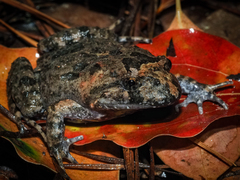
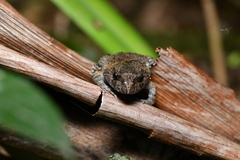
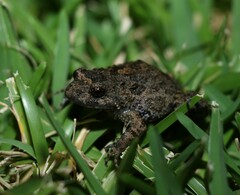
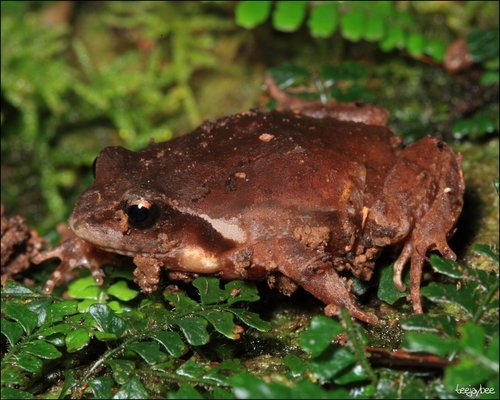
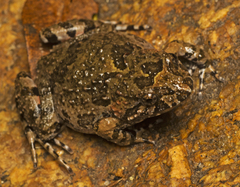
The tusked frog (Adelotus brevis) is a species of ground-dwelling frog native to eastern Australia from Eungella National Park, Queensland south to Ourimbah, New South Wales. It is the only species in the genus Adelotus - adelotus meaning "unseen" and brevis meaning "short".

The tusked frog is a unique frog within Australia, as it is the only species where the female is smaller than male. Males can reach a maximum length of about 5 centimetres (2.0 in), while females reach 4 centimetres (1.6 in). The common name of "tusked frog" derives from the small protrusions on the lower jaw, similar in position to tusks, which can reach about 5 millimetres (0.20 in) in length in males (only visible when the mouth is open).

The pair of bony tusks are modified teeth that protrude from the middle of the lower jaw and fit into special grooves on the upper jaw when the mouth is closed. They are slightly curved and sharply pointed, and are present in both males and females, although they are larger in males.

Males have been observed 'locking jaws' with each other, in a similar way to male deer locking antlers in the struggle to exert dominance over each other. Male tusked frogs have... Wikipedia →

Sounds

Recording0:11

Australia · 2025

© Liam Hall · iNaturalist · CC BY-NC 4.0

Recording0:15

Australia · 2025

© pietervandam1 · iNaturalist · CC BY-NC 4.0

Recording0:17

Australia · 2022

© Luke R. Hardy · iNaturalist · CC BY-NC 4.0

Global Distribution

Parks Where Found

# Park Country Daily sighting probability
1 Lamington National Park 🇦🇺 Australia
~20%
2 Springbrook National Park 🇦🇺 Australia
~10%

Cities Where Found

# City Country Daily sighting probability
1 Brisbane 🇦🇺 Australia
~10%

Before you go

What are the chances of seeing a Tusked Frog in Lamington National Park?

Possible

About 20% of wildlife watchers report a Tusked Frog sighting in Lamington National Park on a given day, based on 17 verified sightings from GBIF citizen-science data from 2019 to 2026. It is the 9th most-seen of the 14 amphibians we can rate there. Over three days the chance rises to about 40%, and over a week to about 70%, if each day is a fresh chance.

When is the best time to see a Tusked Frog in Lamington National Park?

October

In that month about 30% of wildlife watchers report a Tusked Frog in Lamington National Park on a given day, against under 5% in April–June and September, the lowest months.

What time of day is best to see a Tusked Frog?

Between 6 and 9 pm

Across all the parks we cover, that three-hour window holds the most Tusked Frog sightings with a recorded time, and about 6 in 10 of them come between 6 pm and 6 am: it is seen both by day and at night.

Is Lamington National Park the best place to see a Tusked Frog?

Yes

Of the 2 parks where we can rate Tusked Frog sightings, Lamington National Park has the highest daily chance: about 20%. Next come Springbrook National Park (Australia, about 10%).

Which relatives of the Tusked Frog live in Lamington National Park?

Same family: Limnodynastidae

The closest relatives of the Tusked Frog that you can see in Lamington National Park (family Limnodynastidae, Foam-nesting Ground Frogs) are Striped Marsh Frog (about 20%), Loveridge's Frog (about 10%) and Ornate Burrowing Frog (about 10%), with each one's daily chance of a sighting.

Where does the Tusked Frog sighting chance come from?

GBIF citizen-science records

It is estimated from how often the Tusked Frog is recorded against all the amphibians logged in Lamington National Park (17 verified sightings from 2019 to 2026), calibrated against known sighting rates. Figures are rounded to the nearest 10% because citizen-science data supports honest approximations, not decimals, and months with records from fewer than five people show "—". How it works.

← Back to Lamington National Park