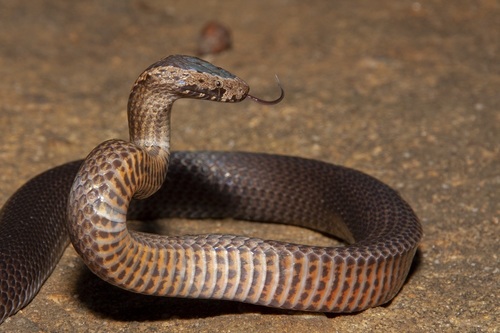
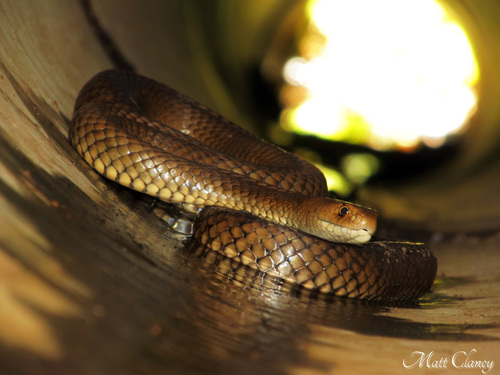
Stephen's Banded Snake

Stephen's Banded Snake

Hoplocephalus stephensii

Silhouette: SeismicShrimp · PhyloPic

LCNTNear ThreatenedVUENCR Endemic
Daily sighting probability ~10% · With luck
at Lamington National Park

In 3 days ~20% in a week ~40%

23 Verified sightings at Lamington National Park From 2019 to 2026
43 In all 2 parks
October Best month
🌙 Nocturnal When it's spotted

About the Stephen's Banded Snake

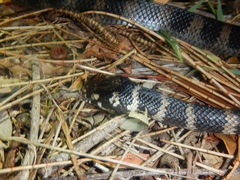
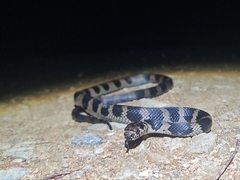
Stephens's banded snake (Hoplocephalus stephensii) is a species of highly venomous tree snake in the family Elapidae. The species is endemic to Australia. Gerard Krefft described Hoplocephalus stephensii as a species new to science in 1869. The specific name stephensii, is in honour of Australian academic William John Stephens.

H. stephensii grows up to 1 meter (39 inches) in total length (including tail), with some specimens having been recorded as having a total length upwards of 120 cm (47 in). The Stephens' banded snake is the largest species within the genus Hoplocephalus, weighing up to 250 g (8.8 oz) as an adult. On average, females of this species are larger than males. This slight sexual dimorphism is an adaptation that likely improves the reproductive capabilities of females.

The anterior scalation of Stephens's banded snake consists of 21 rows of midbody dorsal scales, and 220 to 250 ventral scales. Posteriorly, its singular subcaudal scales can range between 50 and 70 scales from the anal plate to the tip of the tail. This species has a singular (undivided) anal plate that covers its cloacal opening. The ventral scales of the genus Hoplocephalus... Wikipedia →

Global Distribution

Parks Where Found

# Park Country Daily sighting probability
1 Lamington National Park 🇦🇺 Australia
~10%
2 Springbrook National Park 🇦🇺 Australia
~10%

Closest Relatives at Lamington National Park

Before you go

What are the chances of seeing a Stephen's Banded Snake in Lamington National Park?

With luck

About 10% of wildlife watchers report a Stephen's Banded Snake sighting in Lamington National Park on a given day, based on 23 verified sightings from GBIF citizen-science data from 2019 to 2026. It is the 36th most-seen of the 38 reptiles we can rate there. Over three days the chance rises to about 20%, and over a week to about 40%, if each day is a fresh chance.

When is the best time to see a Stephen's Banded Snake in Lamington National Park?

August to May

In those months about 10% of wildlife watchers report a Stephen's Banded Snake in Lamington National Park on a given day, against under 5% in June and July, the lowest months.

What time of day is best to see a Stephen's Banded Snake?

Between 8 and 11 pm

Across all the parks we cover, that three-hour window holds the most Stephen's Banded Snake sightings with a recorded time, and about 8 in 10 of them come between 6 pm and 6 am: it is mostly seen at night.

Is Lamington National Park the best place to see a Stephen's Banded Snake?

Yes

Of the 2 parks where we can rate Stephen's Banded Snake sightings, Lamington National Park has the highest daily chance: about 10%. Next come Springbrook National Park (Australia, about 10%).

Which relatives of the Stephen's Banded Snake live in Lamington National Park?

Same family: Elapidae

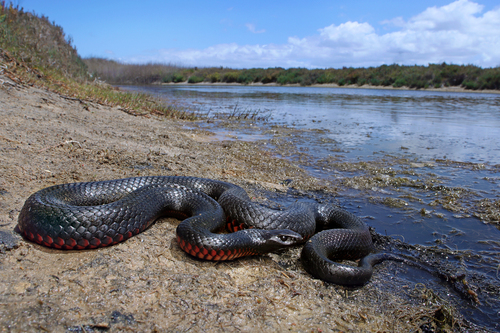
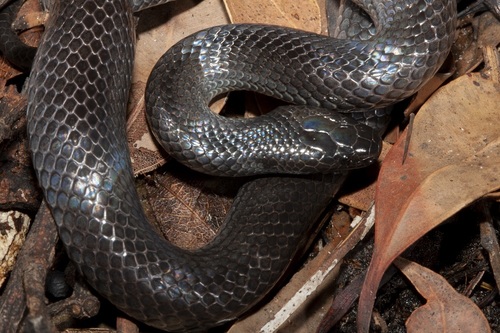
The closest relatives of the Stephen's Banded Snake that you can see in Lamington National Park (family Elapidae, Elapid Snakes) are Red-bellied Black Snake (about 50%), Black-bellied Swamp Snake (about 30%) and Small-eyed Snake (about 20%), with each one's daily chance of a sighting.

Where does the Stephen's Banded Snake sighting chance come from?

GBIF citizen-science records

It is estimated from how often the Stephen's Banded Snake is recorded against all the reptiles logged in Lamington National Park (23 verified sightings from 2019 to 2026), calibrated against known sighting rates. Figures are rounded to the nearest 10% because citizen-science data supports honest approximations, not decimals, and months with records from fewer than five people show "—". How it works.

← Back to Lamington National Park