Black-bellied Swamp Snake

Black-bellied Swamp Snake

Hemiaspis signata

Silhouette: SeismicShrimp · PhyloPic

LCLeast ConcernNTVUENCR Endemic
Daily sighting probability ~30% · Possible
at Lamington National Park

In 3 days ~60% in a week ~90%

42 Verified sightings at Lamington National Park From 2019 to 2026
72 In all 4 parks
February Best month
☀️ Diurnal When it's spotted

About the Black-bellied Swamp Snake

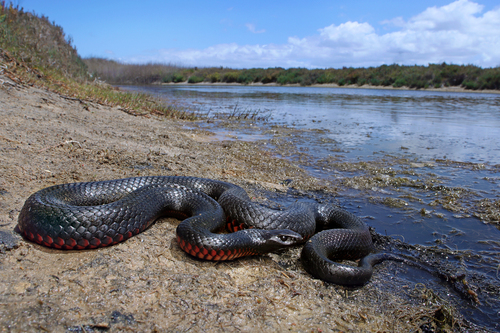
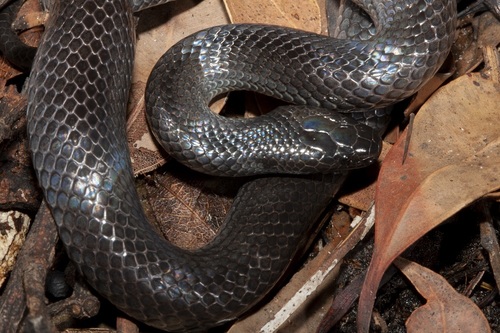
Hemiaspis signata (common names: black-bellied swamp snake and marsh snake) is a species of venomous elapid snake endemic to Australia, where it is found along the east coast. Recognisable by two distinctive narrow white lines on the face, the colour can range from pale olive to black top with a dark grey to black belly. Adults can grow to 70 cm in length, but most specimens are smaller than this. Their diet consists mainly of skinks and frogs.

It was first described in 1859 by Giorgio Jan as Alecto signata. Boulenger GA. 1896. Catalogue of the Snakes in the British Museum (Natural History). Volume III., Containing the Colubridæ (Opisthoglyphæ and Proteroglyphæ)... London: Trustees of the British Museum (Natural History). (Taylor and Francis, printers). xiv + 727 pp. + Plates I-XXV. (Denisonia signata, pp. 338–339).

Jan G, Sordelli F. 1873. Iconographie générale des Ophidiens, Quarante-troisième livraison. Paris: Baillière. Index + Plates I-VI. (Alecto signata, Plate VI, figure 5). (in French). Wikipedia →

Global Distribution

Parks Where Found

# Park Country Daily sighting probability
1 Lamington National Park 🇦🇺 Australia
~30%
2 Springbrook National Park 🇦🇺 Australia
~10%
3 Royal National Park 🇦🇺 Australia
~10%
4 Daintree National Park 🇦🇺 Australia
~10%

Cities Where Found

# City Country Daily sighting probability
1 Sydney 🇦🇺 Australia
<5%
2 Brisbane 🇦🇺 Australia
<5%

Closest Relatives at Lamington National Park

Before you go

What are the chances of seeing a Black-bellied Swamp Snake in Lamington National Park?

Possible

About 30% of wildlife watchers report a Black-bellied Swamp Snake sighting in Lamington National Park on a given day, based on 42 verified sightings from GBIF citizen-science data from 2019 to 2026. It is the 10th most-seen of the 38 reptiles we can rate there. Over three days the chance rises to about 60%, and over a week to about 90%, if each day is a fresh chance.

When is the best time to see a Black-bellied Swamp Snake in Lamington National Park?

February

In that month about 50% of wildlife watchers report a Black-bellied Swamp Snake in Lamington National Park on a given day, against under 5% in June to August, the lowest months. That is one of Lamington National Park's wettest months, with about 160 mm of rain against 40 mm in August.

What time of day is best to see a Black-bellied Swamp Snake?

Between 11 am and 2 pm

Across all the parks we cover, that three-hour window holds the most Black-bellied Swamp Snake sightings with a recorded time, and about 7 in 10 of them come between 6 am and 6 pm: it is a daytime animal.

Is Lamington National Park the best place to see a Black-bellied Swamp Snake?

Yes

Of the 4 parks where we can rate Black-bellied Swamp Snake sightings, Lamington National Park has the highest daily chance: about 30%. Next come Springbrook National Park (Australia, about 10%) and Royal National Park (Australia, about 10%).

Which relatives of the Black-bellied Swamp Snake live in Lamington National Park?

Same family: Elapidae

The closest relatives of the Black-bellied Swamp Snake that you can see in Lamington National Park (family Elapidae, Elapid Snakes) are Red-bellied Black Snake (about 50%), Small-eyed Snake (about 20%) and Eastern Tiger Snake (about 20%), with each one's daily chance of a sighting.

Where does the Black-bellied Swamp Snake sighting chance come from?

GBIF citizen-science records

It is estimated from how often the Black-bellied Swamp Snake is recorded against all the reptiles logged in Lamington National Park (42 verified sightings from 2019 to 2026), calibrated against known sighting rates. Figures are rounded to the nearest 10% because citizen-science data supports honest approximations, not decimals, and months with records from fewer than five people show "—". How it works.

← Back to Lamington National Park