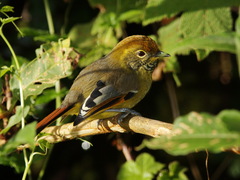
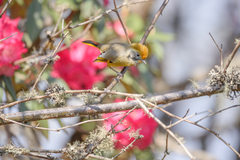
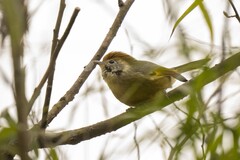
Chestnut-tailed Minla

Chestnut-tailed Minla

Minla strigula

Silhouette: Jiekun He · PhyloPic

Daily sighting probability ~20% · Possible
at Langtang National Park

In 3 days ~60% in a week ~90%

106 Verified sightings at Langtang National Park From 2019 to 2026
1,768 In all 3 parks
July Best month
🌅 Crepuscular When it's spotted

About the Chestnut-tailed Minla

The bar-throated minla or chestnut-tailed minla (Actinodura strigula), or even bar-throated siva, is a species of bird in the laughingthrush and babbler family Leiothrichidae. Traditionally, it has been placed in the genus Minla but is now placed in Actinodura.

The species is found in montane forest from India to Malaysia. Eight subspecies have been described, of which six are widely accepted. The bar-throated minla occupies a range of montane forest habitats from 1,800–3,750 m (5,910–12,300 ft). The species is mainly resident but may move to lower altitudes during harsh winters, coming as low as 1,300 m (4,300 ft). Among the forest types it may occur in are evergreen broadleaf forest, mixed broadleaf and evergreen forest, pine forest, pine or oak and rhododendron forest, rhododendron or bamboo stands.

The diet of the bar-throated minla varies by season; during the summer months it is almost exclusively insectivorous, taking beetles, caterpillars and other insects. In the winter months it will also take berries, seeds, and nectar. It will join flocks of other babblers and yuhinas in the non-breeding season, and feeds from the canopy down to near the forest floor. Two to four eggs are laid in a cup of grass, bamboo leaves, lichen and birch bark. Wikipedia →

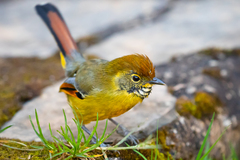
Sounds

Recording0:21

Nepal · 2025

© Natalya Andreyenkova · iNaturalist · CC BY-NC 4.0

Global Distribution

Parks Where Found

# Park Country Daily sighting probability
1 Doi Inthanon National Park 🇹🇭 Thailand
~50%
2 Langtang National Park 🇳🇵 Nepal
~20%
3 Royal Manas National Park 🇧🇹 Bhutan
<5%

Before you go

What are the chances of seeing a Chestnut-tailed Minla in Langtang National Park?

Possible

About 20% of wildlife watchers report a Chestnut-tailed Minla sighting in Langtang National Park on a given day, based on 106 verified sightings from GBIF citizen-science data from 2019 to 2026. It is the 36th most-seen of the 225 birds we can rate there. Over three days the chance rises to about 60%, and over a week to about 90%, if each day is a fresh chance.

When is the best time to see a Chestnut-tailed Minla in Langtang National Park?

July

In that month about 50% of wildlife watchers report a Chestnut-tailed Minla in Langtang National Park on a given day, against about 10% in June, October and December, the lowest months. That is one of Langtang National Park's wettest months, with about 390 mm of rain against 10 mm in November.

What time of day is best to see a Chestnut-tailed Minla?

Between 4 and 7 am

Across all the parks we cover, that three-hour window holds the most Chestnut-tailed Minla sightings with a recorded time, and about half of them come between 6 am and 6 pm: it is most active around dawn and dusk.

Is Langtang National Park the best place to see a Chestnut-tailed Minla?

2nd of 3

Of the 3 parks where we can rate Chestnut-tailed Minla sightings, Langtang National Park ranks 2nd at about 20%. The best odds are in Doi Inthanon National Park (Thailand, about 50%).

Which relatives of the Chestnut-tailed Minla live in Langtang National Park?

Same family: Leiothrichidae

The closest relatives of the Chestnut-tailed Minla that you can see in Langtang National Park (family Leiothrichidae, Laughingthrushes and Allies) are Streaked Laughingthrush (about 60%), Rufous Sibia (about 50%) and Variegated Laughingthrush (about 40%), with each one's daily chance of a sighting.

Where does the Chestnut-tailed Minla sighting chance come from?

GBIF citizen-science records

It is estimated from how often the Chestnut-tailed Minla is recorded against all the birds logged in Langtang National Park (106 verified sightings from 2019 to 2026), calibrated against known sighting rates. Figures are rounded to the nearest 10% because citizen-science data supports honest approximations, not decimals, and months with records from fewer than five people show "—". How it works.

← Back to Langtang National Park