Fire-tailed Myzornis

Fire-tailed Myzornis

Myzornis pyrrhoura

Silhouette: Sheatherius · PhyloPic

LCLeast ConcernNTVUENCR
Daily sighting probability <5% · Rare
at Langtang National Park

In 3 days ~10%

7 Verified sightings at Langtang National Park From 2019 to 2026
7 In 1 park
January Best month
☀️ Diurnal When it's spotted

About the Fire-tailed Myzornis

The fire-tailed myzornis (Myzornis pyrrhoura) is a species of bird. Its genus Myzornis is monotypic, and has recently been transferred to the family Paradoxornithidae, having formerly been treated in the family Timaliidae.

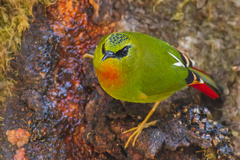
The fire-tailed myzornis is a small species of warbler-like bird, 11–13 cm (4.3–5.1 in) long and weighing 10–13 g (0.35–0.46 oz). It has bright green plumage with a black mask around the eyes and black scalloping on the crown. The wing is black and white with a streak of bright red and the sides of the tail are bright red. The bill is long, slightly curved and black. It is usually silent, but has a high-pitched tsi-tsit call.

The species is found in the Himalaya in Bhutan, southwestern China (southeast Xizang, western Yunnan), northeastern India (Arunachal Pradesh, Sikkim, northernmost West Bengal), northern Myanmar, and Nepal. Its natural habitat is temperate to alpine moist montane forests. It is a common species in the upper ridges of the Sikkim and Arunachal Himalayas, between 1,600–4,300 metres according to climatic conditions and seasonal variation. It prefers bamboo thickets, rhododendrons, birches, and junipers... Wikipedia →

Sounds

Song0:27

China · 2025

© JJSUN · XC1068797 · CC BY-NC-SA 4.0

Call0:18

India · 2024

© Lars Lachmann · XC891150 · CC BY-NC-SA 4.0

Recording0:22

Bhutan · 2021

© Chubzang, bhutanbirdingtours.com · XC651706 · CC BY-NC-SA 4.0

Global Distribution

Parks Where Found

# Park Country Daily sighting probability
1 Langtang National Park 🇳🇵 Nepal
<5%

More parks will be added in future updates.

Before you go

What are the chances of seeing a Fire-tailed Myzornis in Langtang National Park?

Rare

Under 5% of wildlife watchers report a Fire-tailed Myzornis sighting in Langtang National Park on a given day, based on 7 verified sightings from GBIF citizen-science data from 2019 to 2026. It is the 196th most-seen of the 225 birds we can rate there. Over three days the chance rises to about 10%, if each day is a fresh chance.

When is the best time to see a Fire-tailed Myzornis in Langtang National Park?

January and November

In those months about 10% of wildlife watchers report a Fire-tailed Myzornis in Langtang National Park on a given day, against under 5% in February–October and December, the lowest months. Those are among Langtang National Park's driest months, with about 30 mm of rain a month against 390 mm in July.

What time of day is best to see a Fire-tailed Myzornis?

Between 7 and 10 am

Across all the parks we cover, that three-hour window holds the most Fire-tailed Myzornis sightings with a recorded time, and about 8 in 10 of them come between 6 am and 6 pm: it is a daytime animal.

Where else can you see a Fire-tailed Myzornis?

Only Langtang National Park, in our data

Langtang National Park is the only park on Wallace's Line with enough records to rate Fire-tailed Myzornis sightings: under 5% of wildlife watchers there report one on a given day.

Where does the Fire-tailed Myzornis sighting chance come from?

GBIF citizen-science records

It is estimated from how often the Fire-tailed Myzornis is recorded against all the birds logged in Langtang National Park (7 verified sightings from 2019 to 2026), calibrated against known sighting rates. Figures are rounded to the nearest 10% because citizen-science data supports honest approximations, not decimals, and months with records from fewer than five people show "—". How it works.

← Back to Langtang National Park

