Immaculate Wren-Babbler

Immaculate Wren-Babbler

Pnoepyga immaculata

Silhouette: Sheatherius · PhyloPic

LCLeast ConcernNTVUENCR
Daily sighting probability ~10% · With luck
at Langtang National Park

In 3 days ~20% in a week ~40%

22 Verified sightings at Langtang National Park From 2019 to 2026
73 In all 2 parks
June Best month
☀️🌙 Day & Night When it's spotted

About the Immaculate Wren-Babbler

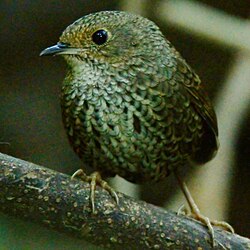
The Nepal cupwing (Pnoepyga immaculata), also known as the Nepal wren-babbler or immaculate cupwing, is a small species of passerine bird in the family Pnoepygidae. It is native to Uttarakhand, Himachal Pradesh, Tibet, and Nepal. It is found in dense montane forest in the Himalayas.

The Nepal cupwing is in the genus Pnyoepyga. Its closest relatives are the scaly-breasted cupwing, Taiwan cupwing, and pygmy cupwing. It was first described by Jochen Martens and Siegfried Eck in 1991, having been identified as a separate species based on differences in voice. Genetic phylogeny suggests that it forms a clade with the pygmy cupwing. No subspecies have been described. It was formerly classified, with the other cuplings, as an Old World babbler in the family Timaliidae until 2009, when the monotypic family Pneopygidae was created for the cupwings, reflecting recent developments in molecular phylogeny.

The name "Nepal cupwing" is used by the International Ornithologist's Union and by the Handbook of the Birds of the World, while "immaculate cupwing" is used in American English and in Indian English, including The Clements Checklist of Birds of the World. The name... Wikipedia →

Sounds

Call0:12

India · 2018

© Kavi Nanda · XC402676 · CC BY-NC-SA 4.0

Song0:44

India · 2017

© Suniti Bhushan Datta · XC390761 · CC BY-NC-SA 4.0

Call0:28

India · 2016

© Prashant Kumar · XC348591 · CC BY-NC-SA 4.0

Global Distribution

Parks Where Found

# Park Country Daily sighting probability
1 Langtang National Park 🇳🇵 Nepal
~10%
2 Jim Corbett National Park 🇮🇳 India
<5%

Cities Where Found

# City Country Daily sighting probability
1 Dehradun 🇮🇳 India
<5%

Before you go

What are the chances of seeing an Immaculate Wren-Babbler in Langtang National Park?

With luck

About 10% of wildlife watchers report an Immaculate Wren-Babbler sighting in Langtang National Park on a given day, based on 22 verified sightings from GBIF citizen-science data from 2019 to 2026. It is the 127th most-seen of the 225 birds we can rate there. Over three days the chance rises to about 20%, and over a week to about 40%, if each day is a fresh chance.

When is the best time to see an Immaculate Wren-Babbler in Langtang National Park?

June

In that month about 20% of wildlife watchers report an Immaculate Wren-Babbler in Langtang National Park on a given day, against under 5% in May and August–February, the lowest months. That is one of Langtang National Park's wettest months, with about 220 mm of rain against 10 mm in November.

What time of day is best to see an Immaculate Wren-Babbler?

Between 8 and 11 am

Across all the parks we cover, that three-hour window holds the most Immaculate Wren-Babbler sightings with a recorded time, and about 6 in 10 of them come between 6 am and 6 pm: it is seen both by day and at night.

Is Langtang National Park the best place to see an Immaculate Wren-Babbler?

Yes

Of the 2 parks where we can rate Immaculate Wren-Babbler sightings, Langtang National Park has the highest daily chance: about 10%. Next come Jim Corbett National Park (India, under 5%).

Where does the Immaculate Wren-Babbler sighting chance come from?

GBIF citizen-science records

It is estimated from how often the Immaculate Wren-Babbler is recorded against all the birds logged in Langtang National Park (22 verified sightings from 2019 to 2026), calibrated against known sighting rates. Figures are rounded to the nearest 10% because citizen-science data supports honest approximations, not decimals, and months with records from fewer than five people show "—". How it works.

← Back to Langtang National Park

