Rusty-cheeked Scimitar-Babbler

Rusty-cheeked Scimitar-Babbler

Pomatorhinus erythrogenys

Silhouette: Jiekun He · PhyloPic

Daily sighting probability ~10% · With luck
at Langtang National Park

In 3 days ~20% in a week ~40%

26 Verified sightings at Langtang National Park From 2019 to 2026
545 In all 3 parks
June Best month
☀️ Diurnal When it's spotted

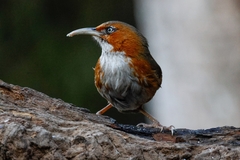
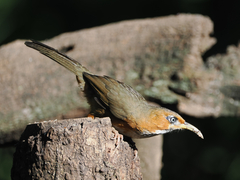
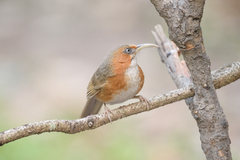
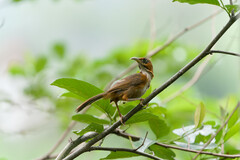
About the Rusty-cheeked Scimitar-Babbler

The rusty-cheeked scimitar babbler (Erythrogenys erythrogenys) is a passerine bird in the babbler family Timaliidae that is found in the Himalayas from northeast Pakistan to Bhutan. It was formerly considered as conspecific with the red-eyed scimitar babbler that is found in eastern Myanmar and northwestern Thailand.

The rusty-cheeked scimitar babbler was formally described in 1831 by the Irish zoologist Nicholas Vigors under the binomial name Pamatorhynus erythrogenys in John Gould's book "Century of Birds from the Himalaya Mountains". The description was accompanied by a hand coloured illustration drawn by Elizabeth Gould. In 1924 the type locality was restricted to "Shimla–Almora". The specific epithet combines the Ancient Greek ερυθρος/eruthros meaning "red" with γενυος/genuos meaning "cheek". The rusty-cheeked scimitar babbler is now one of seven scimitar babblers placed in the genus Erythrogenys. The species was formerly regarded as conspecific with the red-eyed scimitar babbler (Erythrogenys imberbis) that is found in eastern Myanmar and northwestern Thailand. The red-eyed scimitar babbler is now considered as a separate species based on the differences in morphology... Wikipedia →

Sounds

Recording0:12

India · 2023

© dbeadle · iNaturalist · CC BY-NC 4.0

Recording0:10

India · 2026

© Kapish Garg · iNaturalist · CC BY-NC 4.0

Recording0:08

India · 2026

© GURSEWAK SINGH · iNaturalist · CC BY-NC 4.0

Global Distribution

Parks Where Found

# Park Country Daily sighting probability
1 Jim Corbett National Park 🇮🇳 India
~20%
2 Royal Manas National Park 🇧🇹 Bhutan
~10%
3 Langtang National Park 🇳🇵 Nepal
~10%

Cities Where Found

# City Country Daily sighting probability
1 Kathmandu 🇳🇵 Nepal
~20%
2 Dehradun 🇮🇳 India
~20%
3 Islamabad 🇵🇰 Pakistan
<5%

Before you go

What are the chances of seeing a Rusty-cheeked Scimitar-Babbler in Langtang National Park?

With luck

About 10% of wildlife watchers report a Rusty-cheeked Scimitar-Babbler sighting in Langtang National Park on a given day, based on 26 verified sightings from GBIF citizen-science data from 2019 to 2026. It is the 120th most-seen of the 225 birds we can rate there. Over three days the chance rises to about 20%, and over a week to about 40%, if each day is a fresh chance.

When is the best time to see a Rusty-cheeked Scimitar-Babbler in Langtang National Park?

June

In that month about 20% of wildlife watchers report a Rusty-cheeked Scimitar-Babbler in Langtang National Park on a given day, against under 5% in February, May, October and December, the lowest months. That is one of Langtang National Park's wettest months, with about 220 mm of rain against 10 mm in November.

What time of day is best to see a Rusty-cheeked Scimitar-Babbler?

Between 6 and 9 am

Across all the parks we cover, that three-hour window holds the most Rusty-cheeked Scimitar-Babbler sightings with a recorded time, and about 8 in 10 of them come between 6 am and 6 pm: it is a daytime animal.

Is Langtang National Park the best place to see a Rusty-cheeked Scimitar-Babbler?

3rd of 3

Of the 3 parks where we can rate Rusty-cheeked Scimitar-Babbler sightings, Langtang National Park ranks 3rd at about 10%. The best odds are in Jim Corbett National Park (India, about 20%) and Royal Manas National Park (Bhutan, about 10%).

Where does the Rusty-cheeked Scimitar-Babbler sighting chance come from?

GBIF citizen-science records

It is estimated from how often the Rusty-cheeked Scimitar-Babbler is recorded against all the birds logged in Langtang National Park (26 verified sightings from 2019 to 2026), calibrated against known sighting rates. Figures are rounded to the nearest 10% because citizen-science data supports honest approximations, not decimals, and months with records from fewer than five people show "—". How it works.

← Back to Langtang National Park