
Black-winged Ground-Dove

Black-winged Ground-Dove

Metriopelia melanoptera

Silhouette: Sheatherius · PhyloPic

LCLeast ConcernNTVUENCR
Daily sighting probability ~30% · Possible
at Lauca National Park

In 3 days ~60% in a week ~90%

237 Verified sightings at Lauca National Park From 2019 to 2026
237 In 1 park
August Best month
☀️ Diurnal When it's spotted

About the Black-winged Ground-Dove

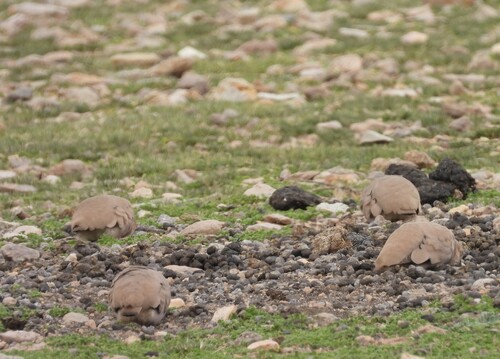
The black-winged ground dove (Metriopelia melanoptera) is a species of bird in the family Columbidae. It lives in Argentina, Bolivia, Chile, Colombia, Ecuador, and Peru and is usually found in grassy areas near tree lines but roosts in Polylepis forest and Puya colonies. Throughout most of its range, it occurs at altitudes between 2,000 and 4,400 m (6,600 and 14,400 ft) but between 900 and 4,900 m (3,000 and 16,100 ft) in Chile. It moves to lower elevations in winter.

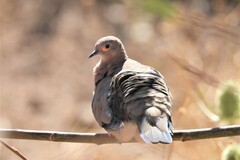
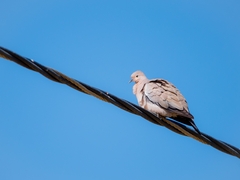
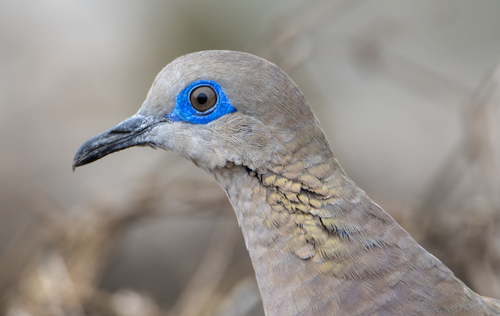
The black-winged ground dove is 21 to 23 cm (8.3 to 9.1 in) long. Males weigh 89.1 to 114 g (3.14 to 4.02 oz) and females 86 to 96.1 g (3.03 to 3.39 oz). The nominate adult male is grayish brown or earth brown above with a faint pink tinge. The throat is whitish and the underparts fawn pink with gray flanks. The closed wing shows a white edge and some pale gray. The eye color is highly variable as is the bare skin that surrounds it. The adult female's upperparts are a duller brown than the male's and the underparts less pink. Juveniles do not have the adults' pink tinge... Wikipedia →

Sounds

Song1:13

Chile · 2020

© Cristian Pinto · XC596950 · CC BY-NC-SA 4.0

Wing whir0:17

Ecuador · 2000

© John V. Moore · XC257619 · CC BY-NC-SA 4.0

Wing whirr0:07

Peru · 2009

© Andrew Spencer · XC45903 · CC BY-NC-ND 2.5

Global Distribution

Parks Where Found

# Park Country Daily sighting probability
1 Lauca National Park 🇨🇱 Chile
~30%

More parks will be added in future updates.

Cities Where Found

# City Country Daily sighting probability
1 Arequipa 🇵🇪 Peru
<5%
2 Santiago 🇨🇱 Chile
<5%

Before you go

What are the chances of seeing a Black-winged Ground-Dove in Lauca National Park?

Possible

About 30% of wildlife watchers report a Black-winged Ground-Dove sighting in Lauca National Park on a given day, based on 237 verified sightings from GBIF citizen-science data from 2019 to 2026. It is the 51st most-seen of the 112 birds we can rate there. Over three days the chance rises to about 60%, and over a week to about 90%, if each day is a fresh chance.

When is the best time to see a Black-winged Ground-Dove in Lauca National Park?

August

In that month about 60% of wildlife watchers report a Black-winged Ground-Dove in Lauca National Park on a given day, against under 5% in December, the lowest month. That is one of Lauca National Park's driest months, with almost no rain against 150 mm in January.

What time of day is best to see a Black-winged Ground-Dove?

Between 10 am and 1 pm

Across all the parks we cover, that three-hour window holds the most Black-winged Ground-Dove sightings with a recorded time, and about 9 in 10 of them come between 6 am and 6 pm: it is a daytime animal.

Where else can you see a Black-winged Ground-Dove?

Only Lauca National Park, in our data

Lauca National Park is the only park on Wallace's Line with enough records to rate Black-winged Ground-Dove sightings: about 30% of wildlife watchers there report one on a given day.

Which relatives of the Black-winged Ground-Dove live in Lauca National Park?

Same genus: Metriopelia

The closest relatives of the Black-winged Ground-Dove that you can see in Lauca National Park (genus Metriopelia, Andean Ground Doves) are Bare-faced Ground-Dove (about 40%) and Golden-spotted Ground-Dove (about 10%), with each one's daily chance of a sighting.

Where does the Black-winged Ground-Dove sighting chance come from?

GBIF citizen-science records

It is estimated from how often the Black-winged Ground-Dove is recorded against all the birds logged in Lauca National Park (237 verified sightings from 2019 to 2026), calibrated against known sighting rates. Figures are rounded to the nearest 10% because citizen-science data supports honest approximations, not decimals, and months with records from fewer than five people show "—". How it works.

← Back to Lauca National Park