
Golden-spotted Ground-Dove

Golden-spotted Ground-Dove

Metriopelia aymara

Silhouette: Sheatherius · PhyloPic

LCLeast ConcernNTVUENCR
Daily sighting probability ~10% · With luck
at Lauca National Park

In 3 days ~20% in a week ~50%

65 Verified sightings at Lauca National Park From 2019 to 2026
65 In 1 park
May Best month
☀️ Diurnal When it's spotted

About the Golden-spotted Ground-Dove

The golden-spotted ground dove (Metriopelia aymara) is a species of bird in the family Columbidae. It is found in Argentina, Bolivia, Chile, and Peru. The golden-spotted ground dove was placed in the monotypic genus Leptophaps by some authors. It has no subspecies.

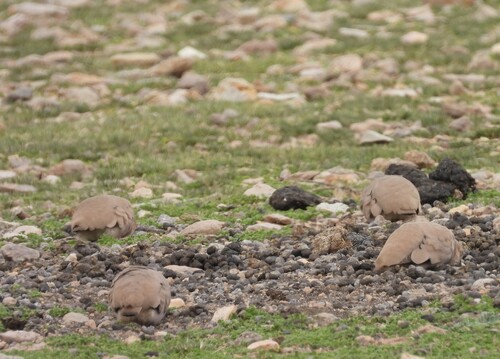
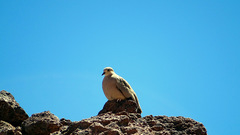
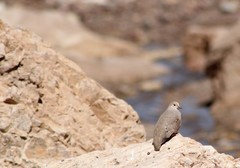
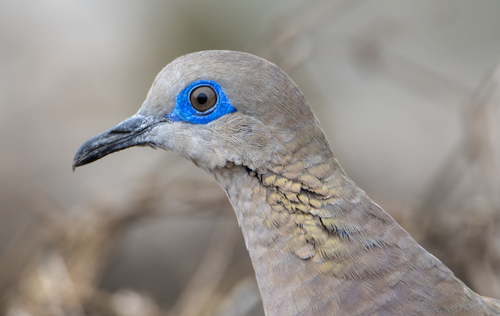
The adult golden-spotted ground dove's upperparts are pale fawn brown with a reddish pink tinge. Its throat is white, its belly buff, and the underparts between them reddish pink. The inner tail feathers are grayish brown with black tips and the outer ones purplish black. The closed wing shows a row of the eponymous iridescent golden spots, two purplish black patches, and a purplish black swath at the tips of the flight feathers. The eye is brown, and uniquely in its genus, is not surrounded by bare skin. Juveniles are paler than the adults, have little or no pink, and do not have the golden spots on the wing.

The golden-spotted ground dove is found from Ancash in central Peru east to west-central Bolivia and south to Chile's Coquimbo Region and Argentina's Mendoza Province. It inhabits the arid and semi-arid parts of the puna zone of the Andes... Wikipedia →

Sounds

Flight call0:05

Chile · 2019

© Cristian Pinto · XC498319 · CC BY-NC-SA 4.0

Song0:30

Bolivia · 2005

© Joseph Tobias and Nathalie Seddon · XC73825 · CC BY-NC-SA 3.0

Wing whirs0:14

Argentina · 2006

© Nick Athanas · XC13000 · CC BY-NC-SA 3.0

Global Distribution

Parks Where Found

# Park Country Daily sighting probability
1 Lauca National Park 🇨🇱 Chile
~10%

More parks will be added in future updates.

Before you go

What are the chances of seeing a Golden-spotted Ground-Dove in Lauca National Park?

With luck

About 10% of wildlife watchers report a Golden-spotted Ground-Dove sighting in Lauca National Park on a given day, based on 65 verified sightings from GBIF citizen-science data from 2019 to 2026. It is the 78th most-seen of the 112 birds we can rate there. Over three days the chance rises to about 20%, and over a week to about 50%, if each day is a fresh chance.

When is the best time to see a Golden-spotted Ground-Dove in Lauca National Park?

May

In that month about 30% of wildlife watchers report a Golden-spotted Ground-Dove in Lauca National Park on a given day, against under 5% in January and November, the lowest months. That is one of Lauca National Park's driest months, with almost no rain against 150 mm in January.

What time of day is best to see a Golden-spotted Ground-Dove?

Between 11 am and 2 pm

Across all the parks we cover, that three-hour window holds the most Golden-spotted Ground-Dove sightings with a recorded time, and about 9 in 10 of them come between 6 am and 6 pm: it is a daytime animal.

Where else can you see a Golden-spotted Ground-Dove?

Only Lauca National Park, in our data

Lauca National Park is the only park on Wallace's Line with enough records to rate Golden-spotted Ground-Dove sightings: about 10% of wildlife watchers there report one on a given day.

Which relatives of the Golden-spotted Ground-Dove live in Lauca National Park?

Same genus: Metriopelia

The closest relatives of the Golden-spotted Ground-Dove that you can see in Lauca National Park (genus Metriopelia, Andean Ground Doves) are Bare-faced Ground-Dove (about 40%) and Black-winged Ground-Dove (about 30%), with each one's daily chance of a sighting.

Where does the Golden-spotted Ground-Dove sighting chance come from?

GBIF citizen-science records

It is estimated from how often the Golden-spotted Ground-Dove is recorded against all the birds logged in Lauca National Park (65 verified sightings from 2019 to 2026), calibrated against known sighting rates. Figures are rounded to the nearest 10% because citizen-science data supports honest approximations, not decimals, and months with records from fewer than five people show "—". How it works.

← Back to Lauca National Park