North Andean Huemul

North Andean Huemul

Hippocamelus antisensis

Silhouette: Steven Traver · PhyloPic

LCNTVUVulnerableENCR
Daily sighting probability ~60% · Likely
at Lauca National Park

In 3 days ~90% in a week >90%

43 Verified sightings at Lauca National Park From 2019 to 2026
43 In 1 park
April Best month
☀️🌙 Day & Night When it's spotted

About the North Andean Huemul

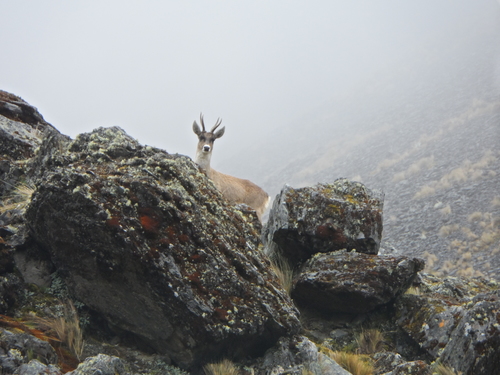
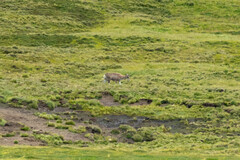
The taruca (Hippocamelus antisensis), also known as the taruka, Peruvian guemal, north Andean deer, north Andean huemul, northern huemul or northern guemal, is a mid sized deer species that inhabits the high regions of the Andes mountains in South America. The common name taruca means "deer" in both the Quechua and Aymara languages. The taruca is closely related to the southern guemal (H. bisulcus), the only other member of the Hippocamelus genus.

The taruca is a medium-sized deer with a heavy body. It measures 128 to 146 cm (50 to 57 in) from head to rump, with an 11 to 13 cm (4.3 to 5.1 in) tail, and stands 69 to 80 cm (27 to 31 in) tall at the shoulder. Adults weigh between 69 and 80 kg (152 and 176 lb). As with most deer, males are significantly larger than females.

It has sandy brown fur over most of its body, with white patches on the underside of its head, neck, tail, and genital region, and on the inner surface of its fore-legs. While females often have a dark brown area on the forehead, facial markings are much clearer in the males. The exact patterns vary between different males, but in general there is a black mask behind the nose, and a black Y or V pattern... Wikipedia →
Global Distribution

Parks Where Found

# Park Country Daily sighting probability
1 Lauca National Park 🇨🇱 Chile
~60%

More parks will be added in future updates.

Zoos & Centres Where Found

# Zoo / Centre Country
1 Bioparque Municipal Vesty Pakos 🇧🇴 Bolivia In captivity
2 Parque de las Leyendas 🇵🇪 Peru In captivity
3 Zoologico Mundo Andino - Tipon 🇵🇪 Peru In captivity
4 Agroflori Parque de las Aves 🇧🇴 Bolivia In captivity
5 Great National Aquarium 🇵🇪 Peru In captivity

Before you go

What are the chances of seeing a North Andean Huemul in Lauca National Park?

Likely

About 60% of wildlife watchers report a North Andean Huemul sighting in Lauca National Park on a given day, based on 43 verified sightings from GBIF citizen-science data from 2019 to 2026. It is the 4th most-seen of the 5 mammals we can rate there. Over three days the chance rises to about 90%, and over a week to over 90%, if each day is a fresh chance.

When is the best time to see a North Andean Huemul in Lauca National Park?

April and July

In those months about 80% of wildlife watchers report a North Andean Huemul in Lauca National Park on a given day, against about 10% in February, the lowest month. Those are among Lauca National Park's driest months, with about 20 mm of rain a month against 150 mm in January. August has too few records to rate.

What time of day is best to see a North Andean Huemul?

Between 8 and 11 am

Across all the parks we cover, that three-hour window holds the most North Andean Huemul sightings with a recorded time, and about 7 in 10 of them come between 6 am and 6 pm: it is seen both by day and at night.

Where else can you see a North Andean Huemul?

Only Lauca National Park, in our data

Lauca National Park is the only park on Wallace's Line with enough records to rate North Andean Huemul sightings: about 60% of wildlife watchers there report one on a given day.

Where does the North Andean Huemul sighting chance come from?

GBIF citizen-science records

It is estimated from how often the North Andean Huemul is recorded against all the mammals logged in Lauca National Park (43 verified sightings from 2019 to 2026), calibrated against known sighting rates. Figures are rounded to the nearest 10% because citizen-science data supports honest approximations, not decimals, and months with records from fewer than five people show "—". How it works.

← Back to Lauca National Park