


Completed


Northern Mountain Viscacha
Lagidium viscacia
Silhouette: Josue Hermoza (original photograph) · PhyloPic
- KingdomAnimalia (Animals)
- PhylumChordata (Chordates)
- ClassMammalia (Mammals)
- OrderRodentia (Rodents)
- FamilyChinchillidae (Chinchillas and Viscachas)
- GenusLagidium (Mountain Viscachas)
- SpeciesLagidium viscacia (Northern Mountain Viscacha)
In 3 days >90%
94 Verified sightings at Lauca National Park From 2019 to 2026
94 In 1 park
September Best month
☀️ Diurnal When it's spotted
About the Northern Mountain Viscacha
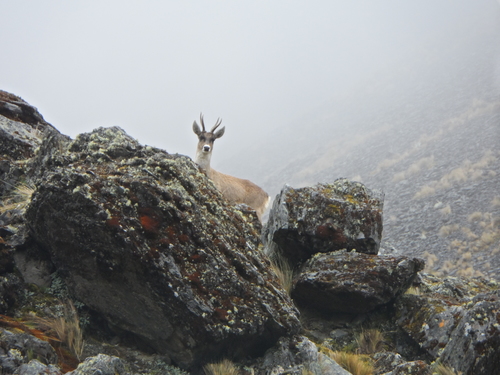
The southern viscacha (Lagidium viscacia) is a species of viscacha, a rodent in the family Chinchillidae found in Argentina, Bolivia, Chile, and Peru. It is a colonial animal living in small groups in rocky mountain areas. It has long ears and hind legs and resembles a rabbit in appearance apart from its long, bushy tail; however, it is not a lagomorph.
The southern viscacha has yellowish-grey upperparts, paler underparts, and a black-tipped, bushy tail. The body fur is long and soft, while that on the tail is coarse. The long, fur-covered ears have a white fringe and both the short front legs and longer hind legs have four digits on the feet. The soles of the feet have fleshy pads called "pallipes", and they can move about with agility over rocky surfaces. The weight of an adult southern viscacha is about 3 kg (6.6 lb). They are also adept climbers, exhibiting proficiency in ascending vertical rock surfaces. Their leaps frequently span distances of five meters or greater, with downward descents covering distances of over fifteen meters. These jumps are often executed from small ledges on which they can barely stand to comparatively narrow outcroppings of rock.
�... Wikipedia →
Recent sightings of Northern Mountain Viscacha in Lauca National Park
LIVEiNaturalistGlobal Distribution
Parks Where Found
| # | Park | Country | Daily sighting probability |
|---|---|---|---|
| 1 | Lauca National Park | 🇨🇱 Chile |
More parks will be added in future updates.
Cities Where Found
| # | City | Country | Daily sighting probability |
|---|---|---|---|
| 1 | La Paz | 🇧🇴 Bolivia |
Zoos & Centres Where Found
| # | Zoo / Centre | Country | |
|---|---|---|---|
| 1 | Bioparque Municipal Vesty Pakos | 🇧🇴 Bolivia | |
| 2 | Parque de las Leyendas | 🇵🇪 Peru |
Closest Relatives at Lauca National Park





Before you go
What are the chances of seeing a Northern Mountain Viscacha in Lauca National Park?
Very likely
About 90% of wildlife watchers report a Northern Mountain Viscacha sighting in Lauca National Park on a given day, based on 94 verified sightings from GBIF citizen-science data from 2019 to 2026. It is the most-seen of the 5 mammals we can rate there. Over three days the chance rises to over 90%, if each day is a fresh chance.
When is the best time to see a Northern Mountain Viscacha in Lauca National Park?
February, May–July, September–October and December
In those months about 90% of wildlife watchers report a Northern Mountain Viscacha in Lauca National Park on a given day, against about 80% in January, March–April and November, the lowest months. August has too few records to rate.
What time of day is best to see a Northern Mountain Viscacha?
Between 2 and 5 pm
Across all the parks we cover, that three-hour window holds the most Northern Mountain Viscacha sightings with a recorded time, and about 8 in 10 of them come between 6 am and 6 pm: it is a daytime animal.
Where else can you see a Northern Mountain Viscacha?
Only Lauca National Park, in our data
Lauca National Park is the only park on Wallace's Line with enough records to rate Northern Mountain Viscacha sightings: about 90% of wildlife watchers there report one on a given day.
Where does the Northern Mountain Viscacha sighting chance come from?
GBIF citizen-science records
It is estimated from how often the Northern Mountain Viscacha is recorded against all the mammals logged in Lauca National Park (94 verified sightings from 2019 to 2026), calibrated against known sighting rates. Figures are rounded to the nearest 10% because citizen-science data supports honest approximations, not decimals, and months with records from fewer than five people show "—". How it works.
