Copland's Rock Frog

Copland's Rock Frog

Litoria coplandi

Silhouette: Robbi Bishop-Taylor · PhyloPic

LCLeast ConcernNTVUENCR Endemic
Daily sighting probability ~30% · Possible
at Litchfield National Park

In 3 days ~60% in a week ~90%

11 Verified sightings at Litchfield National Park From 2019 to 2026
22 In all 2 parks
February Best month
🌙 Nocturnal When it's spotted

About the Copland's Rock Frog

Copland's rock frog or the saxicoline tree frog (Litoria coplandi) is a species of frog in the subfamily Pelodryadinae. It is endemic to Australia, in a range extending from the Kimberley region of Western Australia to Arnhem Land and a record in the north of Queensland.

Its natural habitats are subtropical or tropical dry shrubland, subtropical or tropical dry lowland grassland, intermittent rivers, and rocky areas. The IUCN Red list gives the conservation status of least concern, and notes the population trend as stable.

The publication of the species, by Tyler in 1968, was based on his study of a type collection by Copland. The collection, 29 specimens at the Western Australian Museum, was reassigned as three syntypes; for this species, Litoria watjulumensis, and Litoria peronii. The holotype for L. coplandi was collected at Inverway Station in the Northern Territory. Wikipedia →
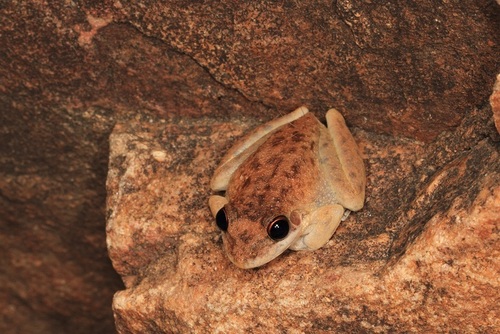
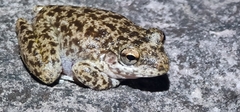
Global Distribution

Parks Where Found

# Park Country Daily sighting probability
1 Litchfield National Park 🇦🇺 Australia
~30%
2 Kakadu National Park 🇦🇺 Australia
~20%

Before you go

What are the chances of seeing a Copland's Rock Frog in Litchfield National Park?

Possible

About 30% of wildlife watchers report a Copland's Rock Frog sighting in Litchfield National Park on a given day, based on 11 verified sightings from GBIF citizen-science data from 2019 to 2026. It is the 4th most-seen of the 6 amphibians we can rate there. Over three days the chance rises to about 60%, and over a week to about 90%, if each day is a fresh chance.

When is the best time to see a Copland's Rock Frog in Litchfield National Park?

February–March, June, September and December

In those months about 40% of wildlife watchers report a Copland's Rock Frog in Litchfield National Park on a given day, against under 5% in January, July–August and October, the lowest months.

What time of day is best to see a Copland's Rock Frog?

Between 7 and 10 pm

Across all the parks we cover, that three-hour window holds the most Copland's Rock Frog sightings with a recorded time, and about 8 in 10 of them come between 6 pm and 6 am: it is mostly seen at night.

Is Litchfield National Park the best place to see a Copland's Rock Frog?

Yes

Of the 2 parks where we can rate Copland's Rock Frog sightings, Litchfield National Park has the highest daily chance: about 30%. Next come Kakadu National Park (Australia, about 20%).

Which relatives of the Copland's Rock Frog live in Litchfield National Park?

Same genus: Litoria

The closest relatives of the Copland's Rock Frog that you can see in Litchfield National Park (genus Litoria) are Rockhole Frog (about 40%), Watjulum Frog (about 30%) and Australian Rocket Frog (about 20%), with each one's daily chance of a sighting.

Where does the Copland's Rock Frog sighting chance come from?

GBIF citizen-science records

It is estimated from how often the Copland's Rock Frog is recorded against all the amphibians logged in Litchfield National Park (11 verified sightings from 2019 to 2026), calibrated against known sighting rates. Figures are rounded to the nearest 10% because citizen-science data supports honest approximations, not decimals, and months with records from fewer than five people show "—". How it works.

← Back to Litchfield National Park