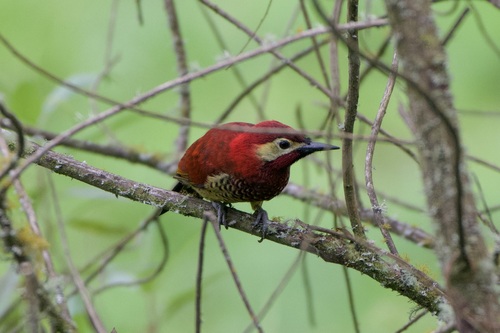
Gray-breasted Mountain-Toucan

Gray-breasted Mountain-Toucan

Andigena hypoglauca

Silhouette: Edwin Price · PhyloPic

LCLeast ConcernNTVUENCR
Daily sighting probability <5% · Rare
at Los Nevados National Natural Park

In 3 days ~10% in a week ~20%

153 Verified sightings at Los Nevados National Natural Park From 2019 to 2026
336 In all 2 parks
April Best month
☀️ Diurnal When it's spotted

About the Gray-breasted Mountain-Toucan

The grey-breasted mountain toucan (Andigena hypoglauca) is a least-concern species of bird in the toucan family, Ramphastidae. It is found in South American countries such as Colombia, Ecuador and Peru. The grey-breasted mountain toucan was originally described in the genus Pteroglossus. Two subspecies are recognized, the nominate:

The grey-breasted mountain toucan is 41 to 48 cm (16 to 19 in) long and weighs 244 to 370 g (8.6 to 13 oz). Males and females within each subspecies have the same plumage, and the two subspecies have the same bill pattern though the female's bill is shorter. The bill's base is yellow to greenish with a black band near the base. The maxilla's outer 2/3 is red, meeting the yellow diagonally. The mandible's outer half is black. Both subspecies have a black cap, face, and nape; a gray-blue band on the hindneck; a greenish brown back; and gray to gray-blue underparts. Their tail is blackish with chestnut tips on the two or three central pairs of feathers. The nominate subspecies has a bright yellow rump, pale gray-blue flanks, chestnut thighs, and red undertail coverts. Its eye is brown and surrounded by bare blue... Wikipedia →

Sounds

Call0:34

Peru · 2026

© Étienne Leroy · XC1185085 · CC BY-NC-SA 4.0

Song0:18

Colombia · 2024

© David Monroy Rengifo · XC935568 · CC BY-NC-SA 4.0

Bill rattle0:09

Peru · 2011

© Andrew Spencer · XC88107 · CC BY-NC-ND 2.5

Global Distribution

Parks Where Found

# Park Country Daily sighting probability
1 Podocarpus National Park 🇪🇨 Ecuador
~10%
2 Los Nevados National Natural Park 🇨🇴 Colombia
<5%

Before you go

What are the chances of seeing a Gray-breasted Mountain-Toucan in Los Nevados National Natural Park?

Rare

Under 5% of wildlife watchers report a Gray-breasted Mountain-Toucan sighting in Los Nevados National Natural Park on a given day, based on 153 verified sightings from GBIF citizen-science data from 2019 to 2026. It is the 209th most-seen of the 424 birds we can rate there. Over three days the chance rises to about 10%, and over a week to about 20%, if each day is a fresh chance.

When is the best time to see a Gray-breasted Mountain-Toucan in Los Nevados National Natural Park?

January and March–April

In those months about 10% of wildlife watchers report a Gray-breasted Mountain-Toucan in Los Nevados National Natural Park on a given day, against under 5% in February and May–December, the lowest months.

What time of day is best to see a Gray-breasted Mountain-Toucan?

Between 9 am and noon

Across all the parks we cover, that three-hour window holds the most Gray-breasted Mountain-Toucan sightings with a recorded time, and about 9 in 10 of them come between 6 am and 6 pm: it is a daytime animal.

Is Los Nevados National Natural Park the best place to see a Gray-breasted Mountain-Toucan?

2nd of 2

Of the 2 parks where we can rate Gray-breasted Mountain-Toucan sightings, Los Nevados National Natural Park ranks 2nd at under 5%. The best odds are in Podocarpus National Park (Ecuador, about 10%).

Where does the Gray-breasted Mountain-Toucan sighting chance come from?

GBIF citizen-science records

It is estimated from how often the Gray-breasted Mountain-Toucan is recorded against all the birds logged in Los Nevados National Natural Park (153 verified sightings from 2019 to 2026), calibrated against known sighting rates. Figures are rounded to the nearest 10% because citizen-science data supports honest approximations, not decimals, and months with records from fewer than five people show "—". How it works.

← Back to Los Nevados National Natural Park