Wattled Guan

Wattled Guan

Aburria aburri

Silhouette: Sheatherius · PhyloPic

LCLeast ConcernNTVUENCR
Daily sighting probability <5% · Rare
at Los Nevados National Natural Park

In 3 days ~10% in a week ~30%

277 Verified sightings at Los Nevados National Natural Park From 2019 to 2026
307 In all 3 parks
June Best month
☀️ Diurnal When it's spotted

About the Wattled Guan

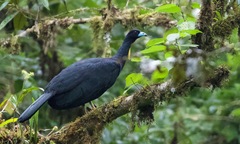
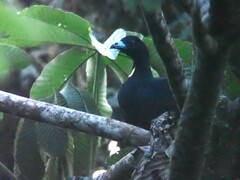
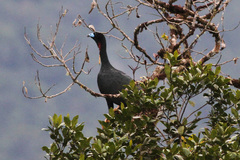
The wattled guan (Aburria aburri) is a species of bird in the family Cracidae. It is a fairly large black cracid with blue-based, black-tipped beak and a long, red-and-yellow wattle. It is found in Colombia, Ecuador, Peru, and Venezuela. Its natural habitats are subtropical or tropical moist lowland forest and subtropical or tropical moist montane forest. The wattled guan is a fairly shy species that is mostly seen when it perches on the outer edge of the canopy from a distance. Like many tropical forest birds, it is heard more often than seen. It is threatened by habitat destruction but the IUCN assessed its conservation status as being "Least Concern" in 2023, though it was previously classified as "Near Threatened" since 2000.

The wattled guan is recognisable by the elongated red and yellow fleshy wattle that dangles from its throat. It is a large bird with a long tail, about 75 centimetres (30 in) long and weighing between 1,200 and 1,550 grams (42 and 55 oz). The plumage is black, the beak is blue and the feet are flesh-coloured.

The wattled guan is endemic to the foothills of the Andes in South America. Its range extends from northwestern... Wikipedia →

Sounds

Dawn song0:18

Ecuador · 2011

© Manuel Sánchez-Nivicela · XC1163448 · CC BY-NC-ND 4.0

Song1:18

Colombia · 2025

© Alain Verneau · XC1141732 · CC BY-NC-SA 4.0

Call0:11

Ecuador · 2009

© Mitch Lysinger · XC260373 · CC BY-NC-SA 4.0

Global Distribution

Parks Where Found

# Park Country Daily sighting probability
1 Los Nevados National Natural Park 🇨🇴 Colombia
<5%
2 Sierra de la Macarena National Park 🇨🇴 Colombia
<5%
3 Manu National Park 🇵🇪 Peru
<5%

Zoos & Centres Where Found

# Zoo / Centre Country
1 Walsrode World Bird Park 🇩🇪 Germany In captivity

Before you go

What are the chances of seeing a Wattled Guan in Los Nevados National Natural Park?

Rare

Under 5% of wildlife watchers report a Wattled Guan sighting in Los Nevados National Natural Park on a given day, based on 277 verified sightings from GBIF citizen-science data from 2019 to 2026. It is the 163rd most-seen of the 424 birds we can rate there. Over three days the chance rises to about 10%, and over a week to about 30%, if each day is a fresh chance.

When is the best time to see a Wattled Guan in Los Nevados National Natural Park?

May–July and December–March

In those months about 10% of wildlife watchers report a Wattled Guan in Los Nevados National Natural Park on a given day, against under 5% in April and August–November, the lowest months.

What time of day is best to see a Wattled Guan?

Between 8 and 11 am

Across all the parks we cover, that three-hour window holds the most Wattled Guan sightings with a recorded time, and about 9 in 10 of them come between 6 am and 6 pm: it is a daytime animal.

Is Los Nevados National Natural Park the best place to see a Wattled Guan?

Yes

Of the 3 parks where we can rate Wattled Guan sightings, Los Nevados National Natural Park has the highest daily chance: under 5%. Next come Sierra de la Macarena National Park (Colombia, under 5%) and Manu National Park (Peru, under 5%).

Which relatives of the Wattled Guan live in Los Nevados National Natural Park?

Same family: Cracidae

The closest relatives of the Wattled Guan that you can see in Los Nevados National Natural Park (family Cracidae, Guans, Chachalacas, and Curassows) are Sickle-winged Guan (about 30%), Andean Guan (about 10%) and Cauca Guan (about 10%), with each one's daily chance of a sighting.

Where does the Wattled Guan sighting chance come from?

GBIF citizen-science records

It is estimated from how often the Wattled Guan is recorded against all the birds logged in Los Nevados National Natural Park (277 verified sightings from 2019 to 2026), calibrated against known sighting rates. Figures are rounded to the nearest 10% because citizen-science data supports honest approximations, not decimals, and months with records from fewer than five people show "—". How it works.

← Back to Los Nevados National Natural Park