Cacomistle

Cacomistle

Bassariscus sumichrasti

Silhouette: Gabriela Palomo-Munoz · PhyloPic

LCLeast ConcernNTVUENCR
Daily sighting probability ~10% · With luck
at Los Quetzales National Park

In 3 days ~30% in a week ~60%

10 Verified sightings at Los Quetzales National Park From 2019 to 2026
43 In all 4 parks
September Best month
🌙 Nocturnal When it's spotted

About the Cacomistle

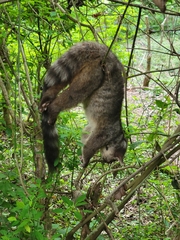
The cacomistle (Bassariscus sumichrasti), also spelled cacomixtle, is a primarily nocturnal, arboreal, omnivorous member of the carnivoran family Procyonidae (coatis, kinkajous and raccoons). Depending on the location, its preferred habitats are humid and tropical evergreen jungle and montane cloud forests; seasonally, it may venture into drier, deciduous forests.

Although its total population is listed as being of "least concern" (i.e., stable), the cacomistle is still a highly cryptic, secretive animal, and generally an uncommon sight throughout much of its range (from southern México to western Panamá); this fact is especially true in Costa Rica, where it inhabits only a very small area. Additionally, the species is completely dependent on trees and dense vegetation for habitat, making it particularly susceptible to deforestation.

The name cacomistle comes from the Nahuatl language (tlahcomiztli) and means "half-cat" or "half-puma"; the same name is also given, by some, to the North American Bassariscus astutus, more commonly known as the ringtail (or, semi-inaccurately, ringtail 'cat'). This "sister species" of the cacomistle inhabits a much more northerly and less tropical range, from arid Northern Mexico into the Southwestern United States. Wikipedia →

Sounds

Call1:21

Honduras · 2024

© Enrique Mejía · XC992843 · CC BY-NC-SA 4.0

Recording1:58

El Salvador · 2021

© Ze Roberto · iNaturalist · CC BY-NC 4.0

Recording0:29

El Salvador · 2025

© AJ Johnson · iNaturalist · CC BY-NC 4.0

Global Distribution

Parks Where Found

# Park Country Daily sighting probability
1 Volcán Barú National Park 🇵🇦 Panama
~20%
2 Los Quetzales National Park 🇨🇷 Costa Rica
~10%
3 La Amistad International Park (Panama) 🇵🇦 Panama
~10%
4 Tapantí-Macizo de la Muerte National Park 🇨🇷 Costa Rica
~10%

Zoos & Centres Where Found

# Zoo / Centre Country
1 Little Rock Zoo 🇺🇸 United States In captivity

Before you go

What are the chances of seeing a Cacomistle in Los Quetzales National Park?

With luck

About 10% of wildlife watchers report a Cacomistle sighting in Los Quetzales National Park on a given day, based on 10 verified sightings from GBIF citizen-science data from 2019 to 2026. It is the 4th most-seen of the 6 mammals we can rate there. Over three days the chance rises to about 30%, and over a week to about 60%, if each day is a fresh chance.

When is the best time to see a Cacomistle in Los Quetzales National Park?

July to September

In those months about 20% of wildlife watchers report a Cacomistle in Los Quetzales National Park on a given day, against under 5% in January–February and October, the lowest months.

What time of day is best to see a Cacomistle?

Between 7 and 10 pm

Across all the parks we cover, that three-hour window holds the most Cacomistle sightings with a recorded time, and about 7 in 10 of them come between 6 pm and 6 am: it is mostly seen at night.

Is Los Quetzales National Park the best place to see a Cacomistle?

2nd of 4

Of the 4 parks where we can rate Cacomistle sightings, Los Quetzales National Park ranks 2nd at about 10%. The best odds are in Volcán Barú National Park (Panama, about 20%).

Where does the Cacomistle sighting chance come from?

GBIF citizen-science records

It is estimated from how often the Cacomistle is recorded against all the mammals logged in Los Quetzales National Park (10 verified sightings from 2019 to 2026), calibrated against known sighting rates. Figures are rounded to the nearest 10% because citizen-science data supports honest approximations, not decimals, and months with records from fewer than five people show "—". How it works.

← Back to Los Quetzales National Park