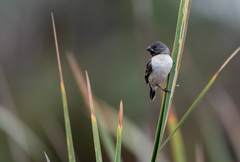
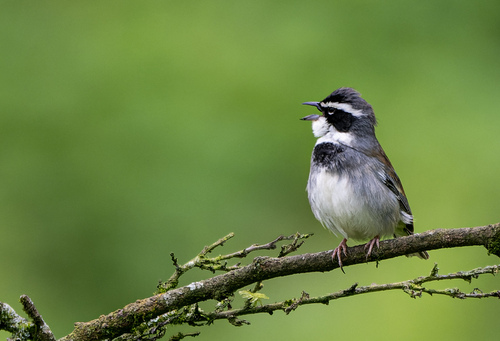
Chestnut-throated Seedeater

Chestnut-throated Seedeater

Sporophila telasco

Silhouette: Sheatherius · PhyloPic

LCLeast ConcernNTVUENCR
Daily sighting probability ~10% · With luck
at Machalilla National Park

In 3 days ~30% in a week ~50%

70 Verified sightings at Machalilla National Park From 2019 to 2026
70 In 1 park
May Best month
☀️ Diurnal When it's spotted

About the Chestnut-throated Seedeater

The chestnut-throated seedeater (Sporophila telasco) is a Neotropical songbird in the family Thraupidae. It is found along the western seaboard of South America, from southwestern Colombia to far northern Chile. The natural habitats of the chestnut-throated seedeater are subtropical or tropical dry shrubland, subtropical or tropical moist shrubland, swamps, sandy shores, and heavily degraded former forest along the Pacific coast and montane uplands of western South America, primarily Ecuador, Peru, and Chile.

The species serves as an indicator of declining forest health, as their populations appear to increase following deforestation and land use change. Males possess a rich chestnut patch on the throat in breeding season. Females share a similar color pattern, but lack the throat patch, with a lighter bill, but moult into drab plumage outside of the breeding season. This occurs because the cost of colorful plumage attracting predators is no longer worth taking when breeding activities are completed.

These songbirds are among the smallest members of the tanager family at approximately 4.0 inches in length, and possess powerful bills to harvest grass seeds. Wikipedia →

Sounds

Call1:16

Chile · 2019

© Cristian Pinto · XC492156 · CC BY-NC-SA 4.0

Song0:30

Chile · 2015

© Fabrice Schmitt · XC336410 · CC BY-NC-SA 4.0

Call0:22

Ecuador · 2003

© John V. Moore · XC259868 · CC BY-NC-SA 4.0

Global Distribution

Parks Where Found

# Park Country Daily sighting probability
1 Machalilla National Park 🇪🇨 Ecuador
~10%

More parks will be added in future updates.

Cities Where Found

# City Country Daily sighting probability
1 Lima 🇵🇪 Peru
~10%
2 Guayaquil 🇪🇨 Ecuador
<5%

Before you go

What are the chances of seeing a Chestnut-throated Seedeater in Machalilla National Park?

With luck

About 10% of wildlife watchers report a Chestnut-throated Seedeater sighting in Machalilla National Park on a given day, based on 70 verified sightings from GBIF citizen-science data from 2019 to 2026. It is the 84th most-seen of the 248 birds we can rate there. Over three days the chance rises to about 30%, and over a week to about 50%, if each day is a fresh chance.

When is the best time to see a Chestnut-throated Seedeater in Machalilla National Park?

May

In that month about 40% of wildlife watchers report a Chestnut-throated Seedeater in Machalilla National Park on a given day, against under 5% in February, June–August, October and December, the lowest months.

What time of day is best to see a Chestnut-throated Seedeater?

Between 8 and 11 am

Across all the parks we cover, that three-hour window holds the most Chestnut-throated Seedeater sightings with a recorded time, and about 9 in 10 of them come between 6 am and 6 pm: it is a daytime animal.

Where else can you see a Chestnut-throated Seedeater?

Only Machalilla National Park, in our data

Machalilla National Park is the only park on Wallace's Line with enough records to rate Chestnut-throated Seedeater sightings: about 10% of wildlife watchers there report one on a given day.

Which relatives of the Chestnut-throated Seedeater live in Machalilla National Park?

Same genus: Sporophila

The closest relatives of the Chestnut-throated Seedeater that you can see in Machalilla National Park (genus Sporophila, Typical Seedeaters and Seed-Finches) are Variable Seedeater (about 30%) and Parrot-billed Seedeater (about 10%), with each one's daily chance of a sighting.

Where does the Chestnut-throated Seedeater sighting chance come from?

GBIF citizen-science records

It is estimated from how often the Chestnut-throated Seedeater is recorded against all the birds logged in Machalilla National Park (70 verified sightings from 2019 to 2026), calibrated against known sighting rates. Figures are rounded to the nearest 10% because citizen-science data supports honest approximations, not decimals, and months with records from fewer than five people show "—". How it works.

← Back to Machalilla National Park