Double-banded Sandgrouse

Double-banded Sandgrouse

Pterocles bicinctus

Silhouette: PhyloPic

LCLeast ConcernNTVUENCR
Daily sighting probability ~10% · With luck
at Mana Pools National Park

In 3 days ~40% in a week ~70%

71 Verified sightings at Mana Pools National Park From 2019 to 2026
2,372 In all 11 parks
December Best month
☀️ Diurnal When it's spotted

About the Double-banded Sandgrouse

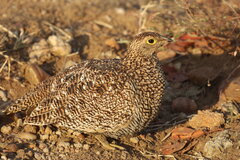
The double-banded sandgrouse (Pterocles bicinctus) is a species of predominantly terrestrial, or ground-dwelling (though not flightless), bird in the family Pteroclidae. It is found in arid parts of southern Africa. These sandgrouse have been observed in and around the Okavango Delta in Botswana.

A moderately-sized, quail-like bird with a plump body, the double-banded sandgrouse has a small, almost pigeon-like head with a long pair of wings and tail. The general colour of the plumage is light brown, with darker mottling and rows of whitish specks; the male is distinguished by having a conspicuous black-and-white band on his forehead, with a chestnut-coloured throat that is delineated by another black-and-white band. Both sexes have an area of bare, yellow skin surrounding their eyeball, and the male has an orange beak. The female is smaller and a more dull-brown in colour. The juveniles resemble the female... Wikipedia →

Sounds

Song0:17

Botswana · 2023

© Marc Anderson · XC1070991 · CC BY-NC-ND 4.0

Call0:27

South Africa · 2022

© Ehren Eksteen · XC793340 · CC BY-NC-SA 4.0

Call0:45

Namibia · 2016

© Peter Boesman · XC347015 · CC BY-NC-ND 4.0

Global Distribution

Parks Where Found

# Park Country Daily sighting probability
1 Gonarezhou National Park 🇿🇼 Zimbabwe
~30%
2 Moremi Game Reserve 🇧🇼 Botswana
~30%
3 Etosha National Park 🇳🇦 Namibia
~20%
4 Hwange National Park 🇿🇼 Zimbabwe
~20%
5 Mana Pools National Park 🇿🇼 Zimbabwe
~10%
6 Kruger National Park 🇿🇦 South Africa
~10%
7 Chobe National Park 🇧🇼 Botswana
~10%
8 Lower Zambezi National Park 🇿🇲 Zambia
~10%
9 South Luangwa National Park 🇿🇲 Zambia
~10%
10 Waterberg Plateau Park 🇳🇦 Namibia
~10%
11 Kafue National Park 🇿🇲 Zambia
<5%

Before you go

What are the chances of seeing a Double-banded Sandgrouse in Mana Pools National Park?

With luck

About 10% of wildlife watchers report a Double-banded Sandgrouse sighting in Mana Pools National Park on a given day, based on 71 verified sightings from GBIF citizen-science data from 2019 to 2026. It is the 121st most-seen of the 275 birds we can rate there. Over three days the chance rises to about 40%, and over a week to about 70%, if each day is a fresh chance.

When is the best time to see a Double-banded Sandgrouse in Mana Pools National Park?

December

In that month about 30% of wildlife watchers report a Double-banded Sandgrouse in Mana Pools National Park on a given day, against about 10% in January–February, April–June and August–September, the lowest months. That is one of Mana Pools National Park's wettest months, with about 140 mm of rain against almost none in August. March has too few records to rate.

What time of day is best to see a Double-banded Sandgrouse?

Between 3 and 6 pm

Across all the parks we cover, that three-hour window holds the most Double-banded Sandgrouse sightings with a recorded time, and about 9 in 10 of them come between 6 am and 6 pm: it is a daytime animal.

Is Mana Pools National Park the best place to see a Double-banded Sandgrouse?

5th of 11

Of the 11 parks where we can rate Double-banded Sandgrouse sightings, Mana Pools National Park ranks 5th at about 10%. The best odds are in Gonarezhou National Park (Zimbabwe, about 30%), Moremi Game Reserve (Botswana, about 30%) and Etosha National Park (Namibia, about 20%).

Where does the Double-banded Sandgrouse sighting chance come from?

GBIF citizen-science records

It is estimated from how often the Double-banded Sandgrouse is recorded against all the birds logged in Mana Pools National Park (71 verified sightings from 2019 to 2026), calibrated against known sighting rates. Figures are rounded to the nearest 10% because citizen-science data supports honest approximations, not decimals, and months with records from fewer than five people show "—". How it works.

← Back to Mana Pools National Park