Bengal Florican

Bengal Florican

Houbaropsis bengalensis

Silhouette: Kai Caspar · PhyloPic

LCNTVUENCRCritically Endangered
Daily sighting probability ~30% · Possible
at Manas National Park

In 3 days ~60% in a week ~90%

465 Verified sightings at Manas National Park From 2019 to 2026
496 In all 2 parks
February Best month
☀️ Diurnal When it's spotted

About the Bengal Florican

The Bengal florican (Houbaropsis bengalensis), also called the Bengal bustard, is a bustard species native to the Indian subcontinent, Cambodia, and Vietnam. It is listed as Critically Endangered on the IUCN Red List because fewer than 1,000 individuals were estimated to be alive as of 2017. It is the only member of the genus Houbaropsis.

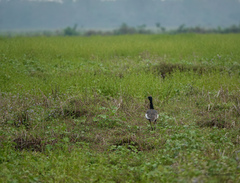
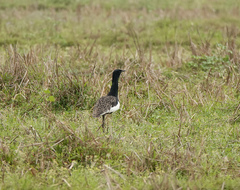
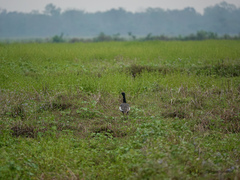
The male Bengal florican has a black plumage from the head and neck to underparts. Its head carries a long lanky crest, and the neck has elongated display plumes. The upperside is buff with fine black vermiculations and black arrowhead markings, and there is a conspicuous large white patch from the wing coverts to the remiges. In flight, the male's wings appear entirely white except for the dark primary remiges. The feet and legs are yellow, the bill and irides are dark. The female is buff-brown similar to the males' back with a dark brown crown and narrow dark streaks down the side of the neck. Her wing coverts are lighter than the remiges and covered in fine dark barring. Immature Bengal floricans look like a female.

Adult Bengal floricans range from 66–68 cm (26–27 in) in length and stand around 55 cm (22 in) tall. The female is... Wikipedia →

Sounds

Flight call0:17

Cambodia · 2013

© Frank Lambert · XC156993 · CC BY-NC-ND 4.0

Global Distribution

Parks Where Found

# Park Country Daily sighting probability
1 Manas National Park 🇮🇳 India
~30%
2 Kaziranga National Park 🇮🇳 India
<5%

Before you go

What are the chances of seeing a Bengal Florican in Manas National Park?

Possible

About 30% of wildlife watchers report a Bengal Florican sighting in Manas National Park on a given day, based on 465 verified sightings from GBIF citizen-science data from 2019 to 2026. It is the 44th most-seen of the 377 birds we can rate there. Over three days the chance rises to about 60%, and over a week to about 90%, if each day is a fresh chance.

When is the best time to see a Bengal Florican in Manas National Park?

February to April

In those months about 40% of wildlife watchers report a Bengal Florican in Manas National Park on a given day, against under 5% in November, the lowest month. Those are among Manas National Park's driest months, with about 150 mm of rain a month against 1070 mm in June.

What time of day is best to see a Bengal Florican?

Between 3 and 6 pm

Across all the parks we cover, that three-hour window holds the most Bengal Florican sightings with a recorded time, and about 8 in 10 of them come between 6 am and 6 pm: it is a daytime animal.

Is Manas National Park the best place to see a Bengal Florican?

Yes

Of the 2 parks where we can rate Bengal Florican sightings, Manas National Park has the highest daily chance: about 30%. Next come Kaziranga National Park (India, under 5%).

Where does the Bengal Florican sighting chance come from?

GBIF citizen-science records

It is estimated from how often the Bengal Florican is recorded against all the birds logged in Manas National Park (465 verified sightings from 2019 to 2026), calibrated against known sighting rates. Figures are rounded to the nearest 10% because citizen-science data supports honest approximations, not decimals, and months with records from fewer than five people show "—". How it works.

← Back to Manas National Park