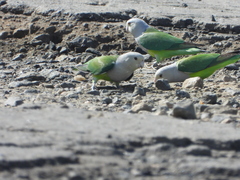
Grey-headed Lovebird

Grey-headed Lovebird

Agapornis canus

Silhouette: Hugo Gruson · PhyloPic

LCLeast ConcernNTVUENCR
Daily sighting probability <5% · Rare
at Mantadia National Park

In 3 days <5% in a week ~10%

7 Verified sightings at Mantadia National Park From 2019 to 2026
162 In all 3 parks
November Best month
☀️ Diurnal When it's spotted

About the Grey-headed Lovebird

The gray-headed lovebird or Madagascar lovebird (Agapornis canus) is a small species of parrot of the lovebird genus. It is a mainly green parrot. The species is sexually dimorphic and only the adult male has grey on its upper body. They are native on the island of Madagascar and are the only lovebird species which are not native on the African continent. They are the smallest of the lovebird species. It is rarely seen in aviculture and it is difficult to breed in captivity.

In 1760 the French zoologist Mathurin Jacques Brisson included a description and an illustration of the grey-headed lovebird in his Ornithologie based on a specimen collected in Madagascar. He used the French name La petite perruche de Madagasgar and the Latin Psittacula Madagascariensis. Although Brisson coined Latin names, these do not conform to the binomial system and are not recognised by the International Commission on Zoological Nomenclature. The lovebird was subsequently described by the French polymath Georges-Louis Leclerc, Comte de Buffon in 1779 and the English ornithologist John Latham in 1781, but neither author included a binomial name. When in 1788 the German naturalist Johann Friedrich... Wikipedia →

Sounds

Call0:11

Madagascar · 2026

© Filippo Ceccolini · XC1173506 · CC BY-NC-SA 4.0

Begging call0:18

Madagascar · 2021

© Ken Behrens · XC647555 · CC BY-NC-SA 4.0

Call0:57

Madagascar · 2012

© Peter Boesman · XC762574 · CC BY-NC-ND 4.0

Global Distribution

Parks Where Found

# Park Country Daily sighting probability
1 Berenty Reserve 🇲🇬 Madagascar
~50%
2 Ankarafantsika National Park 🇲🇬 Madagascar
~10%
3 Mantadia National Park 🇲🇬 Madagascar
<5%

Cities Where Found

# City Country Daily sighting probability
1 Antananarivo 🇲🇬 Madagascar
<5%

Zoos & Centres Where Found

# Zoo / Centre Country
1 Zürich Zoo 🇨🇭 Switzerland In captivity
2 Bronx Zoo 🇺🇸 United States In captivity
3 Paphos Zoo 🇨🇾 Cyprus In captivity

Before you go

What are the chances of seeing a Grey-headed Lovebird in Mantadia National Park?

Rare

Under 5% of wildlife watchers report a Grey-headed Lovebird sighting in Mantadia National Park on a given day, based on 7 verified sightings from GBIF citizen-science data from 2019 to 2026. It is the 91st most-seen of the 98 birds we can rate there. Over three days the chance rises to under 5%, and over a week to about 10%, if each day is a fresh chance.

When is the best time to see a Grey-headed Lovebird in Mantadia National Park?

Any time of year

In every month with enough records, under 5% of wildlife watchers report a Grey-headed Lovebird in Mantadia National Park on a given day, so our monthly data shows no clear season. January to April have too few records to rate.

What time of day is best to see a Grey-headed Lovebird?

Between 5 and 8 am

Across all the parks we cover, that three-hour window holds the most Grey-headed Lovebird sightings with a recorded time, and about 7 in 10 of them come between 6 am and 6 pm: it is a daytime animal.

Is Mantadia National Park the best place to see a Grey-headed Lovebird?

3rd of 3

Of the 3 parks where we can rate Grey-headed Lovebird sightings, Mantadia National Park ranks 3rd at under 5%. The best odds are in Berenty Reserve (Madagascar, about 50%) and Ankarafantsika National Park (Madagascar, about 10%).

Which relatives of the Grey-headed Lovebird live in Mantadia National Park?

Same family: Psittacidae

The closest relatives of the Grey-headed Lovebird that you can see in Mantadia National Park (family Psittacidae, New World and African Parrots) are Lesser Vasa-Parrot (about 60%) and Greater Vasa Parrot (about 30%), with each one's daily chance of a sighting.

Where does the Grey-headed Lovebird sighting chance come from?

GBIF citizen-science records

It is estimated from how often the Grey-headed Lovebird is recorded against all the birds logged in Mantadia National Park (7 verified sightings from 2019 to 2026), calibrated against known sighting rates. Figures are rounded to the nearest 10% because citizen-science data supports honest approximations, not decimals, and months with records from fewer than five people show "—". How it works.

← Back to Mantadia National Park