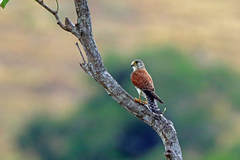

Madagascan Kestrel

Madagascan Kestrel

Falco newtoni

Silhouette: Shyamal · PhyloPic

LCLeast ConcernNTVUENCR
Daily sighting probability ~10% · With luck
at Mantadia National Park

In 3 days ~20% in a week ~40%

41 Verified sightings at Mantadia National Park From 2019 to 2026
465 In all 4 parks
May Best month
☀️ Diurnal When it's spotted

About the Madagascan Kestrel

The Malagasy kestrel (Falco newtoni), also known as the Madagascar kestrel, Malagasy spotted kestrel, Newton's kestrel, Madagascar spotted kestrel, katiti (Creole) or hitsikitsika (Malagasy), is a small bird of prey of the genus Falco. It is named after British ornithologist Edward Newton. It occurs in two subspecies on Madagascar and at Aldabra. The race from Aldabra is also called Aldabra kestrel (Falco newtoni aldabranus). Its closest living relative is the Seychelles kestrel; they were at one time considered conspecific. Their common ancestors appear to have diverged very recently, probably less than 1 million years ago during the Early or Middle Pleistocene. The Mauritius kestrel is more distantly related (Groombridge et al. 2002).

It can reach a size of 30 cm. The wings are 180 mm to 195 mm at the males and 188 mm to 203 mm at the females. The males can reach a weight between 112 and 118 grams. The weight of the females is up to 128 grams. The head and the nape of the males is rufous grey with dark streaks. A dark moustachial streak running from the basis of the bill backwards to sides of the throat. The upperparts and the wingcoverts are chestnut with black... Wikipedia →

Sounds

Call0:16

Madagascar · 2015

© Bernard BOUSQUET · XC295098 · CC BY-NC-SA 4.0

Call1:28

Madagascar · 2015

© Patrik Åberg · XC294625 · CC BY-NC-SA 4.0

Call0:31

Madagascar · 2012

© Hans Matheve · XC155177 · CC BY-NC-ND 3.0

Global Distribution

Parks Where Found

# Park Country Daily sighting probability
1 Berenty Reserve 🇲🇬 Madagascar
~80%
2 Ranomafana National Park 🇲🇬 Madagascar
~20%
3 Ankarafantsika National Park 🇲🇬 Madagascar
~10%
4 Mantadia National Park 🇲🇬 Madagascar
~10%

Cities Where Found

# City Country Daily sighting probability
1 Antananarivo 🇲🇬 Madagascar
~40%

Before you go

What are the chances of seeing a Madagascan Kestrel in Mantadia National Park?

With luck

About 10% of wildlife watchers report a Madagascan Kestrel sighting in Mantadia National Park on a given day, based on 41 verified sightings from GBIF citizen-science data from 2019 to 2026. It is the 72nd most-seen of the 98 birds we can rate there. Over three days the chance rises to about 20%, and over a week to about 40%, if each day is a fresh chance.

When is the best time to see a Madagascan Kestrel in Mantadia National Park?

May

In that month about 40% of wildlife watchers report a Madagascan Kestrel in Mantadia National Park on a given day, against under 5% in August–September and November–December, the lowest months. That is one of Mantadia National Park's driest months, with about 80 mm of rain against 340 mm in January. January to April have too few records to rate.

What time of day is best to see a Madagascan Kestrel?

Between 7 and 10 am

Across all the parks we cover, that three-hour window holds the most Madagascan Kestrel sightings with a recorded time, and about 8 in 10 of them come between 6 am and 6 pm: it is a daytime animal.

Is Mantadia National Park the best place to see a Madagascan Kestrel?

4th of 4

Of the 4 parks where we can rate Madagascan Kestrel sightings, Mantadia National Park ranks 4th at about 10%. The best odds are in Berenty Reserve (Madagascar, about 80%), Ranomafana National Park (Madagascar, about 20%) and Ankarafantsika National Park (Madagascar, about 10%).

Where does the Madagascan Kestrel sighting chance come from?

GBIF citizen-science records

It is estimated from how often the Madagascan Kestrel is recorded against all the birds logged in Mantadia National Park (41 verified sightings from 2019 to 2026), calibrated against known sighting rates. Figures are rounded to the nearest 10% because citizen-science data supports honest approximations, not decimals, and months with records from fewer than five people show "—". How it works.

← Back to Mantadia National Park