
Madagascar Grebe

Madagascar Grebe

Tachybaptus pelzelnii

Silhouette: Tisha Mukherjee · PhyloPic

LCNTVUENEndangeredCR Endemic
Daily sighting probability ~10% · With luck
at Mantadia National Park

In 3 days ~20% in a week ~40%

47 Verified sightings at Mantadia National Park From 2019 to 2026
57 In all 2 parks
September Best month
☀️ Diurnal When it's spotted

About the Madagascar Grebe

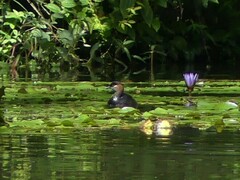
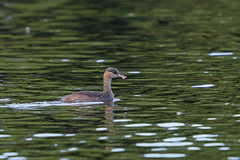
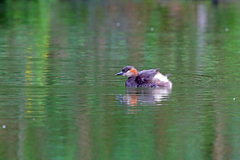
The Madagascar grebe (Tachybaptus pelzelnii) is a grebe found only in western and central Madagascar. The binomial name commemorates the Austrian ornithologist August von Pelzeln. It is classified as endangered by the IUCN, with a population of less than 5,000. It is threatened by habitat loss, predation by carnivorous fish, and competition with introduced species.

The Madagascar grebe is around 25 cm long. It can be identified in its breeding plumage, consisting of a blackish cap and line down the neck, often reddish rear ear-coverts and sides of the neck, pale grey cheeks, throat and foreneck. Some individuals have a narrow whitish line under the eye between the cap and ear-coverts.

The species is widespread throughout western and central Madagascar. Pairs can commonly be found near lakes. Surveys in the late 1990s recorded the species at 25 'Important Bird Areas' distributed throughout Madagascar, but it is suspected to be undergoing rapid declines. Numbers on Lake Alaotra have plummeted: in 1985 several hundred individuals were recorded, only 10–20 in 1993, and none in 1999. The forested lakes of the northwest plateau may harbour... Wikipedia →

Sounds

Call0:10

Madagascar · 2025

© Frank Lambert · XC1066207 · CC BY-NC-ND 4.0

Call0:08

Madagascar · 2012

© Peter Boesman · XC762980 · CC BY-NC-ND 4.0

Call0:25

Madagascar · 2020

© Ken Behrens · XC623751 · CC BY-NC-SA 4.0

Global Distribution

Parks Where Found

# Park Country Daily sighting probability
1 Mantadia National Park 🇲🇬 Madagascar
~10%
2 Ankarafantsika National Park 🇲🇬 Madagascar
<5%

Before you go

What are the chances of seeing a Madagascar Grebe in Mantadia National Park?

With luck

About 10% of wildlife watchers report a Madagascar Grebe sighting in Mantadia National Park on a given day, based on 47 verified sightings from GBIF citizen-science data from 2019 to 2026. It is the 69th most-seen of the 98 birds we can rate there. Over three days the chance rises to about 20%, and over a week to about 40%, if each day is a fresh chance.

When is the best time to see a Madagascar Grebe in Mantadia National Park?

August and September

In those months about 20% of wildlife watchers report a Madagascar Grebe in Mantadia National Park on a given day, against under 5% in June–July and November–December, the lowest months. Those are among Mantadia National Park's driest months, with about 60 mm of rain a month against 340 mm in January. January to April have too few records to rate.

What time of day is best to see a Madagascar Grebe?

Between 11 am and 2 pm

Across all the parks we cover, that three-hour window holds the most Madagascar Grebe sightings with a recorded time, and about 8 in 10 of them come between 6 am and 6 pm: it is a daytime animal.

Is Mantadia National Park the best place to see a Madagascar Grebe?

Yes

Of the 2 parks where we can rate Madagascar Grebe sightings, Mantadia National Park has the highest daily chance: about 10%. Next come Ankarafantsika National Park (Madagascar, under 5%).

Where does the Madagascar Grebe sighting chance come from?

GBIF citizen-science records

It is estimated from how often the Madagascar Grebe is recorded against all the birds logged in Mantadia National Park (47 verified sightings from 2019 to 2026), calibrated against known sighting rates. Figures are rounded to the nearest 10% because citizen-science data supports honest approximations, not decimals, and months with records from fewer than five people show "—". How it works.

← Back to Mantadia National Park