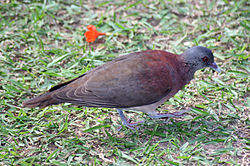
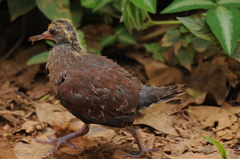
Malagasy Turtle Dove

Malagasy Turtle Dove

Nesoenas picturatus

Daily sighting probability ~20% · Possible
at Mantadia National Park

In 3 days ~60% in a week ~90%

117 Verified sightings at Mantadia National Park From 2019 to 2026
861 In all 4 parks
May Best month
☀️ Diurnal When it's spotted

About the Malagasy Turtle Dove

The Malagasy turtle dove or Madagascar turtle dove (Nesoenas picturatus) is a bird species in the pigeon and dove family, Columbidae. The bird has several subspecies. The Rodrigues pigeon, an extinct but fairly enigmatic taxon from Rodrigues on the Mascarenes, was for some time suspected to be another subspecies of N. picturata, but today is generally considered a distinct species (N. rodericanus).

The pink pigeon (N. mayeri) is its closest living relative, and together they form a lineage apart from both the typical pigeons (Columba) and the typical turtle doves (Streptopelia), slightly closer to the latter, if anything. Consequently, either these two are both placed in Streptopelia, or – as is probably the most accurate solution at present – separated as Nesoenas. The present species was in former times sometimes placed in a monotypic genus Homopelia. While this is not outright wrong, if the Rodrigues population is also placed in Homopelia and Nesoenas is considered distinct too, it would probably be considered oversplitting by modern authors.

It is found in Madagascar, Mauritius, Comoros, Réunion, Mayotte, Seychelles and the Chagos Archipelago... Wikipedia →

Global Distribution

Parks Where Found

# Park Country Daily sighting probability
1 Berenty Reserve 🇲🇬 Madagascar
~80%
2 Ankarafantsika National Park 🇲🇬 Madagascar
~60%
3 Ranomafana National Park 🇲🇬 Madagascar
~20%
4 Mantadia National Park 🇲🇬 Madagascar
~20%

Cities Where Found

# City Country Daily sighting probability
1 Antananarivo 🇲🇬 Madagascar
~10%

Zoos & Centres Where Found

# Zoo / Centre Country
1 Zürich Zoo 🇨🇭 Switzerland In captivity
2 Bronx Zoo 🇺🇸 United States In captivity
3 Berlin Zoological Garden 🇩🇪 Germany In captivity
4 Zoo Santo Inácio 🇵🇹 Portugal In captivity
5 Bird Paradise 🇸🇬 Singapore In captivity
6 Rainforest Wild Asia 🇸🇬 Singapore In captivity
7 Aquarium Berlin 🇩🇪 Germany In captivity

Before you go

What are the chances of seeing a Malagasy Turtle Dove in Mantadia National Park?

Possible

About 20% of wildlife watchers report a Malagasy Turtle Dove sighting in Mantadia National Park on a given day, based on 117 verified sightings from GBIF citizen-science data from 2019 to 2026. It is the 51st most-seen of the 98 birds we can rate there. Over three days the chance rises to about 60%, and over a week to about 90%, if each day is a fresh chance.

When is the best time to see a Malagasy Turtle Dove in Mantadia National Park?

May

In that month about 40% of wildlife watchers report a Malagasy Turtle Dove in Mantadia National Park on a given day, against about 10% in June and July, the lowest months. That is one of Mantadia National Park's driest months, with about 80 mm of rain against 340 mm in January. January to April have too few records to rate.

What time of day is best to see a Malagasy Turtle Dove?

Between noon and 3 pm

Across all the parks we cover, that three-hour window holds the most Malagasy Turtle Dove sightings with a recorded time, and about 9 in 10 of them come between 6 am and 6 pm: it is a daytime animal.

Which relatives of the Malagasy Turtle Dove live in Mantadia National Park?

Same family: Columbidae

The closest relatives of the Malagasy Turtle Dove that you can see in Mantadia National Park (family Columbidae, Pigeons and Doves) are Madagascar Blue-Pigeon (about 40%) and Madagascar Green-Pigeon (about 10%), with each one's daily chance of a sighting.

Where does the Malagasy Turtle Dove sighting chance come from?

GBIF citizen-science records

It is estimated from how often the Malagasy Turtle Dove is recorded against all the birds logged in Mantadia National Park (117 verified sightings from 2019 to 2026), calibrated against known sighting rates. Figures are rounded to the nearest 10% because citizen-science data supports honest approximations, not decimals, and months with records from fewer than five people show "—". How it works.

← Back to Mantadia National Park