Perinet Chameleon

Perinet Chameleon

Calumma gastrotaenia

Silhouette: T. Michael Keesey (from a photograph by Frank Glaw, Jörn Köhler, Ted M. Townsend & Miguel Vences) · PhyloPic

LCLeast ConcernNTVUENCR Endemic
Daily sighting probability ~30% · Possible
at Mantadia National Park

In 3 days ~70% in a week ~90%

15 Verified sightings at Mantadia National Park From 2019 to 2026
15 In 1 park
October Best month
🌅 Crepuscular When it's spotted

About the Perinet Chameleon

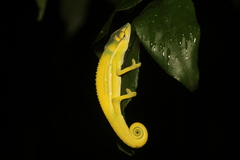
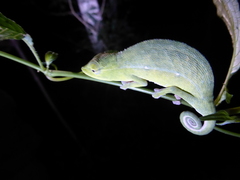
The Perinet chameleon (Calumma gastrotaenia), also known as the Malagasy side-striped chameleon, is a small species of chameleon endemic to humid primary forests, particularly along rivers, in eastern and central Madagascar at elevations between 600 and 1,530 m. It is listed on CITES Appendix II, and as such, trade in the Perinet chameleon is regulated. Exporting the species from Madagascar has been banned since 1995.

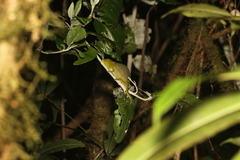
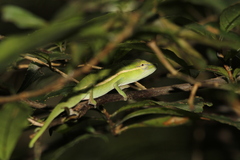
Perinet chameleons are small and slender, reaching 15–20 cm, with elongated heads and bodies. They have smooth, uniformly green, brown or yellow skin with white undersides. A thin stripe runs from their tail bases along the sides of their bodies and across their eyes, and may include white spots. The male Perinet chameleon is larger than the female and has a bony head crest.

Perinet chameleon ARKive.com. Accessed 2011-07-30 Calumma gastrotaenia WAZA.org. Accessed 2011-07-30 Wikipedia →

Global Distribution

Parks Where Found

# Park Country Daily sighting probability
1 Mantadia National Park 🇲🇬 Madagascar
~30%

More parks will be added in future updates.

Zoos & Centres Where Found

# Zoo / Centre Country
1 Mandraka Reptile Farm 🇲🇬 Madagascar In captivity

Closest Relatives at Mantadia National Park

Before you go

What are the chances of seeing a Perinet Chameleon in Mantadia National Park?

Possible

About 30% of wildlife watchers report a Perinet Chameleon sighting in Mantadia National Park on a given day, based on 15 verified sightings from GBIF citizen-science data from 2019 to 2026. It is the 10th most-seen of the 15 reptiles we can rate there. Over three days the chance rises to about 70%, and over a week to about 90%, if each day is a fresh chance.

When is the best time to see a Perinet Chameleon in Mantadia National Park?

October

In that month about 50% of wildlife watchers report a Perinet Chameleon in Mantadia National Park on a given day, against under 5% in January, March–June and August, the lowest months. That is one of Mantadia National Park's driest months, with about 70 mm of rain against 340 mm in January.

What time of day is best to see a Perinet Chameleon?

Between 6 and 9 pm

Across all the parks we cover, that three-hour window holds the most Perinet Chameleon sightings with a recorded time, and about 7 in 10 of them come between 6 pm and 6 am: it is most active around dawn and dusk.

Where else can you see a Perinet Chameleon?

Only Mantadia National Park, in our data

Mantadia National Park is the only park on Wallace's Line with enough records to rate Perinet Chameleon sightings: about 30% of wildlife watchers there report one on a given day.

Where does the Perinet Chameleon sighting chance come from?

GBIF citizen-science records

It is estimated from how often the Perinet Chameleon is recorded against all the reptiles logged in Mantadia National Park (15 verified sightings from 2019 to 2026), calibrated against known sighting rates. Figures are rounded to the nearest 10% because citizen-science data supports honest approximations, not decimals, and months with records from fewer than five people show "—". How it works.

← Back to Mantadia National Park