
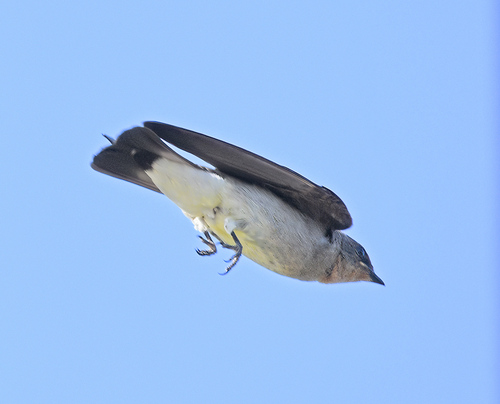
Amazonian Antpitta

Amazonian Antpitta

Hylopezus berlepschi

Silhouette: Edwin Price · PhyloPic

Daily sighting probability ~10% · With luck
at Manu National Park

In 3 days ~30% in a week ~60%

441 Verified sightings at Manu National Park From 2019 to 2026
518 In all 2 parks
March Best month
☀️ Diurnal When it's spotted

About the Amazonian Antpitta

The Amazonian antpitta (Myrmothera berlepschi) is a species of bird in the family Grallariidae. It is found in Bolivia, Brazil, and Peru. The Amazonian antpitta was originally described in 1903 as Grallaria berlepschi. It was later transferred to genus Hylopezus and still later to Myrmothera.

The Amazonian antpitta is 14.5 to 15 cm (5.7 to 5.9 in) long; males weigh 46 to 54 g (1.6 to 1.9 oz) and females 36 to 49 g (1.3 to 1.7 oz). The sexes have the same plumage. Adults of the nominate subspecies have a buffy loral spot and pinkish red bare skin around their eye. Their crown, nape, ear coverts, upperparts, and tail are olive-brown. Their wings are mostly olive-brown with olive-buff outer webs on the primaries. Their throat is white. Their breast and sides are buffy ochraceous with coarse dusky streaks, their belly white, and their flanks and crissum orange-rufous. Subspecies M. b. yessupi has slightly browner and darker upperparts and slightly deeper buff underparts than the nominate. Both subspecies have a brown... Wikipedia →

Sounds

Song0:43

Brazil · 2021

© Felipe Arantes · XC671241 · CC BY-NC-SA 4.0

Subsong0:12

Bolivia · 2021

© Jacob Wijpkema · XC655657 · CC BY-NC-SA 4.0

Call0:22

Brazil · 2008

© Dante Buzzetti · XC483311 · CC BY-NC-SA 4.0

Global Distribution

Parks Where Found

# Park Country Daily sighting probability
1 Manu National Park 🇵🇪 Peru
~10%
2 Tambopata National Reserve 🇵🇪 Peru
<5%

Before you go

What are the chances of seeing an Amazonian Antpitta in Manu National Park?

With luck

About 10% of wildlife watchers report an Amazonian Antpitta sighting in Manu National Park on a given day, based on 441 verified sightings from GBIF citizen-science data from 2019 to 2026. It is the 149th most-seen of the 641 birds we can rate there. Over three days the chance rises to about 30%, and over a week to about 60%, if each day is a fresh chance.

When is the best time to see an Amazonian Antpitta in Manu National Park?

March and September

In those months about 20% of wildlife watchers report an Amazonian Antpitta in Manu National Park on a given day, against under 5% in February, the lowest month.

What time of day is best to see an Amazonian Antpitta?

Between 7 and 10 am

Across all the parks we cover, that three-hour window holds the most Amazonian Antpitta sightings with a recorded time, and about 7 in 10 of them come between 6 am and 6 pm: it is a daytime animal.

Is Manu National Park the best place to see an Amazonian Antpitta?

Yes

Of the 2 parks where we can rate Amazonian Antpitta sightings, Manu National Park has the highest daily chance: about 10%. Next come Tambopata National Reserve (Peru, under 5%).

Where does the Amazonian Antpitta sighting chance come from?

GBIF citizen-science records

It is estimated from how often the Amazonian Antpitta is recorded against all the birds logged in Manu National Park (441 verified sightings from 2019 to 2026), calibrated against known sighting rates. Figures are rounded to the nearest 10% because citizen-science data supports honest approximations, not decimals, and months with records from fewer than five people show "—". How it works.

← Back to Manu National Park