Aquatic Coralsnake

Aquatic Coralsnake

Micrurus surinamensis

Silhouette: Edwin Price · PhyloPic

LCLeast ConcernNTVUENCR
Daily sighting probability ~10% · With luck
at Manu National Park

In 3 days ~20% in a week ~40%

6 Verified sightings at Manu National Park From 2019 to 2026
6 In 1 park
July Best month
☀️🌙 Day & Night When it's spotted

About the Aquatic Coralsnake

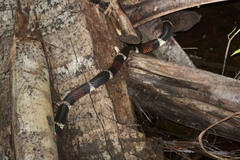
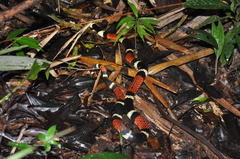
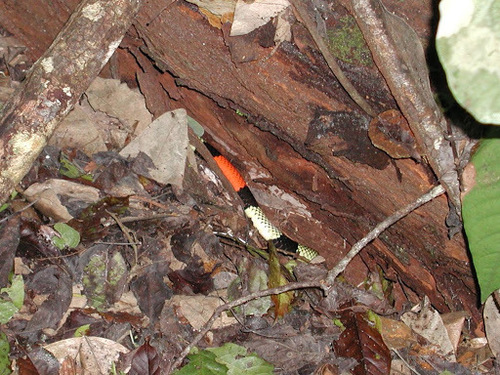
The aquatic coral snake (Micrurus surinamensis) is a semiaquatic species of coral snake, a venomous snake in the family Elapidae. The species is native to northern South America. Local common names for Micrurus surinamensis include cobra coral, coral de agua, coralillo, coral venenosa, culebra del agua, naca-naca, naca-naca de agua, boichumbeguaçu, himeralli, itinkia, kraalslang, koraalslang, krarasneke, kraka sneki, and wata mio.

Micrurus surinamensis is one of the heaviest and most robust coral snakes. Adults have an average total length (tail included) of 0.8–1.0 m (2.6–3.3 ft), with a maximum verified total length of 1.35 m (4.4 ft), although there are unproven reports of 1.8 m (5.9 ft) specimens.

The species is characterized by the coloration of its head, which is mainly red, with black scale edging. The head is large, with a long snout, and eyes and nostrils located more dorsally than in other coral snakes. The dorsal scales are smooth (non-keeled) and shiny, and arranged in 15 rows. Supra-anal keels are present in males, but little developed. The body has wide red rings that are separated by 5–8 triads. Each triad consists of a wide middle... Wikipedia →

Global Distribution

Parks Where Found

# Park Country Daily sighting probability
1 Manu National Park 🇵🇪 Peru
~10%

More parks will be added in future updates.

Before you go

What are the chances of seeing an Aquatic Coralsnake in Manu National Park?

With luck

About 10% of wildlife watchers report an Aquatic Coralsnake sighting in Manu National Park on a given day, based on 6 verified sightings from GBIF citizen-science data from 2019 to 2026. It is the 49th most-seen of the 56 reptiles we can rate there. Over three days the chance rises to about 20%, and over a week to about 40%, if each day is a fresh chance.

When is the best time to see an Aquatic Coralsnake in Manu National Park?

February and July

In those months about 20% of wildlife watchers report an Aquatic Coralsnake in Manu National Park on a given day, against under 5% in April–June, August–September and November–January, the lowest months.

What time of day is best to see an Aquatic Coralsnake?

Between 7 and 10 pm

Across all the parks we cover, that three-hour window holds the most Aquatic Coralsnake sightings with a recorded time, and about 6 in 10 of them come between 6 pm and 6 am: it is seen both by day and at night.

Where else can you see an Aquatic Coralsnake?

Only Manu National Park, in our data

Manu National Park is the only park on Wallace's Line with enough records to rate Aquatic Coralsnake sightings: about 10% of wildlife watchers there report one on a given day.

Where does the Aquatic Coralsnake sighting chance come from?

GBIF citizen-science records

It is estimated from how often the Aquatic Coralsnake is recorded against all the reptiles logged in Manu National Park (6 verified sightings from 2019 to 2026), calibrated against known sighting rates. Figures are rounded to the nearest 10% because citizen-science data supports honest approximations, not decimals, and months with records from fewer than five people show "—". How it works.

← Back to Manu National Park