
South American Coral Snake

South American Coral Snake

Micrurus lemniscatus

Silhouette: Edwin Price · PhyloPic

LCLeast ConcernNTVUENCR
Daily sighting probability ~10% · With luck
at Manu National Park

In 3 days ~20% in a week ~50%

9 Verified sightings at Manu National Park From 2019 to 2026
14 In all 2 parks
June Best month
☀️🌙 Day & Night When it's spotted

About the South American Coral Snake

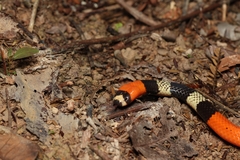
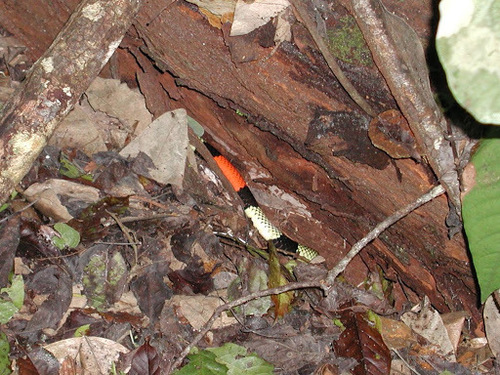
Micrurus lemniscatus, commonly known as the South American coral snake, is a species of venomous snake in the family Elapidae. The species is endemic to South America. Micrurus lemniscatus is a thin and brightly colored species. Adults usually have a total length (tail included) of 60–90 cm (24–35 in), but the maximum reported total length is 145 cm (57 in). The snout is black, followed by a narrow white crossband in front of the eyes, then a wider black band including the eyes. The eyes are small, and the rest of the head is red. The body pattern consists of slightly broad red rings that are separated by seven to 17 triads of three black and two white rings. The tail has two triads.

Like many coral snakes, Micrurus lemniscatus is nocturnal and terrestrial, digging in loose soil or litter. It is not aggressive towards humans, although it can attack to defend itself. Breeding of Micrurus lemniscatus is oviparous, having a clutch size of possibly 20 eggs.

Alimentation of Micrurus lemniscatus is mainly long-bodied vertebrates such as freshwater eels, gymnotiform fishes, caecilians, lizards, and snakes. Wikipedia →

Global Distribution

Parks Where Found

# Park Country Daily sighting probability
1 Manu National Park 🇵🇪 Peru
~10%
2 Yasuní National Park 🇪🇨 Ecuador
~10%

Before you go

What are the chances of seeing a South American Coral Snake in Manu National Park?

With luck

About 10% of wildlife watchers report a South American Coral Snake sighting in Manu National Park on a given day, based on 9 verified sightings from GBIF citizen-science data from 2019 to 2026. It is the 46th most-seen of the 56 reptiles we can rate there. Over three days the chance rises to about 20%, and over a week to about 50%, if each day is a fresh chance.

When is the best time to see a South American Coral Snake in Manu National Park?

June

In that month about 20% of wildlife watchers report a South American Coral Snake in Manu National Park on a given day, against under 5% in January, March–April and July–September, the lowest months. That is one of Manu National Park's driest months, with about 80 mm of rain against 290 mm in February.

What time of day is best to see a South American Coral Snake?

Between 7 and 10 pm

Across all the parks we cover, that three-hour window holds the most South American Coral Snake sightings with a recorded time, and about 6 in 10 of them come between 6 pm and 6 am: it is seen both by day and at night.

Is Manu National Park the best place to see a South American Coral Snake?

Yes

Of the 2 parks where we can rate South American Coral Snake sightings, Manu National Park has the highest daily chance: about 10%. Next come Yasuní National Park (Ecuador, about 10%).

Where does the South American Coral Snake sighting chance come from?

GBIF citizen-science records

It is estimated from how often the South American Coral Snake is recorded against all the reptiles logged in Manu National Park (9 verified sightings from 2019 to 2026), calibrated against known sighting rates. Figures are rounded to the nearest 10% because citizen-science data supports honest approximations, not decimals, and months with records from fewer than five people show "—". How it works.

← Back to Manu National Park