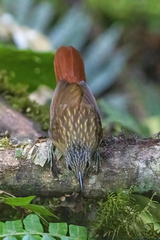

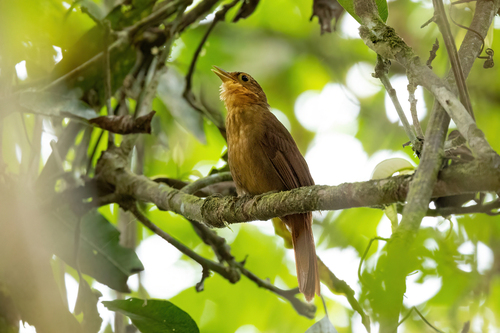
Black-billed Treehunter

Black-billed Treehunter

Thripadectes melanorhynchus

Silhouette: Sheatherius · PhyloPic

LCLeast ConcernNTVUENCR
Daily sighting probability <5% · Rare
at Manu National Park

In 3 days <5%

5 Verified sightings at Manu National Park From 2019 to 2026
87 In all 2 parks
July Best month
☀️ Diurnal When it's spotted

About the Black-billed Treehunter

The black-billed treehunter (Thripadectes melanorhynchus) is a species of bird in the Furnariinae subfamily of the ovenbird family Furnariidae. It is found in Colombia, Ecuador, and Peru. It and the streak-breasted treehunter (T. rufobrunneus) are sister species.

The black-billed treehunter is 20 to 20.5 cm (7.9 to 8.1 in) long and weighs 39 to 46 g (1.4 to 1.6 oz). It is a bulky, dark furnariid with a thrush-like shape. The sexes have the same plumage. Adults of the nominate subspecies have a mostly blackish-brown face with well-defined buff streaks and lores that are grizzled blackish brown and buff. Their crown is blackish brown with narrow buff streaks. Their back is dark brown with buff streaks and their rump dull dark brown that blends to reddish brown uppertail coverts. Their wings are rich dark brown and their tail dark chestnut-brown. Their throat is ochraceous with dark feather borders that give a scaly appearance. Their breast is rufescent-brown with faint pale streaks, their belly... Wikipedia →

Sounds

Song0:08

Ecuador · 2025

© Manuel Sánchez-Nivicela · XC1161982 · CC BY-NC-ND 4.0

Call0:18

Ecuador · 2022

© Paul Bourdin · XC750663 · CC BY-NC-SA 4.0

Subsong0:54

Colombia · 2021

© Jorge L. Peña · XC670559 · CC BY-NC-SA 4.0

Global Distribution

Parks Where Found

# Park Country Daily sighting probability
1 Podocarpus National Park 🇪🇨 Ecuador
~10%
2 Manu National Park 🇵🇪 Peru
<5%

Before you go

What are the chances of seeing a Black-billed Treehunter in Manu National Park?

Rare

Under 5% of wildlife watchers report a Black-billed Treehunter sighting in Manu National Park on a given day, based on 5 verified sightings from GBIF citizen-science data from 2019 to 2026. It is the 623rd most-seen of the 641 birds we can rate there. Over three days the chance rises to under 5%, if each day is a fresh chance.

When is the best time to see a Black-billed Treehunter in Manu National Park?

Any time of year

In every month with enough records, under 5% of wildlife watchers report a Black-billed Treehunter in Manu National Park on a given day, so our monthly data shows no clear season.

What time of day is best to see a Black-billed Treehunter?

Between 5 and 8 am

Across all the parks we cover, that three-hour window holds the most Black-billed Treehunter sightings with a recorded time, and about 7 in 10 of them come between 6 am and 6 pm: it is a daytime animal.

Is Manu National Park the best place to see a Black-billed Treehunter?

2nd of 2

Of the 2 parks where we can rate Black-billed Treehunter sightings, Manu National Park ranks 2nd at under 5%. The best odds are in Podocarpus National Park (Ecuador, about 10%).

Which relatives of the Black-billed Treehunter live in Manu National Park?

Same family: Furnariidae

The closest relatives of the Black-billed Treehunter that you can see in Manu National Park (family Furnariidae, Ovenbirds and Woodcreepers) are Buff-throated Woodcreeper (about 30%), Pale-legged Hornero (about 20%) and Plain-crowned Spinetail (about 20%), with each one's daily chance of a sighting.

Where does the Black-billed Treehunter sighting chance come from?

GBIF citizen-science records

It is estimated from how often the Black-billed Treehunter is recorded against all the birds logged in Manu National Park (5 verified sightings from 2019 to 2026), calibrated against known sighting rates. Figures are rounded to the nearest 10% because citizen-science data supports honest approximations, not decimals, and months with records from fewer than five people show "—". How it works.

← Back to Manu National Park