Blue-headed Macaw

Blue-headed Macaw

Primolius couloni

Silhouette: Sheatherius · PhyloPic

LCNTVUVulnerableENCR
Daily sighting probability ~10% · With luck
at Manu National Park

In 3 days ~40% in a week ~60%

545 Verified sightings at Manu National Park From 2019 to 2026
816 In all 2 parks
March Best month
☀️ Diurnal When it's spotted

About the Blue-headed Macaw

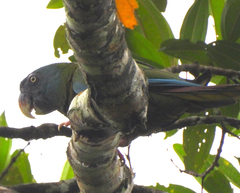
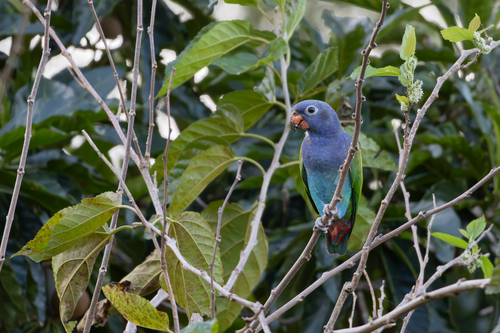
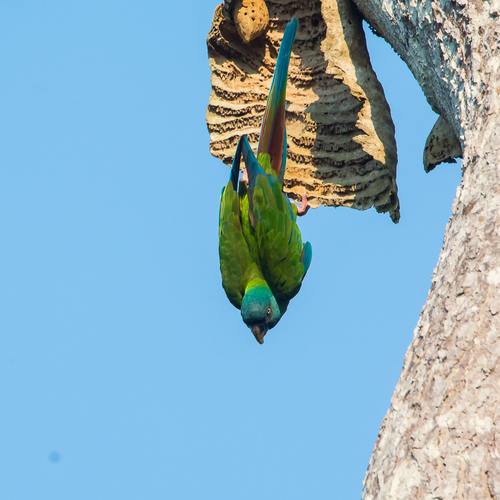
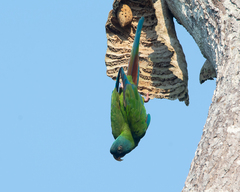
The blue-headed macaw or Coulon's macaw (Primolius couloni) is a macaw native to eastern Peru, northwestern Bolivia (mainly in Pando), and far western Brazil (in Acre). It has a total length of about 41 cm (16 in), making it a member of the group of smaller macaws sometimes known as the mini-macaws, which includes any species of macaw with a total length of 50 cm (20 in) or less. As in all macaws, its tail is long and pointed and the bill is large and heavy.

The specific epithet couloni is in honor of Swiss naturalist Paul Louis Coulon (1804-1894). The blue-headed macaw is 41 cm (16 in) long. It has mainly green plumage (often tinged olive, esp. below) with the head, flight feathers and primary coverts blue. The uppertail has a maroon base, a narrow green center and a blue tip. The undertail and underwing are greenish-yellow similar to that of several other small macaws (e.g. red-bellied and golden-collared macaw). The medium-sized bill is pale greyish-horn with a black base (extent varies, but upper mandible in adults typically appears mainly pale). The iris is whitish with a narrow, often barely visible, maroon eye-ring. Unlike most other macaws, the facial skin... Wikipedia →
Sounds

Flight call0:13

Bolivia · 2019

© Jacob Wijpkema · XC497202 · CC BY-NC-SA 4.0

Call0:23

Peru · 2018

© Roshan Tailor · XC420033 · CC BY-NC-SA 4.0

Call0:24

Peru · 2013

© Martin St-Michel · XC130599 · CC BY-NC-SA 3.0

Global Distribution

Parks Where Found

# Park Country Daily sighting probability
1 Manu National Park 🇵🇪 Peru
~10%
2 Tambopata National Reserve 🇵🇪 Peru
~10%

Zoos & Centres Where Found

# Zoo / Centre Country
1 San Diego Zoo 🇺🇸 United States In captivity
2 ZooParc de Beauval 🇫🇷 France In captivity
3 Ostrava Zoo 🇨🇿 Czechia In captivity
4 Bronx Zoo 🇺🇸 United States In captivity
5 Bioparque Municipal Vesty Pakos 🇧🇴 Bolivia In captivity
6 Zoologischer Garten Magdeburg 🇩🇪 Germany In captivity
7 Paphos Zoo 🇨🇾 Cyprus In captivity
8 Loro Parque 🇪🇸 Spain In captivity

Before you go

What are the chances of seeing a Blue-headed Macaw in Manu National Park?

With luck

About 10% of wildlife watchers report a Blue-headed Macaw sighting in Manu National Park on a given day, based on 545 verified sightings from GBIF citizen-science data from 2019 to 2026. It is the 110th most-seen of the 641 birds we can rate there. Over three days the chance rises to about 40%, and over a week to about 60%, if each day is a fresh chance.

When is the best time to see a Blue-headed Macaw in Manu National Park?

March

In that month about 30% of wildlife watchers report a Blue-headed Macaw in Manu National Park on a given day, against under 5% in February, the lowest month. That is one of Manu National Park's wettest months, with about 250 mm of rain against 60 mm in August.

What time of day is best to see a Blue-headed Macaw?

Between 6 and 9 am

Across all the parks we cover, that three-hour window holds the most Blue-headed Macaw sightings with a recorded time, and about 8 in 10 of them come between 6 am and 6 pm: it is a daytime animal.

Is Manu National Park the best place to see a Blue-headed Macaw?

Yes

Of the 2 parks where we can rate Blue-headed Macaw sightings, Manu National Park has the highest daily chance: about 10%. Next come Tambopata National Reserve (Peru, about 10%).

Which relatives of the Blue-headed Macaw live in Manu National Park?

Same family: Psittacidae

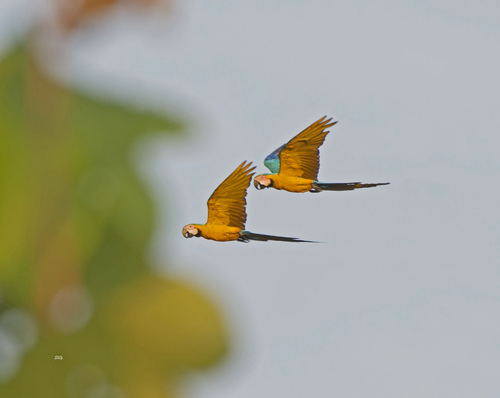
The closest relatives of the Blue-headed Macaw that you can see in Manu National Park (family Psittacidae, New World and African Parrots) are Chestnut-fronted Macaw (about 50%), Blue-headed Parrot (about 40%) and Blue-and-yellow Macaw (about 30%), with each one's daily chance of a sighting.

Where does the Blue-headed Macaw sighting chance come from?

GBIF citizen-science records

It is estimated from how often the Blue-headed Macaw is recorded against all the birds logged in Manu National Park (545 verified sightings from 2019 to 2026), calibrated against known sighting rates. Figures are rounded to the nearest 10% because citizen-science data supports honest approximations, not decimals, and months with records from fewer than five people show "—". How it works.

← Back to Manu National Park