
Cabanis's Spinetail

Cabanis's Spinetail

Synallaxis cabanisi

Silhouette: Sheatherius · PhyloPic

LCLeast ConcernNTVUENCR
Daily sighting probability <5% · Rare
at Manu National Park

In 3 days ~10% in a week ~30%

158 Verified sightings at Manu National Park From 2019 to 2026
168 In all 2 parks
September Best month
☀️ Diurnal When it's spotted

About the Cabanis's Spinetail

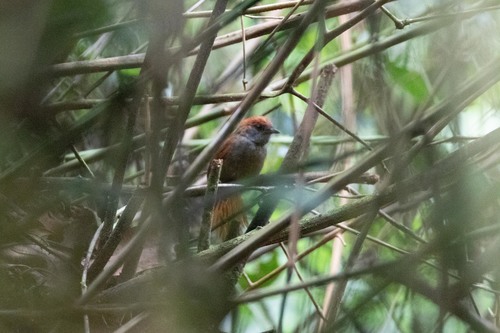
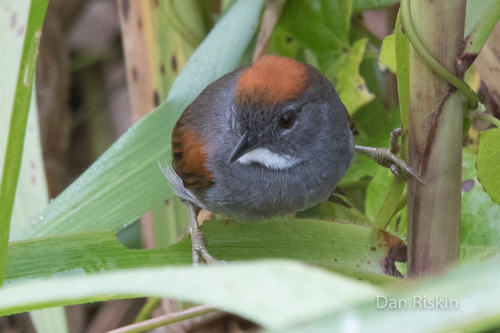
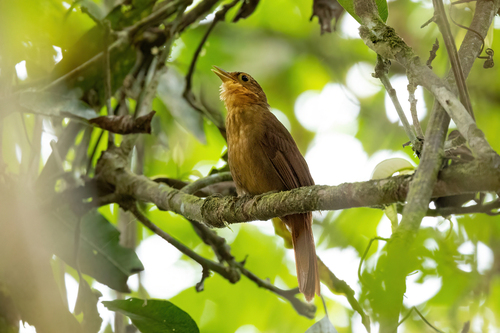
Cabanis's spinetail (Synallaxis cabanisi) is a species of bird in the Furnariinae subfamily of the ovenbird family Furnariidae. It is found in Brazil, Bolivia, and Peru. Well into the twentieth century what is now McConnell's spinetail (S. macconnelli) was treated as conspecific with Cabanis's spinetail. Genetic data published in 2011 supported that Cabanis's spinetail, McConnell's spinetail, and the dusky spinetail (S. moesta) form a monophyletic group. However, data published in 2013 has evidence that the dusky spinetail might instead be more closely related to the rufous-capped spinetail (S. ruficapilla).

The English name and specific epithet of Cabanis's spinetail commemorate the German ornithologist Jean Louis Cabanis. Cabanis's spinetail is 16 to 18 cm (6.3 to 7.1 in) long and weighs 16 to 24 g (0.56 to 0.85 oz). The sexes have the same plumage. Adults of the nominate subspecies have a faint ochraceous chestnut streak behind the eye and a grayish white malar region on an otherwise sooty gray... Wikipedia →

Sounds

Call0:25

Bolivia · 2021

© Jacob Wijpkema · XC693973 · CC BY-NC-SA 4.0

Song1:10

Bolivia · 2014

© Dan Lane · XC263282 · CC BY-NC-SA 4.0

Alarm calls?0:12

Peru · 2004

© Ramiro Yabar · XC29746 · CC BY-NC-ND 2.5

Global Distribution

Parks Where Found

# Park Country Daily sighting probability
1 Manu National Park 🇵🇪 Peru
<5%
2 Tambopata National Reserve 🇵🇪 Peru
<5%

Before you go

What are the chances of seeing a Cabanis's Spinetail in Manu National Park?

Rare

Under 5% of wildlife watchers report a Cabanis's Spinetail sighting in Manu National Park on a given day, based on 158 verified sightings from GBIF citizen-science data from 2019 to 2026. It is the 316th most-seen of the 641 birds we can rate there. Over three days the chance rises to about 10%, and over a week to about 30%, if each day is a fresh chance.

When is the best time to see a Cabanis's Spinetail in Manu National Park?

June, September and December–January

In those months about 10% of wildlife watchers report a Cabanis's Spinetail in Manu National Park on a given day, against under 5% in February–May, July–August and October–November, the lowest months.

What time of day is best to see a Cabanis's Spinetail?

Between 2 and 5 pm

Across all the parks we cover, that three-hour window holds the most Cabanis's Spinetail sightings with a recorded time, and about 8 in 10 of them come between 6 am and 6 pm: it is a daytime animal.

Is Manu National Park the best place to see a Cabanis's Spinetail?

Yes

Of the 2 parks where we can rate Cabanis's Spinetail sightings, Manu National Park has the highest daily chance: under 5%. Next come Tambopata National Reserve (Peru, under 5%).

Where does the Cabanis's Spinetail sighting chance come from?

GBIF citizen-science records

It is estimated from how often the Cabanis's Spinetail is recorded against all the birds logged in Manu National Park (158 verified sightings from 2019 to 2026), calibrated against known sighting rates. Figures are rounded to the nearest 10% because citizen-science data supports honest approximations, not decimals, and months with records from fewer than five people show "—". How it works.

← Back to Manu National Park