
Dusky-green Oropendola

Dusky-green Oropendola

Psarocolius atrovirens

Silhouette: Sheatherius · PhyloPic

LCLeast ConcernNTVUENCR
Daily sighting probability <5% · Rare
at Manu National Park

In 3 days <5%

28 Verified sightings at Manu National Park From 2019 to 2026
357 In all 2 parks
May Best month
☀️ Diurnal When it's spotted

About the Dusky-green Oropendola

The dusky-green oropendola (Psarocolius atrovirens) is a species of bird in the family Icteridae (New World blackbirds). It is found on the eastern slope of the Andes in Bolivia and Peru. Its natural habitats are subtropical or tropical moist montane forests and heavily degraded former forest.

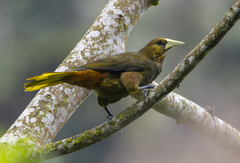
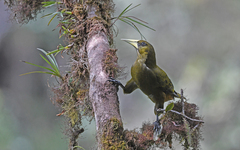
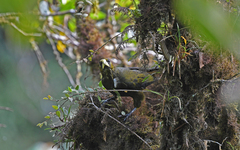
The male dusky-green oropendola grows to a length of about 42 cm (17 in) and the female of about 33 cm (13 in). The sexes are similar in morphology, the plumage being mainly dark brownish-green or blackish-green, with a rufous-brown rump and crissum (the undertail coverts surrounding the cloaca). The beak is greenish-white, there may be a few yellow feathers on the head, and the iris is brown or blue, the latter colour perhaps appearing in older birds. The russet-backed oropendola (Psarocolius angustifrons), which partly shares the same range, has more rufous upper parts, a yellow forehead and olive-green head which contrasts with its back and wings.

The dusky-green oropendola occurs on the east side of the Andes Mountains, its range extending from Huánuco Province in central Peru to Santa Cruz Department in Bolivia. It occurs in montane forests... Wikipedia →

Sounds

Call0:30

Bolivia · 1997

© david thorns · XC664784 · CC BY-NC-SA 4.0

Song0:59

Bolivia · 2020

© Jacob Wijpkema · XC607902 · CC BY-NC-SA 4.0

Call1:30

Peru · 2018

© Rolf A. de By · XC468223 · CC BY-NC-SA 4.0

Global Distribution

Parks Where Found

# Park Country Daily sighting probability
1 Amboró National Park 🇧🇴 Bolivia
~60%
2 Manu National Park 🇵🇪 Peru
<5%

Before you go

What are the chances of seeing a Dusky-green Oropendola in Manu National Park?

Rare

Under 5% of wildlife watchers report a Dusky-green Oropendola sighting in Manu National Park on a given day, based on 28 verified sightings from GBIF citizen-science data from 2019 to 2026. It is the 523rd most-seen of the 641 birds we can rate there. Over three days the chance rises to under 5%, if each day is a fresh chance.

When is the best time to see a Dusky-green Oropendola in Manu National Park?

Any time of year

In every month with enough records, under 5% of wildlife watchers report a Dusky-green Oropendola in Manu National Park on a given day, so our monthly data shows no clear season.

What time of day is best to see a Dusky-green Oropendola?

Between noon and 3 pm

Across all the parks we cover, that three-hour window holds the most Dusky-green Oropendola sightings with a recorded time, and about 9 in 10 of them come between 6 am and 6 pm: it is a daytime animal.

Is Manu National Park the best place to see a Dusky-green Oropendola?

2nd of 2

Of the 2 parks where we can rate Dusky-green Oropendola sightings, Manu National Park ranks 2nd at under 5%. The best odds are in Amboró National Park (Bolivia, about 60%).

Which relatives of the Dusky-green Oropendola live in Manu National Park?

Same genus: Psarocolius

The closest relatives of the Dusky-green Oropendola that you can see in Manu National Park (genus Psarocolius, Oropendolas) are Russet-backed Oropendola (about 60%), Crested Oropendola (about 30%) and Olive Oropendola (about 20%), with each one's daily chance of a sighting.

Where does the Dusky-green Oropendola sighting chance come from?

GBIF citizen-science records

It is estimated from how often the Dusky-green Oropendola is recorded against all the birds logged in Manu National Park (28 verified sightings from 2019 to 2026), calibrated against known sighting rates. Figures are rounded to the nearest 10% because citizen-science data supports honest approximations, not decimals, and months with records from fewer than five people show "—". How it works.

← Back to Manu National Park